


SERVANTS ON CHRIST’S MISSION FRAMEWORK
UPATED 4/16/2025
Click here for a downloadable PDF of the Servants on Christ's Mission Framework.
The Mission and Planning History: We build upon the plans of the past
2013-2014 The Pastoral Plan for Parish Renewal and Restructuring
2020 - Bishop Michael McGovern is appointed as the Bishop of the Diocese of Belleville
- Selling the Bishop’s Residence and the Bishop relocating to the rectory of the Cathedral so the Bishop would be visible and available.
- Relocating the Chancery to the campus of the Cathedral was to consolidate the work of the Curia, save money, and the work of the Chancery to be more accessible to people in the Diocese.
- The Bishop created the Chief of Staff position in the Chancery to provide better overall oversight and to improve operations.
2024 – Setting Priorities for the Future: After consultation with the clergy and laity in the Diocese, Bishop Michael McGovern initiated on May 19, 2024, Pentecost Sunday the pastoral vision for the Diocese of Belleville 2024-2027 entitled, SERVANTS ON CHRIST'S MISSION. In his May 19th letter to the Diocese, the Bishop outlines priorities and goals that are urgent for the future life of the Diocese.
- Establishing a Mission and Planning Office: To support the work and implementation of SERVANTS ON CHRIST'S MISSION, Bishop McGovern announced on October 8, 2024, the establishment of the new Diocesan Office for Mission & Planning. At the same time, the Bishop announced the appointment of Reverend Patrick McDevitt, C.M.as the Director.
The Purpose of the New Mission & Planning Office
To engage the presbyterate, lay leadership, faith communities, and other Catholic institutions in synodal conversations about the call to discipleship, evangelization, service, and a future vision.
To engage other communities of the four sectors of business, government, nonprofit, and the ecumenical faith community about shared mission values and develop potential partnerships to achieve our mutual mission.
To implement the SERVANTS ON CHRIST'S MISSION: A PASTORAL VISION FOR THE DIOCESE OF BELLEVILLE 2024-2027 through developing conceptional frameworks for strategies, outcomes, responsible parties, timelines, outcomes for achieving the priorities and goals SERVANTS ON CHRIST'S MISSION.
To develop a Communication Plan for Servants on Christ's Mission.
To establish structures and mechanisms to measure mission effectiveness. What is working? What does not work? The intention is to establish a synodal culture of reflection, assessment, change, and renewal.
To develop leadership and community development programs to assist communities to embrace, own, and implement needed changes in their communities and diocese.
I . SERVANTS ON CHRIST’S MISSION will utilizes a process called “Appreciative Inquiry.”
Appreciative Inquiry (AI) is about changing organizational culture through positive and affirming approaches to organizational change. AI is intended to energize and motivate people to move forward in their desired direction for the good of their organization. The AI frameworks identify strengths, capacities, successes, activities, and opportunities for organizations to commit to change and find success.
The five principles of appreciative inquiry
- Constructionist Principle
“Words create worlds”
The words we use help steer the process and create a new reality.
- Simultaneous Principle
The act of inquiry, asking questions, starts to create the changing process
Asking questions leads to curiosity, energy, and imagination.
- Poetic Principle
We have an opportunity to choose what we want to study
Topic of study: the history, life, and faith of the people of the Belleville Diocese
- Anticipatory Principle
The stories of our lives create images and models for us
These images have anticipatory meaning for us
- Positive Principle
Positive questions produce positive outcomes and positive changes
The four stages of Appreciative Inquiry
The process of Appreciative Inquiry is often referred to as the 4-D Cycle of Discovery, Dream, Design, and Destiny. The 4-D Cycle replaces language of Death, Dying, Decline, and Diminishment.
- Discovery Phase (interviews and group discussions)
Learn from the people in the Diocese about how they came to their calling. What attracted them to the call to serve in the Belleville Diocese? What inspires and motivates them today in their commitment to the Diocese?
- Dream Phase
Have a dialog about what could be for the future. What is the BLUE SKY thinking for the Diocese? What are people’s hopes and dreams for the future of the Diocese? What are the ideal outcomes?
- Design Phase
Begin making concrete lines-of-action based on the discussions, data, and information collected.
- Destiny Phase
We create what will be
Identify what we will be doing ongoing in the future.
Put in place structures, supports, and processes for implementation and ongoing improvements for achieving the priorities and goals of SERVANTS ON CHRIST’S MISSION.
II. The synodal planning framework for SERVANTS ON CHRIST’S MISSION
The synodal planning process is to be organic and iterative. It is anticipated that strategic changes can be made throughout the Discovery, Dream, Design, and Destiny phases. Each stage of the process provides needed data and opportunities for implementation of SERVANTS ON CHRIST’S MISSION.
- Pastoral Vision Steering Group - Mandate
- Will oversee the supervise process
- Receive planning updates and keep Bishop updated
- Review Diocesan Mission Statement
- Develop a Vision Statement
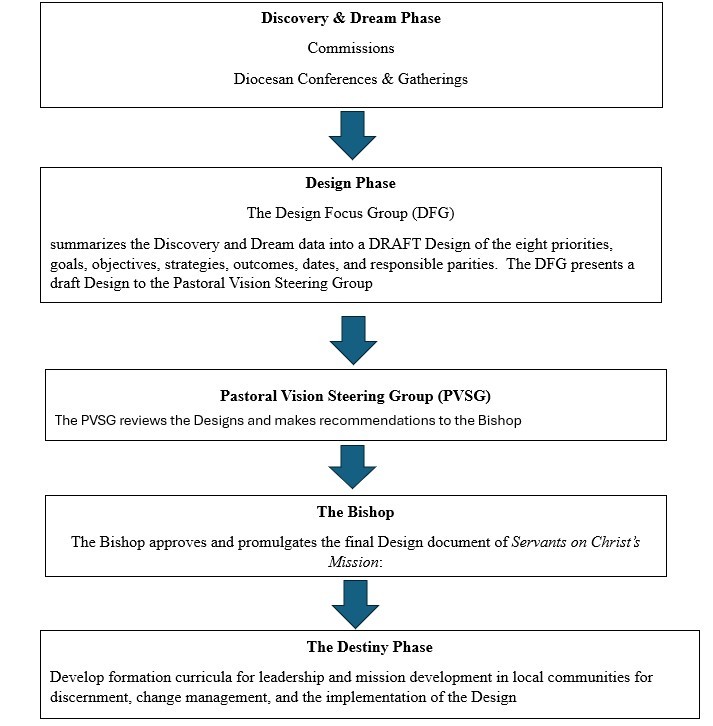
- Review the DRAFT DESIGN PLAN
- Present a recommended DESIGN PLAN to the Bishop
- Discovery & Dream Ambassadors - Mandate
- Each Vicarate will have enough Ambassadors to conduct interviews of individuals and groups.
- Ambassadors will meet with as many priests, individuals, or groups as possible and listen to their vocations stories & what inspires them.
- The Ambassadors will ask the following questions:
- Discovery – What do the priorities inspire & motivate?
- Dream – Blue Sky: What is the ideal outcome? If you had a magic wand….
- The Ambassadors will provide a written record of the Discovery and Dream conversations.
- Discovery and Dream reports to the Commissions.
- Synodal Listening Sessions with Vicariates, parishes, and other groups. The Synodal Sessions focus on three questions:
- What excites/motivates you about the Diocese, Vicariate, and your local community? (DISCOVERY)
- What are your hopes and dreams for the future of the Diocese, Vicariate, and your local community? (DREAM)
- What changes/growth are you willing to make for growth in the Diocese, Vicariate, and your local community? (DESTINY)
4. Commissions - Mandate - The Commissions will have a three-part function
- They will summarize the Discovery and Dream materials of their assigned priorities into a signal report.
- Out of the data of the Discovery and Dream materials, they will formulate DESIGN PLANS with GOALS, OBJECTIVES, STRATGIES, TIMELINES, RESPONSIBLE PARITES over a 3-year period.
- The commissions will submit the DESIGN PLANS to the Design Focus Group.
The PROPOSED FIVE COMMISSIONS:
1. Commission: Vocation & Clergy Support
2. Commission: Evangelization & Discipleship
3. Commission: Infrastructure
4. Commission: Social Service
5. Commission: Development & Communication
5. Design Focus Group – Mandate:
- To put together a single Draft Design Plan from the work of the five Commissions with consistency in language, formatting, and nomenclature for goals, objectives, strategies, outcomes, and timelines
- Assessment of goals, objectives, strategies, outcomes, and timelines
- Begin developing a financial model for supporting the implementation of goals
- The Design Focus Group will present to the Pastoral Vision Steering Committee a Draft Design Plan
III. The Process of the FLOW of DATA and INFORMATION