



Bishop Emeritus Braxton Writings
O Woman, O Man, Great is Your Faith! Let it be Done for You as You Desire

His Excellency,
The Most Reverend Edward K. Braxton, Ph.D., STD
Bishop Emeritus
Diocese of Belleville
Nineteenth Sunday in Ordinary Time
August 16, 2026, 9:00 AM Mass
Saint Luke Parish
O Woman, O Man, Great is Your Faith! Let it be Done for You as You Desire
(This is the text as originally written. During the actual delivery, some passages were omitted and other comments were added spontaneously. Nota bene: This text has not been thoroughly proofread. Therefore, there may be errors in spelling, grammar, and punctuation.)
Dear Sisters and Brothers in Christ:
Recently I saw part of William Friedkin’s classic 1973 “horror film,” “The Exorcist” on cable television. When it was released, one reviewer called it one of the best films ever made about the Catholic Church. This ever-popular film, based on William Peter Blatty’s best-selling novel is about a girl possessed by a demon, whose mother asks two Catholic priests to save her by performing an exorcism. Then all hell breaks loose.
Mr. Friedkin, the director, who was Jewish and an agnostic, said his film was based on the premise that the claims of Catholic Church about God, the devil, heaven and hell, are all true. The young girl in the story does not have psychological problems. She really is possessed by a demon. Her entire being has been taken over by Satan. The director said it was strange for him to learn that many contemporary Catholics seem to doubt the existence of the devil and see his film simply as a “horror movie,” when it is actually about the spiritual power of the Catholic faith.
* * * * * * *
This morning’s gospel, Matthew 15: 21-28 presents the story of a woman whose daughter is possessed by a demon. Jesus and His disciples travel to the region of Tyre and Sidon, two Mediterranean seaside villages in Phoenicia, which is modern-day Lebanon. Sidon was founded by Canaanites, pagans who worshiped the “gods” Baal, Astarte, Mot, and Yam. Jewish people never entered these towns because they hated these unclean idol worshippers who were enemies of Israel. (So why did Jesus go there?)
From a distance, a Syrophoenician or Canaanite woman called out to Jesus, “Lord, Son of David, have mercy on me! My daughter is suffering terribly from demon-possession.” (The story does not tell us how a Canaanite woman could know about Jesus, why she would address him as “Lord,” why she would call him “Son of David,” (the Jewish Messiah), or why a pagan Canaanite believed Jesus could help her).
Jesus completely ignores the woman and shows no interest in helping her, saying He came into the world to tend only to the lost sheep of Israel. As you know, in ancient semitic culture it was strictly forbidden for a woman to address a man in public.
The annoyed disciples urge Jesus to get rid of her. But the woman is persistent. She kneels down before Jesus and pleads in desperation, “Lord, help me!” Jesus’ reply is harsh, “It is not right to take the food of the children and throw it to the dogs.” Jesus may be using a common Jewish slur by referring to the Canaanites as “dogs.” Still, the courageous Canaanite woman does not let this insult stop her. “Please, Lord, even the dogs eat the scraps that fall from their master’s table.”
Amazed, Jesus says, “O woman,” using the same gracious greeting that He used when speaking to His own mother, Mary, “great is your faith!” (This is in contrast with His words scolding Peter last Sunday, “O you of little faith.”) Then, He tells her “Let it be done for you as you desire.” And the woman's daughter was healed at that very hour. (How does gospel writer know this?) This story implies that Jesus initially thought that His mission was only to the Jewish people and certainly not to unclean idol worshipers. Did He only realize gradually that His Good News was for ALL people everywhere?
* * * * * * *
“Get Out of the Boat and Into the Stormy Sea of Life” (Matthew c.14:v.22-33)
His Excellency,
The Most Reverend Edward K. Braxton, Ph.D., STD
Bishop Emeritus
Diocese of Belleville
Nineteenth Sunday in Ordinary Time
August 9, 2026, 11:00 AM Mass
Saint Teresa Parish
“Get Out of the Boat and Into the Stormy Sea of Life” (Matthew c.14:v.22-33)
(This is the text as originally written. During the actual delivery, some passages were omitted and other comments were added spontaneously. Nota bene: This text has not been thoroughly proofread. Therefore, there may be errors in spelling, grammar, and punctuation.)
Dear Sisters and Brothers in Christ:
What do you think of Mother Nature? Summer is a wonderful time to relax and enjoy the wonders of nature. Camping, hiking, gardening, picnicking, outdoor sports, swimming, boating, sitting in a flower garden reading a good book, and traveling to places you have never seen before. At the same time, each day’s news reminds us of nature’s destructive summer fury: flooding from torrential rainstorms, devastating wildfires, melting mountain snow’s deadly avalanches, ocean undercurrents sweeping people out to sea, and sudden storms sinking boats without warning.
Through the centuries the paradox of the pleasures and perils of nature have caused many people, including Christians, to ask what is the relationship between God and nature? Does God have direct control over all the forces of nature? Or, once created, does God simply allow nature to take its course resulting in joys and sorrows, life and death? Does God have the power to intervene in nature and prevent nature’s deadly consequences and simply chooses not to? Or is nature, in some way, free of divine governance? I know from personal conversations that Catholics have very different thoughts about the relationship between God and nature. Others just don’t think about it at all.
* * * * * * *
“Saint Paul on Predestination*: God Foreknew, God Predestined, God Called, God Justified, God will Glorify” (Romans c 8:v 28-30)
His Excellency,
The Most Reverend Edward K. Braxton, Ph.D., STD
Bishop Emeritus
Diocese of Belleville
Seventeenth Sunday in Ordinary Time
July 26 , 2026, 11:00 AM Mass
Ss. Peter and Paul Parish
“Saint Paul on Predestination*:
God Foreknew, God Predestined, God Called, God Justified, God will Glorify” (Romans c 8:v 28-30)
(This is the text as originally written. During the actual delivery, some passages were omitted and other comments were added spontaneously. Nota bene: This text has not been thoroughly proofread. Therefore, there may be errors in spelling, grammar, and punctuation.)
*(Saint Paul’s complex biblical understanding of divine predestination for salvation must not be confused with the later philosophical and scientific theory of Determinism. Determinism is the theory that all events, including human actions and choices, are completely caused by prior events and natural laws. This means everything happens the only way it can possibly happen. Determinism argues that human beings have no free will. The subjective experiences of freedom of choice to do good or bad is a complete illusion. Human beings cannot act in any way different from the way they actually act. Saint Paul’s idea of predestination does not reject the concept of free will which is essential for Christian moral decisions and the human acceptance or rejection of the gifts of Divine Love.)
Dear Sisters and Brothers in Christ:
Do you believe in predestination? Do you, your relatives and friends believe that God has predestined who will experience eternal life in Heaven and who will not? Do you think the Catholic Church teaches predestination? Is this a part of your Catholic faith that you never think about?
The brilliant and profound thinker, St. Paul of Tarsus ponders these questions in the three verses you just heard from his letter to the followers of Jesus Christ living in Rome (c 8:v 28-30). Paul believes firmly in the controversial idea of predestination and his thoughts about predestination are some of the most profound, most difficult, and most thought-provoking passages in the New Testament that have influenced Christianity for over two thousand years. These dense sentences seek to assure Christians that God works all things together for our good. Paul lays out in clear unbroken steps the way in which God’s loving grace can lead to our final destination of joy, happiness, and glory in Christ. Theologians later called these steps “the golden chain of salvation”.
In Verse 28 Paul begins with the promise of God’s goodness. He writes “We know that for those who love God all things work together for good, for those who are called according to His purpose.” Paul then tells us the scope of God’s promise which encompasses “all things,” which includes the good things as well as the bad things that happen in our lives. Surprisingly, Paul is quick to tells us that God’s promise is NOT for everyone. It is only for those who love God and the good is determined by God's purpose, not by our personal wishes. Paul is not writing about the blessings that God gives to all people. Paul believes that all things are working together for the good of a specific people: Christians “who love God, and who are called according to God’s purpose.” Paul is NOT writing about those who are not Christians or those who do not believe in God.
In Verse 29 Paul makes clear what the “Good” is that God promises, “For those whom He foreknew He also predestined to be conformed to the image of His Son, in order that they might be the firstborn among many brothers and sisters.” The “good” is not primarily the comfortable, safe, and happy life we might desire. The good Paul is writing about is the spiritual journey of our individual lives, a process by which God shapes us into the likeness of Jesus Christ. Paul is convinced that God, in some way, uses all of the circumstances of our lives to help us become like Christ.
Wheat and Weeds in the Field of the United States
His Excellency,
The Most Reverend Edward K. Braxton, Ph.D., STD
Bishop Emeritus
Diocese of Belleville
Sixteenth Sunday in Ordinary Time
July 19, 2026, 9:00 AM Mass
Saints Luke Parish
Wheat and Weeds in the Field of the United States
(This is the text as originally written. During the actual delivery, some passages were omitted and other comments were added spontaneously. Nota bene: This text has not been thoroughly proofread. Therefore, there may be errors in spelling, grammar, and punctuation.)
Dear Sisters and Brothers in Christ:
I have just returned from New York’s renowned Chatauqua Institution. During a dramatic presentation marking the semi-quincentennial of the United States, an actor proclaimed, “The unanimous Declaration of the thirteen united States of America…We hold these truths to be self-evident, that ALL are created equal, that they are endowed by their Creator with certain unalienable Rights, that among these are Life, Liberty and the pursuit of Happiness.” The attentive listener would have noticed that the speaker omitted Thomas Jefferson’s controversial word “MEN” saying simply, “ALL are created equal”. It is well known that Jefferson did not really mean all men, intending only free, male Europeans, excluding women and Africans held in chattel slavery, excluding those he “owned” at Monticello. Ever since July 4, 1776, we the people of the United States have been working in order to form a more perfect union, establish Justice and ensure domestic tranquility. This has included striving to show that “all men” must mean “all people”. You could say the American people have been striving to separate the wheat from the weeds that have grown since the seeds of the American democratic experiment were sown 250 years ago.
Jesus of Nazareth in this morning’s parable (Matthew 13: 24-30) about the wheat and the weeds is particularly thought provoking because he is dealing with the question of why God who is all-good and all-powerful allows evil and good to exist side by side in the world even though He has to power to uproot the weeds planted by an evil enemy.
Jesus says as seeds grow into wheat, damaging weeds grow and mix with the wheat. What should the farmer do about his field full of good wheat endangered by weeds? The farm workers, using common sense, ask the farm owner to allow them to dig up the weeds so the wheat can grow unharmed. The workers are stunned when the landowner tells them to let the wheat and weeds grow together. At harvest time, the reapers will separate them, storing the wheat in his barn and burning the weeds.
The puzzled disciples wonder why the farmer would allow the weeds to grow with the wheat since the weeds are dangerous.
Jessus explains that the Son of Man plants the good seeds, which are the sons and daughters of the Kingdom of Heaven. The weeds are the sons and daughters of the evil one. The enemy who sowed the weeds is Satan. The harvest is the end of the world, and the reapers are angels. Just as the weeds are gathered and burned with fire, angels will do the same thing to evildoers at the end of the world.
This explanation of the parable tells us that in spite of the life, teachings, death and resurrection of Jesus Christ, all manner of evil, all imaginable forms of weeds still flourish in the world. This is the problem of evil that we all experience. Why does evil remain in the world after the resurrection of Jesus?
Some interpretations of Jesus’ explanation of the parable can lead Christians to think that since God will deal with the weeds of evil and suffering in the world at the end of time, Christians have no obligation to fight against the terrible evil of the wars that are causing so much suffering and death around the world, the economic injustice keeping so many in poverty, and the evidence of corruption we may see in some religious and political leaders. We should keep our eyes on heaven and let God keep His eyes on the world.
This view of the parable suggests that Christianity and the Church should not be overly concerned with ridding the world of suffering and evil. Christ would rather allow the weeds of evil to grow for now to make sure the wheat is not harmed. Christians should focus on their personal salvation by raising good Christian families and uprooting the weeds of evil from their personal lives. This is far more important than Christians worrying about the weeds of political, racial, economic, educational, environmental, sexual, and cultural evil in our country and in our world.
This interpretation of the parable seems to be the opposite of Jesus’ teaching throughout the gospels, the opposite of the parable of the Good Samaritan which teaches us to love and care for the beaten and robbed stranger. If we do not cooperate with God to overcome evil on earth, we become passive Christians when our baptism calls us to be active Christians, the Body of Christ in the world.
* * * * * * *
God The Father and Father’s Day
His Excellency,
The Most Reverend Edward K. Braxton, Ph.D., STD
Bishop Emeritus
Diocese of Belleville
Eleventh Sunday in Ordinary Time
June 21, 2026, 9:00 AM Mass
Saints Luke Parish
God The Father and Father’s Day
(This is the text as originally written. During the actual delivery, some passages were omitted and other comments were added spontaneously. Nota bene: This text has not been thoroughly proofread. Therefore, there may be errors in spelling, grammar, and punctuation.)
Dear Sisters and Brothers in Christ:
When I was studying theology in the seminary, I became curious about what my parents, Cullen and Evelyn Braxton, who were converts, personally thought and believed about Christianity. I knew they went to Sunday Mass faithfully, prayed the blessing before meals, prayed the Rosary, the Stations of the Cross, and, most significantly, I had seen them, since my childhood, praying night prayers at the side of their bed every night, on their knees. Still, I had never had an in-depth conversation with them about their personal faith.
One day, I took my dear father to lunch at Chicago’s world famous Berghoff Restaurant. While we were having his favorite desert, vanilla bean ice cream with chocolate sauce and fresh strawberries, I told him I wanted to ask him a few questions about religion. He said, “Shoot”. “Papa, do you really believe that God exists? “Have you ever had an experience of the presence of God?” “Do you think Jesus Christ truly rose from the dead?” “What do you think happens to us when we die?” These and other questions kept us at our table long after the ice cream was all consumed. After some hesitation, my father opened his heart to me and told me his personal beliefs and how they had changed over the years. I learned that he struggled with certain teachings of Christianity. Some he really didn’t understand. He wondered about Catholic teachings that he could not find in the Bible. I shared with him my personal religious beliefs and questions as well. At the end, we prayed together in our own words for the first time. This long conversation at The Berghoff brought about subtle changes in our father/son relationship.
You may be surprised to learn that it was only in 1972 that President Richard Nixon formally declared Father’s Day a national holiday. But, for faithful Christians every day is, or should be Father’s Day and Mother’s Day.
We all know many fathers who are outstanding Christian gentleman. However, all are not. Some fathers are indifferent to the needs of their children. They do not show them the love and concern they crave. Some harm their children and violently abuse them. Others are unfaithful and abandon their wives and children. Sadly, some die young leaving their wives in sorrow and their sons and daughters without the paternal love they need. On this Fathers’ Day we express deep gratitude and love for our fathers, living and dead and we pray for all fathers including those who have not been the kind of selfless fathers Jesus Christ would want them to be.
* * * * * * *
Magnifica humanitas: God and Artificial Intelligence
Magnifica humanitas: God and Artificial Intelligence
By
His Excellency,
The Most Reverend Edward K. Braxton, Ph.D., STD
Bishop Emeritus
Diocese of Belleville
Eleventh Sunday in Ordinary Time
June 14, 2026, 10:00 AM Mass
Saints Peter & Paul Parish
(This is the text as originally written. During the actual delivery, some passages were omitted and other comments were added spontaneously. Nota bene: This text has not been thoroughly proofread. Therefore, there may be errors in spelling, grammar, and punctuation.)
Dear Sisters and Brothers in Christ,
This morning, Jesus of Nazareth, in Matthew 9, 36 – 10, 8 tells His 12 apostles to go to the Jewish towns and announce, “The Kingdom of Heaven is at hand”. Then He instructs them to do four things none of us can do. “Cure the sick, raise the dead, cleanse lepers, and drive out demons.” Since we cannot do these remarkable things, the message for us must be that each of us must show Christ’s compassion to all people and care for them, in whatever way we can, as true shepherds.
When His Holiness, Pope Leo XIV was elected to the Chair of Peter a year ago, May 8, 2025, his first words to the entire world were, “Peace be with you!” He later said he hoped that his pontificate could be dedicated to peace by safeguarding humanity, promoting truth, the dignity of work, and social justice in the face of the challenges presented by Artificial Intelligence. He acknowledged that it would be particularly challenging to proclaim that the Kingdom of Heaven is at hand in the face of the world changing impact of the astounding new technology of AI.
Attentive Catholics are not surprised that Pope Leo’s first encyclical, Magnifica humanitas: On Safeguarding the Human Person in the Time of Artificial Intelligence sets out to bring the Gospel of Jesus Christ into direct dialogue with Artificial Intelligence and its potential impact for good or evil on all people everywhere. He writes, “Humanity, created by God in all its grandeur, is today facing a pivotal choice: either to construct a new Tower of Babel or to build the city in which God and humanity dwell together.” To underscore his concern, the pontiff signed the document on May 15, the 135th anniversary of the promulgation of Pope Leo XIII’s Rerum Novarum, (On New Things), the landmark encyclical on the impact of the first Industrial Revolution on the poor, on laborers, and the need to safeguard them against developments that could undermine the God given dignity of every human person.
It is well known that the majority of Catholics in America are not inclined to read carefully and pray about what they assume to be a long, complicated, unexciting document from the Vatican. Many may think that Magnifica humanitas is addressed only to the people of Silicon Valley, who may well ignore it. But the ethical, moral, and religious questions raised by the Holy Father are as close as your computer and your teenagers’ cell phones and other electronic devices. Christians must remain human in the age of algorithms. We have the responsibility in the face of Artificial Intelligence of making sure that the world continues to “recognize the human heart as the place where God desires to dwell”.
* * * * * * * *
Bishop Braxton’s Statement on Paragraph 176 of Pope Leo XIV’s First Encyclical Asks Forgiveness for the Catholic Church’s Approval of the Enslavement of African People
Bishop Braxton’s Statement on Paragraph 176 of Pope Leo XIV’s First Encyclical Asks Forgiveness for the Catholic Church’s Approval of the Enslavement of African People
By
His Excellency,
The Most Reverend Edward K. Braxton, Ph.D., STD
Bishop Emeritus
Diocese of Belleville
Paragraph 176 tucked into the text of His Holiness, Pope Leo XIV’s Encyclical, “Magnifica Humanitas,” (Magnificent Humanity), asks forgiveness for the Catholic Church’s approval of the enslavement of African People. Those who only skim papal documents could easily skim past the paragraph without grasping its landmark significance.
In the midst of his timely, extensive reflections on Artificial Intelligence and its potential for the good of humanity and its potential to bring about new forms of slavery, the pontiff formally apologizes for and, more importantly, asks forgiveness for the institutional Catholic Church’s official approval of human slavery. This involved transporting of as many as 12 million chained free West African human beings in the Middle Passage across the Atlantic Ocean to the Americas in subhuman conditions. They served as “beast of burden” on the plantations that created wealth for the landowners and disenfranchised a whole community of people with negative consequences lingering to modern times. (See Edward E. Baptist, The Half Has Never Been Told: Slavery and the Making of American Capitalism.)
This formal apology and plea for forgiveness, which People of Color have urgently sought, is long overdue. It is important for African Americans, all Americans, and the people of Africa, the continent where the Catholic faith is growing faster than any place else. Hopefully, it is not too late for the pope’s words to have a significant positive impact on the Church and the people of the United States.
Pope Leo writes, “In the development of her doctrine, the Church has gradually come to a deeper awareness of the gravity of these issues. It is true that past events cannot be judged anachronistically, as though the moral criteria that matured over time had always been available. Yet neither can we deny or diminish the delay with which both society and the Church came to denounce the scourge of slavery.” (176) Many African and African American people may feel compelled to ask: Why is this extremely important statement inserted in a lengthy examination of the challenges posed by the brave new world of Artificial Intelligence running the risk of going unnoticed? Did Christianity’s biblical belief that God is the creator of every human being and that, by the Incarnation of the Word of God, Jesus Christ’s life, death, and resurrection brought salvation and redemption to all people not make it clear that there could be no moral justification for Christians to enslave other free human beings? Why did this essential Christian moral truth need centuries to “mature over time”? Why does this critical paragraph speak of “slavery” in a vacuum with no mention of Africa or African Americans?
The Holy Father continues, “In antiquity and the Middle Ages many individuals and even ecclesiastical institutions had slaves. Already in the early modern period, the Apostolic See of Rome, responding to requests from Sovereigns, intervened several times in order to regulate and legitimize forms of subjugation, and, in certain cases, the enslavement of “infidels.” It was only in the nineteenth century that a formal, absolute and universal condemnation of slavery was clearly articulated, notably under Pope Leo XIII.” (176) Some Catholic apologists argue that earlier popes condemned slavery as “the work of Satan” but with little impact.
Jesse Louis Jackson and I : A Reflection During Eastertide
Jesse Louis Jackson and I : A Reflection During Eastertide
By
His Excellency,
The Most Reverend Edward K. Braxton, Ph.D., STD
Bishop Emeritus
Diocese of Belleville
Jesse Louis Jackson and I : A Reflection During Eastertide
The Reverend Dr. Jesse Louis Jackson, 84, who was born in Greenville, South Carolina on October 8, 1941, died on Mardi Gras, February 17, 2026 at the beginning of the Lenten-Easter Season. The next day, Ash Wednesday, another towering African American leader, Dr. Norman Francis died. He was the 94-year-old brother of the late Bishop Joseph Francis, SVD., a distinguished educator and President of Xavier Catholic University in New Orleans for 47 years.
I was able to concelebrate the Liturgy of Christian Burial for my friend, Dr. Francis, at the Cathedral of St. Louis in New Orleans. However, I regret that I was not able to attend the funeral services for Reverend Jackson in late February and early March. Jesse Jackson and I knew each other, but not very well. Though my contacts with him were infrequent, his life and work have had a significant impact on my life and ministry. During these days of Eastertide, when we contemplate the life and death of Jesus of Nazareth and ponder the mystery of the Risen Lord, we also think about our own hope to share in “the life of the world to come.” These thoughts prompt this reflection on Jesse Jackson, a singular human being, who I believe thought of himself first and foremost not as a “civil rights activist” but as a Christian and a Baptist minister. I pray for him as the Church reflects on the gospels of the Sundays of Easter.
Americans in general and American Catholics in particular have profoundly different opinions of Reverend Jackson. There are those who thought he was a much-needed Spirit-filled visionary, the conscience of America, and a troubadour for racial justice and world peace. Some people thought of him as a loud, divisive, and ambitious troublemaker. Other people thought of him as a latter-day Old Testament prophet speaking truth to power. Still other people thought of him as the flawed heir to the irreplaceable Reverend Dr. Martin Luther King, Jr., keeping hope alive. Many people of a certain age are convinced that he was the person without whom there would have been no biracial President Barack Obama. There are entire generations of African Americans who are deeply grateful to him for building up their self-esteem by encouraging them to affirm, “I am SOMEBODY! I am SOMEBODY!” During my seminary years and my early years in the priesthood, I had the impression that, for various reasons, many of the Catholic laity, religious, and clergy I encountered disagreed with his message and his manner. They did not like him, did not respect him, did not know him.
Cognoverunt Eum In Fractione Panis
His Excellency,
The Most Reverend Edward K. Braxton, Ph.D., S.T.D.
Diocese of Belleville
Third Sunday of Easter
April 19, 2026, 9:00 AM Mass
St. Luke Parish
Cognoverunt Eum In Fractione Panis
(This is the text as originally written. During the actual delivery, some passages were omitted and other comments were added spontaneously. Nota bene: This text has not been thoroughly proofread. Therefore, there may be errors in spelling, grammar and punctuation.)
Dear Sisters and Brothers in Christ,
When I was a senior at Quigley Preparatory High School Seminary in Chicago, I traveled to Europe for the first time by myself starting my month-long adventure in Ireland armed with a copy of Arthur Frommer’s “Europe on Five Dollars a Day”, which directed me to a small monastic guesthouse outside of Dublin. On the wall of the guest refectory were the Latin words, Cognoverunt eum in fractione panis. I knew enough Latin and scripture to know the translation was, “They recognized Him in the Breaking of the Bread,” the most important sentence in this morning’s reading from Luke 24:13-35. I have spent all of my years as a Priest and Bishop striving to appreciate the full meaning of these remarkable words.
* * * * * * *
Cleopas and an unnamed companion are walking away from Jerusalem discussing the death of Jesus and reports that He had been raised from the dead. The risen Jesus joins their conversation, but they do not recognize Him. Jesus tells them how foolish they are for not understanding. He explains the scriptures to them that say “the Christ” would suffer and die before entering His glory. Their hearts were burning, yet their eyes remained closed. They invite Jesus to join them for dinner. At the table, Jesus took bread, blessed it, broke it, and gave it to them. These actions “took,” “blessed,” “broke” and “gave” are the same actions as the Last Supper, same as the feeding of the 5,000, and same as the actions of every priest at Mass bringing about Christ’s Eucharistic Presence. The "Breaking of the Bread" is the earliest name for the Eucharist, the Mass. Just as the disciples recognized Jesus in the “Breaking of the Bread”, we recognize His Presence in the Mass I am celebrating this morning. Indeed, this passage from Luke contains the structure of the Mass. The discussion of scripture on the road to Emmaus is the “Liturgy of the Word” and the meal is the “Liturgy of the Eucharist.” Once recognized, Jesus vanishes, reminding us of the necessity of faith to grasp His Presence in the “Breaking of the Bread” and in the community of believers. The disciples return to Jerusalem and announce that the risen Jesus was made known to them in “the Breaking of Bread.”
The monastic guest house master served us freshly baked buttered bread at breakfast and told us that as Christians we are called to recognize Christ not only in the “Breaking of the Bread” at Mass but also whenever we break bread sharing a meal with others. It is a reminder that we are all called to be “bread broken” for others in selfless love. When I returned home from abroad, I shared this experience with my Mother Dear who regularly baked delicious home-made bread. After that, when she brought a loaf of warm bread fresh from the oven to the dinner table, she often said, as she pulled the bread apart and buttered it, “We recognize Christ in the “Breaking of the Bread.”
* * * * * * *
Be Not Afraid: He Has Been Raised
His Excellency,
The Most Reverend Edward K. Braxton, Ph.D., S.T.D.
Diocese of Belleville
Easter Sunday
April 5, 2026, 9:00 AM Mass
St. Luke Parish
Be Not Afraid: He Has Been Raised
(This is the text as originally written. During the actual delivery, some passages were omitted and other comments were added spontaneously. Nota bene: This text has not been thoroughly proofread. Therefore, there may be errors in spelling, grammar and punctuation.)
Dear Sisters and Brother in Christ:
Reid Wiseman, Victor Glover, Christina Koch, and Jeremy Hansen are the four astronauts floating amid the flaming stars of heaven powered by 700,000 gallons of liquid hydrogen and liquid oxygen on a 238,900 mile journey on Artemis II to view the other side of the moon while sending back to us dazzling photographs of Earth, the fragile speck of dust on which we live. Do these words “Be not afraid, I know that you are looking for Jesus who was crucified, He is not here, He has been raised” mean anything to a world so advanced in knowledge and complex technology that it can accomplish so great a feat as sending human beings to the far side of the moon and back? Is modern American culture marked by post Christian agnosticism able to see beyond the empty tomb to embrace the mystery of the resurrection or do many Americans think of Christ’s resurrection as a myth believed by the naïve and the foolish who are unwilling to accept the inevitability of death?
Paradoxically, in the United States, on the one hand, the number of active Catholics has declined significantly. On the other hand, this year, most dioceses have seen a significant increase in the number of new Catholics, especially young people, who were baptized, confirmed and received their First Communion last night at the Easter Vigil in parishes all over the country. Could it be that, at least for some, there is a new interest in and devotion to the Man who left behind the world’s most famous empty tomb?
Mary Magdaline and the other Mary in this morning’s gospel (Matthew 28:1-10) were not looking for an empty tomb. They were looking for a dead body, the lifeless body of Jesus of Nazareth so they could perform a Jewish anointing ceremony. Instead, a divine messenger rolls back the stone shows then the empty tomb and tells them, “Be not afraid, I know that you are looking for Jesus who was crucified. He is not here, for he has been raised, just as he said.”
These women have every reason to be afraid. The Man they admire and love, and whom they think is the long-awaited Messiah, is dead, crucified, like a common criminal. They fear what will happen to them now that He is gone. Will the Roman authorities begin executing them and all of Jesus’s followers?
The messenger tells them: “Be not afraid!” But their fears were not suddenly erased. The startling message that Jesus had been raised to new life challenged them to allow a glimmer of hope to overtake their fears. They leave the tomb quickly, with fear partially transformed by great joy. Then, while on their way, the risen Jesus appears to them and repeats the messenger’s words, “Be not afraid!” He tells them to go and tell His brothers and sisters to go to Galilee, where they will see Him. This seems like a strange message. Why should they go to Galilee? Why not stay in Jerusalem rather than travelling sixty miles to Galilee, so far from where they have just seen Him?
But Galilee is where Jesus’s ministry began, where the community of his followers is gathered. It is home, far away from the hostilities of Jerusalem. Jesus is telling them to go back to your families and your daily lives. It is there that you and the apostles will see the risen Lord. Jesus is telling us that we will experience the joy and hope of the resurrection fully in the community of our friends living out our daily lives as the Body of Christ.
Are We Among The Many Who Believe in Him? (John 11: 1-45)
His Excellency,
The Most Reverend Edward K. Braxton, Ph.D., S.T.D.
Diocese of Belleville
Fifth Sunday of Lent
March 22, 2026, 10:00 AM Mass
Ss. Peter and Paul Parish
"Are We Among The Many Who Believe in Him?”
(John 11: 1-45)
(This is the text as originally written. During the actual delivery, some passages were omitted and other comments were added spontaneously. Nota bene: This text has not been thoroughly proofread. Therefore, there may be errors in spelling, grammar and punctuation.)
Dear Sisters and Brothers in Christ:
“After seeing Jesus raise Lazarus from the dead, many of the Jewish people believed in Him.” Why only many? Why not all, or at least most? Wouldn’t you think that ALL or at least most of the crowd would have believed in Jesus, after witnessing such an astounding sight as a man dead for four days raised to life again? But the gospel clearly says only “many” believed. Other than the account of the resurrection of Jesus Himself, almost no other gospel story is more startling, more challenging, and, let’s face it, more difficult for many people to believe than this morning’s story from John c11, v1-45 in which Jesus of Nazareth raises Lazarus from the dead.
This is the last of John’s three great stories of faith that we hear during the final weeks of Lent. It follows the Samaritan woman at the well who comes to believe that Jesus can give her the living waters of eternal life and the man, blind from birth, to whom Jesus gives physical sight as a sign of the spiritual sight that comes through eyes of faith.
Now, we hear the climatic story of a dead man restored to life. These stories form a Lenten catechesis designed to prepare all of us, especially candidates for Baptism, Confirmation and First Eucharist for Holy Week and Easter. The narratives are intended to compel us to think seriously and examine the depth of our Christian faith. But, since we hear these three New Testament stories year after year, we may not be moved at all to confront the profound questions of faith prompted by this reading. We cannot assume that simply because we are in church this morning, we are among the “many” who believe in Him.
* * * * * * *
Mary and Martha send word to Jesus that His close friend, and their brother, Lazarus is very ill. Jesus tells His disciples, this illness does not lead to death; rather it is for the glory of God (Just as the blindness of last week’s blind man was for the glory of God. ) Though Jesus deeply loved Lazarus and his two sisters, He deliberately waited two days before leaving for Bethany. But then He tells his disciples that Lazarus is sleeping and He will go and wake him up. The disciples think Lazarus is resting to recover from his illness. They think this is just as well since the last time Jesus was in Bethany, just two miles outside of Jerusalem, the Pharisees had plotted His death. Lazarus’ sisters’ message only said their brother was ill. Jesus says bluntly, “Lazarus is dead.” This is John’s way of letting us know that Jesus is fully aware of everything that is going on.
(Jesus is taking His time before performing His greatest sign, one that will surpass all others with the exception of His own resurrection. John seems to suggest that Jesus’ final sign will be a definitive act that will overcome the questions of those who doubt that He is the Messiah. )
* * * * * * *
We Who See Can Still Be Blind
His Excellency,
The Most Reverend Edward K. Braxton, Ph.D., S.T.D.
Diocese of Belleville
Fourth Sunday of Lent
March 15, 2026, 10:00 AM Mass
St.Luke Parish
We Who See Can Still Be Blind
(This is the text as originally written. During the actual delivery, some passages were omitted and other comments were added spontaneously. Nota bene: This text has not been thoroughly proofread. Therefore, there may be errors in spelling, grammar and punctuation.)
Dear Sisters and Brothers in Christ:
The hymn, “Faith’s Review and Expectation,” world famous by another name, was written by a man whose life, like last week’s Samaritan woman at the well, was changed completely by Jesus Christ. The author, born in London in 1725, became the captain of a slave ship and was engaged in human slavery. During a storm, the captain underwent a spiritual conversion which led him to become a devout Christian. Yet he continued his involvement in the transporting of enslaved, free human beings. Like us, he could not see clearly what it means to follow Christ. At 31, he suffered a stroke and eventually became an Anglican priest.
Years later, at 64, he began to campaign publicly against slavery. He said, “My conversion to Christianity was gradual. It took me a long time to see that slavery was an absolute evil.” Then he wrote the hymn “Faith’s Review and Expectation.” His name is John Newton, and the hymn is now known by its opening line, “Amazing Grace, How Sweet the Sound.” Shortly before Reverend Newton’s death, he said, “My memory is nearly gone, but I remember two things: I committed the great sin of human slavery and that Jesus Christ is my great Savior!” The pivotal line in his hymn is from this morning reading from the gospel of John, “I once was blind, but now I see” (c 9, v 25).
* * * * * * *
Come and See Jesus, The Savior of the World
His Excellency,
The Most Reverend Edward K. Braxton, Ph.D., S.T.D.
Diocese of Belleville
Third Sunday of Lent
March 8, 2026, 10:00 AM Mass
St. Peter and Paul Parish
Come and See Jesus, The Savior of the World
(This is the text as originally written. During the actual delivery, some passages were omitted and other comments were added spontaneously. Nota bene: This text has not been thoroughly proofread. Therefore, there may be errors in spelling, grammar and punctuation.)
Dear Sisters and Brothers in Christ:
Two strangers meet beside a well on a hot afternoon in Samaria. One is a woman. The other is a man. We have no idea who the unnamed woman is. The man is Jesus of Nazareth. Their conversation, which is the longest conversation Jesus has with any other individual in the gospels, changed the woman’s life forever.
This familiar story is as simple as it is profound. A man meets a woman in a seemingly chance brief encounter. This story is only in the Gospel of John, and this woman is never mentioned again. As the story unfolds, Jesus urges us to take our baptism seriously during Lent by striving to be His true followers in the face of religious hatred, ethnic and racial prejudice, and teaches us the way we Christians should treat our sisters and brothers whom others have judged to be sinful, immoral, or social outcasts. This story’s conclusion challenges each of us to be evangelists, sharing our love for Jesus with others. I urge you to read it in its entirety, John c 4, v 1-42.
Since John tells us it is noon, we know sun is beating down on Jesus and the sweat is pouring off His brow as He walked along the dusty road. To make matters worse, He has been traveling with His friends since sunrise. Now the sun is directly overhead.
We know immediately that there is something wrong in the life of the woman He meets because she has come to draw water from the well by herself and at noon. She has come to the well in the heat of the day, rather than in the cool of the dawn or early evening. She has come alone, rather than with the other women of the village of Sekar . For some reason she is an outsider, not welcome among other women.
Ordinarily, women fill their water jugs early in the morning or late in the evening when it isn’t so hot. However, the Samaritan woman braves the scorching sun to collect her water alone most likely to avoid running into people who frown on her personal life. They surely know about her five husbands, and she wants to avoid the embarrassment. Some scholars have suggested, without evidence, that she might be a woman who gave herself to men for money. But Jesus does not judge her. He relates to her, in a friendly manner, as a teacher to a disciple.
* * * * * * * *
Into the Wilderness with Jesus
His Excellency,
The Most Reverend Edward K. Braxton, Ph.D., S.T.D.
Diocese of Belleville
First Sunday of Lent
February 22, 2026, 10:00 AM Mass
St. Peter and Paul Parish
Into the Wilderness with Jesus
(This is the text as originally written. During the actual delivery, some passages were omitted and other comments were added spontaneously. Nota bene: This text has not been thoroughly proofread. Therefore, there may be errors in spelling, grammar and punctuation.)
Dear Sisters and Brothers in Christ,
Remember man, remember woman that you are dust and unto dust you shall return. For centuries Catholics around the world have heard these sobering words as ashes are imposed on their foreheads to mark the beginning of Lent: forty days of prayer, penance, fasting, and almsgiving to help us turn our attentions away from the distractions of daily life and focus on our spiritual need to take up our cross and follow Jesus into the wilderness and up to Jerusalem meditating on His teachings, suffering, and death in the hope of sharing in the mystery of His resurrection.
The phrase, “Remember that you are dust” is both fascinating and disquieting. It reminds us that no matter how young or old we are, no matter how healthy or unwell we are, our human lives are brief.
In recent days, as always, many people have died. Some of them may have been people for whom we care deeply. Others, we know only through the news: [President Kennedy’s granddaughter, Tatiana Kennedy Schlosberg, 35, Vice President Dick Chaney, 84, renowned actor, Robert Duval, 95, legendary architect Frank Gehery, 96, six vibrant young wives and mothers and their three guides swept away by a massive avalanche while skiing in Lake Tahoe, OMIT?] prophetic social justice advocate, Reverend Jesse Jackson, 84 who died on Mardi Gras, and Dr. Norman Francis, 94, distinguished educator and president of Xavier Catholic University in New Orleans for 47 years, who died on Ash Wednesday. Each of these lives and deaths, like all lives and deaths, contain experiences that could nourish our First Sunday of Lent meditation.
*******
One person who died recently spoke openly on social media about the spiritual lessons he has learned by praying about his coming death. James Van Der Beek, 48, died of cancer on February 11th. I knew nothing about him. I have never seen his famous television show. His blunt comments caught my attention. Mr. Van Der Beek made this startling statement, “My illness has, in a way, been the best thing that has happened to me. Cancer has cleared my head and forced me to face harsh reality, to face my own mortality and to see my life from the proper perspective. In the past, I wanted to be a good actor, a good neighbor, and most of all a good husband and father. And I still want that. But in the past, I thought of God as a reality that I focused on from time to time as an important PART of my life. [I thought about God watching a beautiful sunset, facing family problems, worrying about the problems in the world, and tending to my ranch.” OMIT?]
“BUT NOW, cancer has forced me to face the obvious truth, God is and must be at the center of all of my life, my wife, Kimberly’s life, and the lives of our six children. I now realize, for the first time, that my relationship to God is the main reason for my life’s journey, the central reason for my time on this planet. So, if I recover and enjoy a long life, or if cancer gets the best of me and I die soon, it has already taught me life’s most important lesson, I am here, all of us are here to love God and live for God.” When he died 27 days later, his wife, Kimberly, said James faced death with faith, courage, gratitude, and grace.
These thoughtful reflections of Mr. Van Der Beek, who was not a Catholic, are a poignant reminder to each of us that Lent is more than Ash Wednesday. It is 40 days during which we, like Jesus, are called into the wilderness to endure and overcome the temptation of allowing anything or anyone to be more central in our lives than God Himself revealed in Jesus Christ. James’s seemingly interrupted life reminds us that these days of Lent should not be wasted.
*******
The Chosen: The Sermon on the Mount
His Excellency,
The Most Reverend Edward K. Braxton, Ph.D., S.T.D.
Diocese of Belleville
Sixth Sunday in Ordinary Time
February 15, 2026, 9:00 AM Mass
St. Luke Parish
The Chosen: The Sermon on the Mount
(This is the text as originally written. During the actual delivery, some passages were omitted and other comments were added spontaneously. Nota bene: This text has not been thoroughly proofread. Therefore, there may be errors in spelling, grammar and punctuation.)
Dear Sisters and Brothers in Christ,
Do you know who Jonathan Roumie is? His name may not be familiar to you. But many of you have seen his portrayal of what one critic called “a ruggedly handsome” Jesus of Nazareth in “The Chosen,” the popular seven season American television series, dramatizing Jesus’ life and ministry, created, directed, and co-written by Dallas Jenkins, an Evangelical Christian with the assistance of a Roman Catholic priest, and a Messianic Jewish rabbi. The series presents Jesus as seen through the eyes of the apostles, Jewish religious leaders, Roman government officials, and the crowds of Jewish people who followed Him. So far, over 280 million people worldwide have watched it in 50 languages and Mr. Jinkins hopes it will reach 1 billion viewers. It has earned more than $140 million. “The Chosen” is considered a massive success with faithful viewers in 175 countries.
Catholic and Protestant audiences have generally been enthusiastic about the series applauding the image of a very human and not overly pious Jesus, who is easy to relate to and whose teachings are easily understood. They like seeing the biblical characters with real personalities and watching the gospels come to life with details about the thoughts and feelings of Jesus and those around Him that are not provided by the evangelists. Some Catholics say it is like going to church and they would never miss an episode.
Other Christians, however, wonder if viewers, who do not know the gospels well, will confuse statements created by the scriptwriters with what Jesus actually has to say in the New Testament.
********
The second and third seasons of “The Chosen” have episodes showing Jesus preparing and delivering the “Sermon on the Mount.”
Matthew’s “Sermon on the Mount”, Jesus’ longest discourse (chapters 5, 6 and 7) is not found in Mark or John. Luke has a shorter and much different version delivered not on a mount but on a plain. Luke dramatically alters the eight Beatitudes turning four of the eight into woes or curses. Luke changes Matthew’s “Blessed are the poor in spirit” to the more forceful, “Blessed are the poor” and adds, “Woe to you who are rich!” While we cannot be certain where it was delivered, a tradition dating back to the fourth century suggest the sermon was delivered on what we now call the Mount of Beatitudes on a hillside near the Sea of Galilee, in northern Israel. In 1938, the Church of the Beatitudes, was built over 4th century mosaics with eight sides representing each of the Beatitudes.
In Matthew 5:17-37, from which this morning’s reading is taken, Jesus is presented as the new Moses, standing on a mountain proclaiming a strict interpretation of the “Law of Moses”. He declares He has not come to abolish the “Law of Moses” but to fulfill it, insisting that mere outward observance of the Law is of little value, if we are not striving for an inward change of heart that will impact what we do and say each day. Only then will we have a place in the Kingdom of Heaven.
Jesus’ words in the “Sermon on the Mount” about what we Christians should and should not do are disturbing and demanding. He rejects conduct that seems acceptable in our modern, hedonistic, secular culture. He tells us that if someone slaps us on the right cheek, we should turn the other cheek. Clearly, this is not easy to do! Jesus says not only is it sinful for us to commit murder, but it is also sinful for us to fill our hearts with anger, since deep, burning anger can lead to acts of violence.
Jesus, when telling his listeners about bringing the gifts to the temple, tells us, in effect, if we are on our way to Sunday Mass and we realize that there is a quarrel between us and our family, coworker or neighbor, we should first seek to be reconciled. Otherwise, our prayers at Mass can be hypocritical. We should not gather in church singing hymns of Christian love when we know we have caused resentment and hatred among others by our words and deeds. Instead, we should only participate in the Eucharist after we have been reconciled with those we have offended. Many of us do not do that.
“Behold the Lamb of God: Here am I, Lord; Send Me” (John in 1:29-34)
His Excellency,
The Most Reverend Edward K. Braxton, Ph.D., S.T.D.
Diocese of Belleville
Second Sunday in Ordinary Time
January 18, 2026, 9:00 AM Mass
St. Luke Parish
“Behold the Lamb of God: Here am I, Lord; Send Me”
(John in 1:29-34)
(This is the text as originally written. During the actual delivery, some passages were omitted and other comments were added spontaneously. Nota bene: This text has not been thoroughly proofread. Therefore, there may be errors in spelling, grammar and punctuation.)
Dear Sisters and Brothers in Christ,
Last Sunday in Matthew 3:13-17 the Church, somewhat abruptly, turned our attention away from the birth of Jesus and asked us to get Jesus out of the manger and into the world by looking at the adult Jesus, plunged into the Jordan river for His Jewish baptism of repentance by His kinsman, John the Baptist, bringing Christmastide to a close with the feast of the Baptism of the Lord.
Today, the Second Sunday in Ordinary Time, the author of the Gospel of John in 1:29-34 deliberately ignores the baptism of Jesus. He tells us, “John the Baptist saw Jesus and said, “Behold, the Lamb of God, who takes away the sin of the world. I saw the Spirit come down like a dove from heaven and remain upon him. I did not know him, (though Luke says they were relatives.) but the one who sent me to baptize with water told me, ‘The one on whom you see the Spirit come down, He is the one who will baptize with the Holy Spirit. Now I have seen (Him), and I testify that He is the Son of God.”
John's Gospel omits Jesus's baptism because from John’s perspective of Jesus's unique superior divine identity, it is beneath the dignity of the one who John called the Son of God who baptizes with the Holy Spirit to be baptized in John’s baptism of repentance for sin. This is the same reason why the Gospel of John ignores Jesus' temptation in the wilderness, a story detailed in Matthew, Mark, and Luke. John does not think it is fitting to acknowledge that the Son of God endured temptations.
John the Baptist announces that Jesus is not the conquering king the Jewish people expected, but the “sacrificial Lamb.” stressing that Jesus is the ultimate sacrificial Passover Lamb, and Suffering Servant fulfilling Old Testament prophecies. Jesus is the one who brings hope and salvation to us and to all who love Him. His sacrificial death ends the repeated sacrifices of the Old Testament. Jesus, the Lamb, pours out God’s abundant love us on all.
John the Baptist sees Jesus, the Lamb of God, as the source of hope for a fallen world, the ultimate victory over sin, guilt, and shame in our personal lives and in our dystopian world. The Baptist’s role is to invite all of us to “Come and see” Jesus and then urge all of us “go and show” “Jesus to the members of our families, to our fellow parishioners, and to the world by our actions. John like St. James in his Epistle believes that faith without good works, is dead. Our belief that Jesus is the Lamb of God compels us to live by that belief.
It is timely that, we hear the words “Behold, the Lamb of God, who takes away the sin of the world” at the start of this New Year, anno domini 2026. We need to hear the call to come and see Jesus and the command to go and show him to the world by expressing our faith in Christ, the Lamb, by doing good works for justice and peace.
*******
Out of the Manger and into the World
His Excellency,
The Most Reverend Edward K. Braxton, Ph.D., S.T.D.
Diocese of Belleville
Christmas Eve
December 24, 2025, 4:00 PM Mass
St. Teresa Parish
Out of the Manger and into the World
(This is the text as originally written. During the actual delivery, some passages were omitted and other comments were added spontaneously. Nota bene: This text has not been thoroughly proofread. Therefore, there may be errors in spelling, grammar and punctuation.)
Dear Sisters and Brothers in Christ,
A central message of Christmas is that we must get Jesus out of the manger ad into the world. And Jesus Himself has told us how to do this. We must love God with our whole being and we must love our neighbors as we love our selves.
Do you know what the most popular Christmas song in the whole world is? Joy to the World? No. O Come all Ye Faithful? No! The Little Drummer boy? No! The MOST popular Christmas song in the world is Bing Crosby’s 1942 song. “I’m Dreaming of a White Christmas” from the movie, Holiday Inn. It was written by Irving berlin, who was Jewish like Jesus! But, instead of writing about Jesus, he wrote about the winter solstice and contributed significantly to the fast-paced transformation of the Christmas Holydays into the secular holidays.
Do you know what the most popular Christmas hymn is? (Songs we sing in church are hymns.) That would be “Silent Night.” “Stille Nacht” was first performed on Christmas Eve, 1818, at the the parish church of Oberndorf in Austria. A young Catholic priest, Father Joseph Mohr, wrote the poem “Stille Nacht. Halige Nacht.” On Christmas Eve, 1818, Father Mohr brought the words to the Nikolauskirche, (St Nicholas Church) organist Franz Xaver Gruber, who compose a melody for guitar accompaniment for the Midnight Mass, since a flood had destroyed the church organ.
Silent night, holy night
All is calm, all is bright
Round yon Virgin, Mother and Child
Holy Infant so tender and mild
Sleep in heavenly peace
Sleep in heavenly peace
Silent night, holy night
Son of God, love’s pure light
Radiant beams from Thy holy face
With the dawn of redeeming grace
Jesus Lord, at Thy birth
Jesus Lord, at Thy birth
These words are a good background for our reflection on our parish creche, our nativity scene and for our reflection on Luke 2:1-14.
St. Francis of Assisi created the first Christmas creche (nativity scene), in Italy in the 13th century to teach ordinary people the meaning of the story of the birth of Jesus. He put the infancy narrative in gospel of Luke together in a scene with the infancy narrative in gospel of Matthew. (Mark and John begin with the adult Jesus, without an infancy narrative.)
Luke and Matthew tell completely different stories for different audiences. Luke tells us shepherds visit the newborn Jesus: shepherds who are considered lowly, undesirables, untrust worthy, the rejected, the Anawim. A central them of Luke’s gospel is that Jesus came preeminently to care for the poor and the marginalized!
Matthew’s story has no lowly shepherds or singing angels. Instead, he has Maji (“wise men”) who came from the “east,” which represents the world beyond the Jewish community which has largely rejected Jesus. For Matthew, Jesus has come for whole world. He doesn’t bother to tell us where the east is. It is the non-Jewish world.
The Maji are not kings! (Wisemen? Scholars? Astrologers?) Nor does he say there are three of them from African, Asian, and European. We do not know their names. Caspar, Melchior, Balthazar are from tradition not the scripture. No mention of camels! They followed a star, an ancient symbol of something important happening on earth. The three gifts: gold, He is royalty, of the House of David, frankincense, He is “God with us,” Myre, oil of anointing, He will die a sacrificial death.
*******
How Can This Be? St. Joseph: A Real Man of Silence and Action
His Excellency,
The Most Reverend Edward K. Braxton, Ph.D., S.T.D.
Diocese of Belleville
December 21, 2025
Fourth Sunday of Advent
St. Luke Parish, Belleville
“How Can This Be?
St. Joseph: A Real Man of Silence and Action”
(This is the text as originally written. During the actual delivery, some passages were omitted and other comments were added spontaneously. Nota bene: This text has not been thoroughly proofread. Therefore, there may be errors in spelling, grammar and punctuation.)
Dear Sisters and Brothers in Christ:
We know almost nothing about him. He never speaks a single word in the story. He and his wife may well have been teenagers when the baby was born. He drops out of the story when the boy is twelve. We do not know how old he was or where or when he died. All of us, especially American men, have a great deal to learn from him.
When we meet him this morning in Mathew 1, 18-24, Joseph is planning to divorce Mary after he finds out she was going to have a baby. Many Christians wonder how he could divorce her when they were not yet formally married. At the time of Jesus, Betrothal was not a mere engagement, but a legally binding marriage commitment, the first of two stages, making the couple husband and wife in the eyes of the law, even though they lived apart for a year until the second stage of home-taking. A betrothed couple did not consummate their marriage until after the formal home-taking ceremony. Breaking the betrothal required a formal divorce, just as marriage did. The angel calls Mary Joseph’s “wife” because they were betrothed, meaning people who learned she was with child would not think she had an “affair,” but that she had committed adultery, punishable by stoning to death. Matthew stresses these details to make sure we understand his theological belief that Joseph was NOT the natural father of Jesus.
That Mary was expecting in these circumstances was obviously a scandal. Joseph, being a “just,” man planned to divorce her quietly to protect her honor, showing both compassion for her and his obedience to Jewish law. If he divorced her publicly, Mary would have been a shamed woman, and Jesus would not have had an earthly father.
*******
We might wonder why Joseph did not discuss the situation with Mary. She could have told him about the apparition of the angel Gabriel and God’s unique call to be the mother of the Lord as recorded only in Luke. We do not know if Joseph would have believed such a story. Would his relatives and friends have believed it? Would you have believed it? Even Mary’s initial response was, “How can this be?”
Matthew says Joseph’s divorce plans are interrupted when an unnamed angel appears to him in a dream revealing that Mary’s child was conceived by the Holy Spirit. Joseph was probably a quite young when he learned of Mary’s unique motherhood. You should not be thinking of the elderly man with a white beard you see in churches. There is nothing in scripture to suggest that he was so old that he could not have children.
The angel tells Joseph he should name the child “Jesus,” “the one who saves.” (Jesus is the Greek version of name Joshua, the man who, with Moses, led the Israelites out of slavery in Egypt into the Promised Land. But the angel tells Joseph that Jesus’ work is not to save his people from an oppressive Pharoah, but to save humanity from the web of sinfulness.) Matthew says Joseph awoke and accepted Mary as his wife, in an act of profound obedience to God. But this does not mean he fully understood what was happening. Humanly speaking, Joseph must have had questions, doubts, and even fears.
*******
Saint John The Baptist: Are You The One Who Is To Come?
His Excellency,
The Most Reverend Edward K. Braxton, Ph.D., S.T.D.
Diocese of Belleville
December 14, 2025
Third Sunday of Advent
Ss. Peter and Paul Parish, Waterloo
“Saint John The Baptist: Are You The One Who Is To Come?”
(This is the text as originally written. During the actual delivery, some passages were omitted and other comments were added spontaneously. Nota bene: This text has not been thoroughly proofread. Therefore, there may be errors in spelling, grammar and punctuation.)
Dear Sisters and Brothers in Christ:
You are in Walmart trying to buy new Christmas tree lights since, of course, last year’s new lights don’t work this year! Suddenly a strange man comes roaring into the store half naked, dressed in the skin of a camel, held around his body by a leather belt. He has wild locusts in one hand and a honeycomb in the other. He is shouting words you cannot understand. You hear a customer complain, “Our kids came to see Santa and to tell him what they want for Christmas. Get this guy out of here!” As security drags the man out of the store, you hear his saying, “I am the Prophet! I am the Prophet!”
*******
John the Baptist is the central player in Advent even though he neither knows nor says anything about the birth of Jesus. No, John is the prophetic voice crying in the wilderness of your lives and my life, announcing that the adult Jesus IS the expected Messiah. He is a unique character in the New Testament, boldly declaring inconvenient and politically incorrect religious truths confidently, announcing truth to power, proclaiming a single, alarming message: “Repent of your sins and turn to God, for the Kingdom of Heaven is at hand!” This is Advent’s central message: “Repent of your sins and turn to God, for the Kingdom of Heaven is at hand!”
According to the Gospel of Luke, Jesus of Nazareth and John the Baptist were blood relatives. Luke tells us Jesus’ mother, Mary and John’s mother, Elizabeth were “kinswomen,” perhaps distant cousins. There are many famous paintings showing John and Jesus playing together. Yet, Matthew, Mark, and John’s gospels do not mention that they were related. If they were related, it seems strange that, as adults, they have almost no contact with each other.
At times they seem to be in competition with each other as when John’s disciples think John, not Jesus, might be the Messiah. In the gospels John and Jesus only meet and speak briefly once when John baptizes Jesus in the Jordan River. Later, in today’s reading, Matthew 11:2-11, they speak indirectly through their disciples, shortly before John is beheaded by King Herod Antipas. But nothing in these encounters suggests that they are related or that they had met before.
*******
Jesus Christ is Coming, Coming When He is Coming
His Excellency,
The Most Reverend Edward K. Braxton, Ph.D., S.T.D.
Diocese of Belleville
November 30, 2025
First Sunday of Advent
Ss. Peter and Paul Parish, Waterloo
“Jesus Christ is Coming, Coming When He is Coming”
(This is the text as originally written. During the actual delivery, some passages were omitted and other comments were added spontaneously. Nota bene: This text has not been thoroughly proofread. Therefore, there may be errors in spelling, grammar and punctuation.)
Dear Sisters and Brother in Christ,
On Saturday, November 22nd, the 62nd anniversary of the assignation of her grandfather, President John Fitzgerald Kennedy, Tatiana Kennedy Schlossberg, 35, in “A Battle with My Blood,” a poignant essay in The New Yorker magazine, announced to the world that she is dying from a rare form of cancer, acute myeloid leukemia with a mutation called Inversion 3. She learned this a year ago just hours after delivering her second child, a daughter. In the essay, Mrs. Schlossberg describes the shocking impact of the news, her concern for her parents, especially her mother, Caroline Kennedy Schlossberg, whose storied family has endured such profound grief through the years, her fears that her children would not remember her, the heroic unsuccessful efforts of her physicians to find a cure, and her heartfelt experience of the universal questions, “Why? Why is this happening to me and to my family?” “Why won’t I, my husband, George Moran, and our children live out the happy lives that we thought was our future?”
Reading this moving essay at Thanksgiving and on this First Sunday of Advent invites us to meditate on life’s deepest questions. Have we lived our lives each day knowing everyday is Thanksgiving? Is excruciation human suffering, like Tatiana’s, random or is it part of an inscrutable design of Providence? Does belief in God, Jesus Christ, life as a Christian and belief in the life of the world to come provide real comfort and hope to families in the face of such shocking news, or is all of that eclipsed by the dark hole of a grief that cannot be spoken? Today’s Gospel, Matthew 24, 37-44 about the mysterious Second Coming of Jesus brings is face to face with such questions about the meaning of life.
When the disciples ask Jesus how we will know He is coming, Jesus stresses that no one knows when He will return saying, surprisingly, that He Himself did not know. Only His Father knows.
He reminds us of the epic story of Noah, his Ark and the great flood which destroyed everyone but Noah and his family.(Genesis 6-9). Jesus uses Noah’s story to tell us that, unlike the people in Noah’s time, who were not prepared for the flood, we need to be prepared for the unknown time of His return. We must be prepared for God’s judgment by staying spiritually awake and living faithful lives unlike Noah’s friends and neighbors, who abandoned their faith and focused only on things of this world.
*******
Sisters and Brothers to Us
His Excellency,
The Most Reverend Edward K. Braxton, Ph.D., S.T.D.
Diocese of Belleville
November 16, 2025
Thirty-Third Sunday in Ordinary Time
St. Luke Parish, Belleville
“Sisters and Brothers to Us”
(This is the text as originally written. During the actual delivery, some passages were omitted and other comments were added spontaneously. Nota bene: This text has not been thoroughly proofread. Therefore, there may be errors in spelling, grammar and punctuation.)
Dear Sisters and Brothers in Christ,
Albert Lee Lewis, his wife, Serah, and their two children, Daniel and Sadie, were evicted recently from their small one-bedroom apartment at 1234 South Kedzie because they could not pay the rent, since he lost his job as a custodian three months earlier. For a while, they lived in their car. Now they live in a public shelter. During the government shutdown, Albert was not able to buy food for his family because they are among the 42 million Americans who benefit from the Supplemental Nutrition Assistance Program (SNAP), which provides federal funds to buy groceries for low income and no income households. Though the longest Government shutdown in history ended this week, these food stamps are still not available. As a result, the Lewis family, like so many others, look to family members, food pantries, and religious groups such as Catholic Charities, and the St. Vincent DePaul Society for assistance. However, these agencies are inadequate to meet the growing need.
As the number of homeless people and people with no money to buy food in the United States has grown social commentators have developed odd neutral sounding new terminology to describe them. People with no place to live are called “unhoused,” or people with “housing insecurity,” rather than homeless. People with no money to buy food are called people experiencing “food insecurity” rather than people who go to bed hungry or children who are starving to death.
Some observers looking at the Lewis family’s bleak situation might call attention to St. Paul’s words which we just heard from his Second Letter to the Thessalonians (3:7-12), “We instructed you that if anyone was unwilling to work, neither should that person eat! We did not act in a disorderly way among you, nor did we eat food free from anyone. We worked in toil and drudgery, night and day, so as not to burden any of you.” Some critics of the plight of the poor argue that most of the problems dealing with unemployment, homelessness and hunger in this country could be met if all of these needy people would return to what has been called “the Protestant work ethic” that they think Paul is recommending in his words to followers of Jesus Christ living in Thessalonica. Rather than seeking handouts from the government, the needy should avoid idleness, pull themselves up by their bootstraps, get a job, and contribute constructively to society.
“If someone is not willing to work. Let them not eat.” St. Paul’s words have a long history influencing how Americans respond to the needs of others. Individuals, churches, cities, states, and national governments are all challenged by Paul’s words to think about what they should do to provide food and housing for those most in need. What social and religious obligations do we have to assist those who do not have enough to eat? The Catholic Church and parishes like St. Luke and St. Theresa have a distinguished history of dedication to feeding the hungry.
Some, however, have used Paul’s words to criticize Medicaid, food stamps, and other social programs, arguing that these services encourage sloth and freeloading among the poor, taking advantage of the tax money of decent, hardworking people. Yet, we all know people who want to work but have a hard time finding employment. We know others with physical or mental disabilities, making it almost impossible for them to work. St. Paul in not suggesting that these sisters and brothers to us should not be given assistance for food and housing. Those “unable to work” are not the same as those “unwilling to work.”
Lord, Be Merciful To Me A Sinner
His Excellency,
The Most Reverend Edward K. Braxton, Ph.D., S.T.D.
Diocese of Belleville
October 26, 2025, 10:00 AM
Thirtieth Sunday in Ordinary Time
Sts. Peter and Paul Parish, Waterloo
“Lord, Be Merciful To Me A Sinner”
(This is the text as originally written. During the actual delivery, some passages were omitted and other comments were added spontaneously. Nota bene: This text has not been thoroughly proofread. Therefore, there may be errors in spelling, grammar and punctuation.)
Dear Sisters and Brothers in Christ,
Good people can go to hell, and bad people can go to heaven.
Good people can do, say, think, and feel things that completely destroy their loving relationship with God, established for them by Jesus Christ, depriving them of life in the Kingdom of Heaven. Bad people can do, say, think, and feel things that completely restores their loving relationship with God, established for them by Jesus Christ, gaining them a place in the Kingdom of Heaven.This morning in Luke 18: 9-14, the parable of the Pharisee and the tax collector, Jesus is talking to people who were certain of their own goodness in the sight of God, their place in the Kingdom of Heaven and treated others with contempt. He tells us: A Pharisee and a tax collector are in the temple praying, The Pharisee prays “God, I thank you that I am not like other people, extortioners, unjust, adulterers, or even like this tax collector. I fast twice a week; I give ten % of my income to those in need.” The tax collector prays, “God, be merciful to me, a sinner!” Amazingly, Jesus says, “the tax collector went home justified, and not the Pharisee.” To be justified means to be in the right relationship with God, the requirement for entering the Kingdom of Heaven.
At the time of Jesus, the crowd would have thought of a Pharisee as a good person, (like St. Paul, the former Pharisee who wrote in his letter to Timothy the words you just heard. “I have run the race; I have kept the faith. The crown of righteousness awaits me.” OMIT?) The Pharisees were considered outstanding leaders of the community and the best members of the temple. They were the moral, clean-living, conservative, God fearing people. So, when Jesus tells this story, people are shocked to hear that it is NOT the Pharisee but the tax collector who goes home justified, that is, ready for Heaven.
The tax collector was clearly a bad person. Tax collectors were notorious for working for the Roman Empire, extortionists who collected excessive taxes from the Jewish people. They were considered despicable criminals, outcasts, hated by their fellow Jews. But when the tax collector prayed, he spoke to God from his soul, standing at a distance from the sanctuary. He bows low, beats his breast and prays in a brief seven words, “God, be merciful to me, a sinner.”
Is God and Unjust Judge?
His Excellency,
The Most Reverend Edward K. Braxton, Ph.D., S.T.D.
Diocese of Belleville
Twenty-Ninth Sunday in Ordinary Time
October 19, 2025, 2025, 9:00 AM Mass
St. Luke Parish, Belleville
“Is God An Unjust Judge?”
(This is the text as originally written. During the actual delivery, some passages were omitted and other comments were added spontaneously. Nota bene: This text has not been thoroughly proofread. Therefore, there may be errors in spelling, grammar and punctuation.)
Dear Sisters and Brothers in Christ:
Chief Justice John Roberts, only the third Catholic Chief Justice in history, and the eight Associate Justices of the Supreme Court did not attend the annual Red Mass in Washington DC on October 5th that marks the beginning of the judicial year, as is their custom, because of concern for the judges’ safety. The approval rating of the Supreme Court is, according to gallop polls, at an all-time low with 39% of Americans approving the court’s work and 56% of Americans disapproving the court’s work. This may be because of the sensitive and debated cases the court chooses to hear; the opposing views of the American people about the court’s rulings; the impact that these rulings have on the daily lives of citizens; the perception of some that the Court is not objective but political with a conservative wing and a liberal wing; and the beliefs of a few that there may be unjust judges on the court. May God continue to grant our Supreme Court the gifts of wisdom and judicial integrity.
Now turn your calendars back 2000 years...
This morning, Jesus of Nazareth makes critical comments about a judge in Luke 18, 1-8, suggesting that, then as now, being a good judge was not easy. In one of His most difficult and most debated parables, Jesus talks about a judge who did not fear God and did not respect the people around him. A woman whose husband had died came to him repeatedly asking him to give her a just decision against an adversary. For a long time, the judge was unwilling to hear her case. “I don’t know this woman and I don’t care about her case. I am indifferent to God, and to this woman’s legal problems.” He was not interested in taking the time to listen to the evidence in her case and determining right from wrong, what was just or unjust. He was a judge without a moral compass.
According to Mosaic law, judges were required to give special attention to widows, since they were left at the mercy of their eldest son to provide for them, if they had one. They were second class citizens.
The woman tells the judge: “Your Honor, please hear my case and vindicate me against my adversary.” The judge rejects her plea: “Go away, You are bothering me.” Perhaps he thought as a widow she could not pay him. But she came back again and again. “I’m begging you. I have no one else who can help me. Isn’t this what God expects you to do?” The judge says “I don’t believe in God. Go away. I have no time to hear your case.” But she kept coming back! Finally, the judge relents. “ Alright, I will give her a just decision. Otherwise, she might attack me.” It is important to understand that the judge does not hear her case out of fear of permitting an unjust outcome, nor out of fear of being regarded as not caring about the poor widow. He simply says, “I will hear her case because it is the only way to get rid of her. She is a dangerous person.”
Significantly, we never find out what the widow’s case is about, if she won her case, or if her cause was just. Then Jesus says, "Pay attention to the words of this dishonest judge. “If this corrupt judge will administer justice because he’s tired of people pestering him, how much more will the Judge of heaven and earth vindicate His people who call upon him for help.”
*********
You Cannot Serve Both God And Mammon
His Excellency,
The Most Reverend Edward K. Braxton, Ph.D., S.T.D.
Diocese of Belleville
Twenty-Fifth Sunday in Ordinary Time
September 21, 2025, 9:00 AM Mass
St. Luke Parish, Belleville
“You Cannot Serve Both God And Mammon.”
(Luke 16, 1-13)
(This is the text as originally written. During the actual delivery, some passages were omitted and other comments were added spontaneously. Nota bene: This text has not been thoroughly proofread. Therefore, there may be errors in spelling, grammar and punctuation.)
Dear Sisters and Brothers in Christ:
Jeopardy is the most popular American quiz show. Imagine that this morning we are all contestants on a special edition of Jeopardy. The category is: The Bible. Listen carefully to the clue. Jesus of Nazareth said, “If you are completely devoted to this, then you cannot be completely devoted to God.” The prize for the correct answer is $100,000. What is the answer? It seems that no one knows the correct answer. So, the prize doubles to $200,000. The moderator gives you a second clue. “You just heard the answer in the last sentence from the reading from the gospel of Luke. Here is the clue again, “If you are completely devoted to this, then you cannot be completely devoted to God.” Eureka! Mammon. Someone remembers the last sentence was, “You cannot serve both God and mammon.”
Now the $250,000 jackpot question is: what is mammon? Does anyone know? What is mammon? No Jackpot winner. Mammon is what causes us to stumble and lose our way in the spiritual life. Some Bibles translate the Aramaic word, mammon as “money.” “You cannot serve God and money.” But that is not a good translation. Fortunately, when the American Bishops approved the latest translation of the gospels, we decided to keep the word, mammon because it has many possible meanings. Mammon means much more than “money” or “wealth.” Mammon is derived from amen in Aramaic; the language Jesus spoke. While it can mean money, it also means something in which we place our trust, as well as ‘faithful,’ and ‘true. So, Jesus is using a word with multiple meanings in the native languages of his hearers. These layers of meaning are lost if the word is translated simply as ‘wealth,’ which could imply that money is intrinsically evil. Mammon is anything or anyone we followers of Jesus are tempted to serve with more love and devotion than love and devotion with which we should serve God.
********
Now that we know what mammon is, we are back in the Jeopardy game. The category is: “Saints.” Here is the clue: “These 103 saints, who the Catholic Church honored yesterday, died because they were unwilling to love and serve mammon more than they loved and served God. Who are these saints? Those who go to daily Mass learned yesterday that they are the South Korean martyrs: Saint Andrew Kim Tae-gŏn, the first native South Korean priest, Saint Paul Chŏng Ha-sang, a lay catechist and their Companions, a group of 103 Korean Christians, who were martyred for their faith between 1839 and 1867 during severe persecutions in Korea, before religious freedom was granted in 1883. St. John Paul II canonized them during his Pastoral Visit to South Korea in 1984. Their feast day was yesterday, September 20.
Fr. Andrew Kim was baptized at 15 and ordained a priest in Shanghai. He was tortured and beheaded in 1846. Paul Chŏng was a married layman and catechist who was martyred in 1839. The Catholic Church in Korean was unique in that it was founded entirely by laypeople, not missionary priests. From the very beginning, Christians in Korea faced intense religious persecutions by the king, who viewed Christianity as a foreign and colonizing presence. An estimated 10,000 Catholics in Korea were martyred for their faith. The king told St. Paul Chŏng that the Catholic religion was forbidden and demanded that he renounce his commitment to Christ. Paul answered, “I am a Catholic. I will be a Catholic until the day I die.”
These faithful Korean Christians knew that king who persecuted them wanted then to serve him and not God. He was mammon. They were strengthened by Jesus’ words, “You cannot serve both God and mammon.” They valued their commitment to Christ above everything else. In dying for their faith, their martyrs’ blood led to the flourishing Catholic community in South Korea today. Saints are followers of Jesus who will not place any form of mammon above God. You and I are called to be saints.
********
The Holy Cross: The World’s Greatest Love Story
His Excellency,
The Most Reverend Edward K. Braxton, Ph.D., S.T.D.
Diocese of Belleville
The Feast of the Exaltation of the Holy Cross
September 13, 2025, 5:00 PM Mass
Sts. Peter and Paul Parish, Waterloo
“The Holy Cross: The World’s Greatest Love Story”
(This is the text as originally written. During the actual delivery, some passages were omitted and other comments were added spontaneously. Nota bene: This text has not been thoroughly proofread. Therefore, there may be errors in spelling, grammar and punctuation.)
Dear Sisters and Brothers in Christ:
Robert Francis Prevost, His Holiness, Pope Leo XIV was born in Chicago 70 years ago tomorrow, the Feast of the Exaltation of the Holy Cross. Let us pray for the Roman Pontiff this evening on the anniversary of his birth and for the fruitfulness of his ministry at the dawn of his young Pontificate.
We honor the Holy Cross this evening. St. Helena (246-330), the Mother of the Roman Emperor Constantine I, found the relics of the Cross, which, according to tradition, were first publicly venerated outside the Church of the Holy Sepulcher in Jerusalem on September 14th, 326 Anno Domini.
Many people, especially those who are not Christians, wonder why the Catholic Church honors a piece of wood on which Jesus was crucified. They argue that there is no way of knowing with certainty that these wood fragments are from the “True Cross.” They ask, “Why would you want to honor a reminder of the Roman Empire’s punishment of excruciatingly painful, slow death by crucifixion?”
For people of faith, the image of Jesus nailed to His Cross is the reminder of His overwhelming love for all people everywhere. As Deacon Helfrick just proclaimed from the Gospel of John, “For God so loved the world that he gave his only Son, so that everyone who believes in him might not perish but might have eternal life. (3:16)”
Catholics do not venerate the Cross primarily as a reminder of Jesus’ agonizing suffering. The cross is primarily a reminder of His unconditional love. As Jesus said at the Last Supper, “No one has any greater love than to lay down His life for His friends (John 15:13),” which is what He did when he gave His life on the Cross so that we might live.
St. Paul, in his letter to the Christians living in Phillippi, teaches us the profound meaning of the Cross this evening, “Christ Jesus, though he was in the form of God, did not regard equality with God something to be grasped. Rather, he emptied Himself, taking the form of a slave, coming in human likeness; he humbled himself, becoming obedient unto death, even death on a cross.”
St. Paul continues, “Because of this, God greatly exalted Him and bestowed on Him the Name that is above every name, that at the Name of Jesus every knee should bend, of those in heaven and on earth and under the earth, and every tongue confess that Jesus Christ is Lord, to the glory of God the Father. (Philippians, 2: 6-11)”
With these words, gives us his theology of the Cross, teaching us that it is precisely because Jesus, not wishing to grasp at His dignity of equality with God, was willing to humble Himself even to death on a cross. This is why God exalted Him making His Name greater than every Mame moving people all over the world to proclaim that “Jesus Christ is Lord.” St. Paul teaches that God is most fully revealed in the crucified Jesus. The one who humbled Himself completely shows us how God acts and how we should act.
Every year, on Good Friday, we venerate the Cross with a kiss. This evening, on the Feast of the Exaltation of the Holy Cross, we are reminded that we must do more than kiss the Cross. We must embrace it as a way of life. Jesus did not say, “I’m taking up the Cross to save you the trouble of carrying your own cross.” He said, “If you wish to be my disciple, you must deny yourself, take up your Cross and follow me.”
********
Parables Have Teeth: Unconditional Love
His Excellency,
The Most Reverend Edward K. Braxton, Ph.D., S.T.D.
Diocese of Belleville
Nineteenth Sunday in Ordinary Time
August 31, 2025, 11:00 AM Mass
Ss. Peter and Paul Parish, Waterloo
“Our Faith in God and God’s Faith in Us”
(This is the text as originally written. During the actual delivery, some passages were omitted and other comments were added spontaneously. Nota bene: This text has not been thoroughly proofread. Therefore, there may be errors in spelling, grammar and punctuation.)
Dear Sisters and Brothers in Christ:
When I was growing up in Chicago, my precious parents, who were excellent cooks, taught me, my sisters, Gwendolyn and Patricia, and my brother, Lawrence, how to cook delicious meals, how to set the table for a formal dinner, and how to receive guests in our home for dinner parties. (And my grandfather taught us how to make homemade vanilla bean ice cream with Georgia peaches.) After I entered the seminary and began the serious study of scripture, my parents and I discussed the parables of Jesus. I remember a conversation about this morning’s reading from St. Luke c.14 about the comments of Jesus about making arrangements for a dinner party. Is Jesus being realistic when he tells us to take the last place at a dinner party and to invite disabled strangers to dinner who cannot afford to invite us to their homes for dinner?”
Today Jesus is teaching us about the Kingdom of Heaven with two short, parables: the 1st might be called the parable of the dinner cushions and 2nd might be called the parable of the invitation list. Luke c. 14: v. 1 tells us Jesus is at a wedding banquet on the sabbath at the home of a “prominent Pharisee.” The gospel writer informs us that people were watching Jesus closely probably because he had just healed a man with dropsy at the door of the Pharisee’s residence, which was strictly forbidden on the sabbath.
Knowing that the Pharisees and Jesus were not friends, we might ask why Jesus was invited to this banquet? Could the invitation have been a trap to see if Jesus would do or say something contrary to strict Jewish Law on the sabbath? Luke tells us Jesus was being “watched very carefully.”
In Jesus’ time people did not sit in chairs at a table to eat. They reclined on cushions. At a formal Jewish dinner, it was understood that only the most prominent people took cushions close to the host in the front of the dining area. If you were less prominent you took places towards the back of the banquet room. Jesus noticed that some of the guests were rushing to cushions closest to the host’s cushions. Jesus comments, “When you are invited to a wedding feast, do not try to recline close to the head table. If you do, the host may arrive and ask you to move to cushions at the back because the front cushions have been reserved for a more important guest. Then you will be forced to walk to the back in shame. If you take a place at the back, the host, noticing your humility, may invite you to move up higher.” Then Jesus proclaims the point of the story. “Everyone who exalts himself will be humbled and everyone who humbles himself will be exalted.”
*******
Our Faith in God and God’s Faith in Us
His Excellency,
The Most Reverend Edward K. Braxton, Ph.D., S.T.D.
Diocese of Belleville
Nineteenth Sunday in Ordinary Time
August 10, 2025, 11:00 AM Mass
St. Theresa Parish
“Our Faith in God and God’s Faith in Us”
(This is the text as originally written. During the actual delivery, some passages were omitted and other comments were added spontaneously. Nota bene: This text has not been thoroughly proofread. Therefore, there may be errors in spelling, grammar and punctuation.)
Dear Sisters and Brothers in Christ,
“Don’t you think it’s harder to have faith these days than it used to be?” Without introducing herself to me, the grey-haired lady sitting next to me in the crowded economy section of a night flight from Washington to Paris, continued, “I’m sort of a fallen away Catholic and since you are obviously a priest, I thought I would ask you this question based on my personal experience.” (Unlike many priests, I almost always travel dressed as a priest wearing my Roman collar.) I folded up my Sunday New York Times and braced myself for a long night of questions about the Christian faith, with little hope of getting much sleep.
Christian faith is the concern of our second reading from Hebrews 11:1-2, 8-12. We do not know who wrote the letter. Nor do we know exactly who “the Hebrews” are. Scholars have rejected the view that it was written by St. Paul. The letter, written in eloquent Greek, was probably written to a group of educated Jewish converts to Christianity who were beginning to doubt their faith in Christ. The author sets out to show that Christianity surpasses the faith of Judaism. It may have been written to persuade Jewish Christians to persevere in faith at a time when some believers were considering turning back to Judaism to escape being persecuted for embracing Jesus as the Messiah.
This morning’s reading begins with the words, “Faith is the assurance of things hoped for, and evidence of things not seen.” These words stress that faith is a confident expectation that the teachings of Jesus will be fulfilled and a firm belief in realities that we cannot see with our human eyes. The writer is telling Jewish Christians that by faith believers can grasp and understand spiritual realities that are not obvious. He argues that true faith leads to trusting in God so completely that a person strives to live a life following the teaching of Jesus Christ, no matter what!
The women on the plane seemed to think faith was mainly about praying to God for things she needed and expecting a positive answer to her prayers. Sadly, her son was addicted to heroin. She went to Mass daily praying that God would give him the strength to overcome his addiction. Periodically, he would stop using drugs and when he did, she would rejoice thanking God for what seemed like a miracle. But he relapsed again and again until he died from an overdose leaving behind his wife and two young children. His mother’s sadness led to depression; depression led to anger with God for not answering her prayers. Eventually, she concluded that either God would not or could not answer her prayers. Gradually she drifted away from her faith.
Are some of you like my companion on the plane? You pray and pray every day for good things to happen in the world. But most of the time your prayers do not seem to be answered. Does this force you to conclude that miracles are very rare, that God does not ordinarily intervene and fix the world? But unlike my companion, you persevere in faith. Or is faith for you primarily a personal relationship with God through Jesus Christ giving you the confidence and the assurance that God is journeying with you through life so that no matter what happen to you, your family, your country, or the world, God never abandons you and God did not abandon the grieving mother whose son overdosed. Did she abandon God? Still, there is no easy answer to her question.
The Mystery of The Blesssed Trinity: A Communion of Love
His Excellency,
The Most Reverend Edward K. Braxton, Ph.D., S.T.D.
Diocese of Belleville
Trinity Sunday
June 15, 2025, 9:00 AM Mass
St. Luke Parish, Belleville
The Mystery of The Blesssed Trinity: A Communion of Love
(This is the text as originally written. During the actual delivery, some passages were omitted and other comments were added spontaneously. Nota bene: This text has not been thoroughly proofread. Therefore, there may be errors in spelling, grammar and punctuation.)
Dear Sisters and Brothers in Christ,
Many things have happened in our Church and our world since the last time I was the celebrant here at St. Luke. I have been at Saints Peter and Paul in Waterloo. His Holiness, Pope Francis suffered intensely from double pneumonia in Gemelli Hospital for more than a month and then returned to the Vatican where he heroically managed the give his final Urbi et Orbe blessing from the loggia of St. Peter’s Basilica to the city of Rome and to the world on Easter Sunday. Then, on Easter Monday, somewhat unexpectedly, The Holy Father died.
Weeks later few Catholics were thinking of an Augustinian friar from the south side of Chicago who spent most of his ministry as a missionary in Peru when they heard the Cardinal Protodeacon Dominique Mamberti, proclaim “Annuntio vobis gaudium magnum. Habemus papam!” The Most Reverend and The Most Eminent Robert Francis Cardinal Prevost, who has chosen the name Leo XIV. Most were stunned. Could it be an American? Why the name Leo XIV?
Tragically, during these same days, a deadly and dangerous war erupted when Isael attacked Iran killing key leaders and destroying nuclear facilities destabilizing the Middle East and indirectly involving the United States. This added to the ongoing terrible Russian war against Ukraine and the devastating war between Hamas and Israel. Meanwhile, here at home, demonstrations and protests against government immigration policies have led to the deployment of the National Guard and the Marines. Two days ago , Minnesota State Representative Melissa Hortman and her husband, Mark Hortman were assassinated in a politically motivated shooting. We are living in uncertain times.
Another event that happened since I was last with you, which you may not have noticed, was the beginnings of the celebration of the 1,700th anniversary of the First Council of Nicaea, which was held in modern day Türkiye. The council, which began in May 325 AD, was the first ecumenical council which produced the great Nicene Creed which we shall proclaim shortly. While there were 1,800 Catholic bishops, only about 318 of them attended. Pope Sylvester himself did not attend the gathering which was convoked by Emperor Constitine. The Bishop of Rome did send delegates. This historic Council clarified the Church’s beliefs about Jesus’ identity and the mystery of the Trinity which we honor in a special way today, Trinity Sunday.
While many Americans doubt that God even exists, we Catholics ponder how God is God in the Christian belief in the mystery of God the Father, God the Son, and God the Holy Spirit, one God in three persons. Many Christians rarely think about this Trinity of love and, if they do, they say they do not understand it. When Catholics pray, they are more likely to pray the Our Father, or devotions to the Sacred Heart of Jesus, or prayers through the intercession of Mary, the Mother of Jesus and not the Trinity. The one exception might be, “Glory be to the father, and to the Son, and to the Holy Spirit.” But, because of the changes in the Mass made by Pope St. Paul VI, every Catholic begins the Mass with words, “In the name of the Father, and of the Son, and of the Holy Spirit.” The pope made this change because he wanted Catholics to be more mindful of our Trinity centered faith. He wanted us to think about the Trinity beyond a vague memory of the story St. Patrick using a Shamrock to talk about the Trinity to the people of Ireland telling them just as three leaves make one clover plant, so, too, there are three persons in one God.
Pope Paul explained, “While the Trinity is an incomprehensible mystery, it can be expressed somewhat simply: God loves us. God saves us. God brings us life. God the Father is God over us, the Creator and who is beyond human understanding. God the Son is God with us, through Jesus Christ who entered our human history. God the Holy Spirit is God in us, the living force of God in our lives and in the world. The Holy Spirit inspires us, brings us to a new life, and gives us strength in times of difficulty. The Trinity reveals that God is a community of love within the Divine being.” A Trinity of Love!
While the Trinity is not mentioned in the Old Testaments and Judaism considers the idea of three persons in One God to be incomprehensible and incompatible with strict Jewish monotheism, some Christian commentators discern a hint of the Holy Spirit in the personification of Wisdom we just heard from the Book of Proverbs. “Thus says the Wisdom of God: "When the Lord established the heavens I was there, when He marked out the vault over the face of the deep; when He made firm the skies above, when He fixed fast the foundations of the earth; when He set for the sea its limit, then was I beside Him as His craftsman.”
*******
Come O Holy Spirit!
His Excellency,
The Most Reverend Edward K. Braxton, Ph.D., S.T.D.
Diocese of Belleville
Pentecost Sunday
June 8, 2025, 10:00 AM Mass
Sts. Peter and Paul Parish, Waterloo
Come O Holy Spirit!
(This is the text as originally written. During the actual delivery, some passages were omitted and other comments were added spontaneously. Nota bene: This text has not been thoroughly proofread. Therefore, there may be errors in spelling, grammar and punctuation.)
Dear Sisters and Brothers in Christ:
I am delighted to see my friends Riley and William Iberg in the front pew with their parents this morning. They are two of my favorite children and they are the grandchildren of my dear friend Karen Siddall who I have asked you to pray for during this morning’s Eucharist, as we mark her 65th birthday. I am sure Riley and William know what a “ghost” is. Children see these scary creatures sometimes in cartoons. But you are not old enough to know that the Catholic Church once called the Holy Spirit who we honor today, Pentecost Sunday, “the Holy Ghost.” Instead of praying, “In the name of the Father, and of the Son, and of the Holy Spirit,” we prayed, “In the name of the Father, and of the Son, and of the Holy Ghost.” But the Church decided that since the word ghost (geist) might be associated with the spirits of the dead, it would be better to use the word spirit (spiritus). So today is the feast of the Holy Spirit instead of the Holy Ghost.
On the first Pentecost, Acts 1, 15 tells us the followers of Jesus were gathered together in Jerusalem, when suddenly there was a noise like a strong driving wind. Then there appeared tongues as of fire, which came to rest on them. And they were all filled with the Holy Spirit. Notice the Spirit is not the noise, the Spirit is not the wind, and the Spirit is not the fire. The spirit is a pure divine presence.
Luke is obviously exaggerating when he writes, “Now there were devout Jewish people from every nation under heaven staying in Jerusalem for the Jewish Shavuot or Pentecost.” Every nation under heaven? Really? This statement is Luke’s way of saying the good news about Jesus is not just for Jewish people but for people all over the world. The crowd was confused because somehow, when the disciples began to speak, they could all understand the Galileans, who spoke Aramaic, in their own language. This need not mean the apostles were suddenly speaking different languages. It could mean the Spirit enabled the crowd to understand them. “We hear them speaking in our own languages about the mighty acts of God.” These mighty acts are the life, teachings, death and resurrection of Jesus Christ.
The Pentecost message for you and for me is obvious. Each of us should try to talk to others about Jesus Christ and our Catholic faith in a way that is easy for them to understand. We must bring the gospel to people where they are. It is not always easy to talk about our faith with teenagers, for example, who may think religion is irrelevant or that God does not exist. It is challenging to speak about Christian hope to a person who is suffering from a terminal illness. It is difficult to talk about Christian love with someone who has been hurt by the Catholic Church and does not see the Church as a welcoming, accepting community. We must pray to the Holy Spirit for the gift of speaking in tongues. Not the rare charismatic gift of literally speaking in tongues, but to speak from our hearts in such a way that people can hear and understand the greatest story ever told.
Never Again War!
His Excellency,
The Most Reverend Edward K. Braxton, Ph.D., S.T.D.
Diocese of Belleville
Sixth Sunday of Easter
May 25, 2025, 10:00 am Mass
Ss. Peter and Paul Parish, Waterloo
(This is the text as originally written. During the actual delivery, some passages were omitted and other comments were added spontaneously. Nota bene: This text has not been thoroughly proofread. Therefore, there may be errors in spelling, grammar and punctuation.)
“Jamais plus la guerre! Jamais plus la guerre!”
“Never again war! Never again war!” St.
Pope Paul VI, Address to the United Nations, October 4, 1965, feast of St. Francis of Asssisi
Dear Sisters and Brothers in Christ,
For American Catholics, every day is Memorial Day!
At every Mass we memorialize the words of Jesus’ at the Last Supper. After sharing bread and wine, sacraments of His Body and Blood, with His apostles, He said, “Do this in memory of Me.” The Mass makes every day our memorial day of the life, teachings, suffering, death, resurrection, and ascension of Jesus Christ. At the same time, every day at Mass we pray, “Rember our sisters and brothers who have died, especially those for whom we now pray.” In that prayer we are implicitly praying for all who have died, including those who have died in war.
In April 1863, in Columbus, Mississippi, after decorating graves of her two sons who died representing the South, an elderly woman walked to two mounds of dirt at the corner of the cemetery to place memorial flowers there also. “What are you doing?” her friends asked, “Those are the graves of two union soldiers.” Softly this compassionate mother said, “I know. I also know that somewhere in the North, a mother or a young wife mourns for them as we mourn for our sons dead too soon in war.”
On May 5, 1868, General John A. Logan said “Let us gather around their sacred remains and garland the passionless mounds above them with the choicest flowers of springtime. Let us raise above them the flag they saved from dishonor. Let us in this solemn presence renew our pledges to aid and assist those whom they have left among us as a sacred charge upon a Nation's gratitude.”
When I was eleven years old, Charles Jones, Jr. died when he was only twenty-four years old. He was the son of my parents’ dear friends, Margie and Charles Jones. He was married with two children, and he was like an older brother to me. Three months earlier he fulfilled his dream of serving his country by joining the army. He was in the midst of his training at a base in Alabama when his jeep careened off the road and fell into a river. He and two others drowned. His sudden death caused unspeakable sorrow for his parents, my parents, and for me. For years, after that terrible day, we visited Charles’s grave on his birthday and on Memorial Day. We cried, we laughed, played his favorite song, planted daffodils, prayed for him and his family, and sat in silence lamenting untimely death. His father comforted himself saying, “Charlie died doing what he longed to do, serving his country.”
Memorial Day (originally known as Decoration Day) honors and mourns those who died while serving in the United States Armed Forces in multiple wars. For those whose family members perished in wars, it is a day of memories and grief. For those whose hearts burst with patriotism, it is a day full of pride and gratitude for those who died defending the American dream of democracy. But we know that many Americans think of the Memorial Day weekend primarily as the beginning of summer recreation, a time for travel, cook outs, and outdoor fun with little thought about war, peace and the honored dead.
It is the prayer and hope of the Catholic Church and ideally of every Christian that the human family will put an end to war so there will be no new honored dead on the battlefield to memorialize. In this morning’s gospel Jesus offers us a gift, “Peace I leave with you; my peace I give to you. Not as the world gives do I give it to you.” If leaders of nations could truly embrace Jesus’ gift of peace, they would make greater effort to resolve complex conflicts like those raging between Russia and Ukraine, between Israel and the Palestinians in Gaza, and the armed conflicts in Sudan, Ethiopia, and the Democratic Republic of the Congo by dialogue, negotiation, and compromise, instead of by bloodshed. Many Americans may think this religious ideal of non-violent resolution of conflict is completely unrealistic. Does this mean the gospel is unrealistic?
Jesus just told us, “Whoever loves me will keep my word, and my Father will love him, and we will come to him and make our dwelling with him. The Advocate, the Holy Spirit, whom the Father will send in My name, will teach you everything and remind you of all that I told you.” As Catholics believing in the mystery of the indwelling Trinity, Memorial Day weekend is a good time to reflect and pray about the Church’s long history of teachings on peace and her opposition to the wars that destroy so many lives.
*******
Easter Monday Reflections 2025
His Excellency,
The Most Reverend Edward K. Braxton, Ph.D., S.T.D.
Diocese of Belleville
The Transfiguration: Pope Francis Living in the Valley
His Excellency,
The Most Reverend Edward K. Braxton, Ph.D., S.T.D.
Diocese of Belleville
The Transfiguration: Pope Francis Living in the Valley
March 16, 2025, 9:00 AM Mass
St. Luke Parish, Belleville
(This is the text as originally written. During the actual delivery, some passages were omitted and other comments were added spontaneously. Nota bene: This text has not been thoroughly proofread. Therefore, there may be errors in spelling, grammar and punctuation.)
Dear Sisters and Brothers in Christ,
Jorge Mario Cardinal Bergoglio, Metropolitan Archbishop of Buenos Aires, Argentina was 76, and he did not look forward to the long flight to Rome for the conclave to elect the successor of Pope Benedict XVI, who had shocked to world by being the first Roman Pontiff to renounce the Chair of Peter since Pope Gregory XII in 598 years. Since he had already submitted his letter of resignation to the Holy Father, the Cardinal almost didn’t go. Then, the world was shocked again when on March 13, 2013, Cardinal Bergoglio was elected the 266th Successor of St. Peter as Bishop of Rome, the first pope not born in Europe in over 1200 years and the first Jesuit pope ever. He continued to shock the world by choosing the name Francis, deciding not to live in the Apostolic Palace, and by announcing that his pontificate would be brief. “I will serve you for 2 or 3 years and then I will be off to the house of the Father.”
Now 88 and living in the valley of sickness and suffering, His Holiness has just celebrated the 12th anniversary of his election with a small bite of cake at Rome’s Gemelli Hospital, where he is suffering from acute pneumonia in both lungs. His physicians say he is no longer in immediate danger of death, though his condition remains guarded. His pontificate has brought a whirlwind of changes to the Catholic Church, not only in style, but also, some would say, in substance. He is fond of referring to the Catholic Church as a field hospital for all who are wounded and in need of healing. His admirers think Francis is the first truly modern pope, boldly adapting to the signs of the times, focusing more on world peace, undocumented migrants, and the fate of the earth in the midst of a climate crisis than on Church law, Liturgical renewal, and human sexual morality. His critics think Francis has led the Church down the path of confusion and moral and doctrinal uncertainty. Those who whisper on the loggia of the Vatican cannot resist talk of the next conclave and gossiping about which of the 138 cardinals under the age of 80 will be the next leader of 1.4 billion Catholics, in the oldest, largest, and most influential religious body in the world.
Pope Francis, who was already wheelchair-bound and suffering from bronchitis before his hospitalization, has no interest in gossip about succession. His focus from his hospital bed is on Christians all over the world observing this season of Lent with a true spirit of repentance for sin, a true renewal of Christian spirituality, and a commitment to spread the of the joy and the hope that spring from the life, Death, and Resurrection of Jesus Christ. The Pope has proclaimed 2025 as a year of Jubilee, echoing the Old Testament tradition of Jubilee years as a time of forgiveness of sins and the forgiveness of debts. He has invited Catholic leaders to work for the alleviation of poverty during Jubilee 2025. Francis has placed special focus on the need for Christians to work for debt relief, to deal with poverty and the protection of the earth (confer his encyclical, Laudato si’) as the natural consequence of Christ-centered living. Even in a world struggling with the impacts of war, division, disease, and suffering, the Pope declared Catholics must be “Pilgrims of Hope.”
********
Do Whatever He Tells You To Do!
His Excellency,
The Most Reverend Edward K. Braxton, Ph.D., S.T.D.
Diocese of Belleville
Do Whatever He Tells You To Do!
Second Sunday in Ordinary Time
January 12, 2025, 9:00 AM Mass
St. Luke Parish, Belleville
(This is the text as originally written. During the actual delivery, some passages were omitted and other comments were added spontaneously. Nota bene: This text has not been thoroughly proofread. Therefore, there may be errors in spelling, grammar and punctuation.)
Dear People of God:
“Do whatever He tells you to do!”
What are we to make of this mysterious, nameless woman standing at the crossroads of history, telling everyone to do whatever Jesus tells us to do?
This morning, John’s gospel (2:1-11) tells us that Jesus performed the first of His seven SIGNS at a wedding feast in Cana in Galilee. John does not call it a miracle! He calls it one of the seven SIGNS of His unique identity. The story begins with, “The mother of Jesus was at a wedding in Cana.” John’s gospel never calls her by name. Then, almost as an afterthought, John tells us, “Jesus and His disciples were also there.”
When the wine runs out, this anonymous woman utters only two sentences. She tells her son, “They have no wine.” Somewhat sharply, Jesus replies, “Woman, (not ‘mom,’ not even ‘mother,’) how does your concern affect Me? My hour has not yet come.” Ignoring her son’s sharp words, His mother tells the servers, “Do whatever He tells you to do.” She never utters another word in this gospel. The head waiter is shocked when the water becomes wine of the highest quality. You may wrongly ask, “How did Jesus do that?” But the question that we, the Church, and the whole world should be asking is, “Are we doing whatever Jesus tells us to do?”
What does Jesus tell us to do?
“Love God with your whole being and love your neighbor as you love yourself. Love one another as I have loved you. Do unto others as you would have others do unto you. Forgive and love your enemies. Judge not lest you be judged. Let the one who is without sin cast the first stone! Be merciful! Be peacemakers!”
********
The Reverend Dr. Martin Luther King, Jr. was born 96 years ago, Wednesday, January 15th, and was brutally murdered at 39 on April 4th, 1968. He died trying to end racial prejudice in the United States, proclaiming love to be the only force strong enough to turn an enemy into a friend! Was not his struggle for all people to be judged by the content of their character and not the color of their skin, his way of heeding the words of Jesus’s mother, “Do whatever He tells you to do?”
A number of Supreme Court and state court rulings in the last ten years have reversed or significantly weakened legislations that were designed to counter the moral evil of racial prejudice that Reverend King preached against. Can anyone argue credibly that reversing fair housing, fair employment, fair voting, and fair education rights laws are examples of doing whatever Jesus tells us to do?
********
Wednesday, January 22nd will mark the 52nd anniversary of the 1973 Supreme Court Roe v. Wade decision, declaring abortion legal in the United States because a woman has the constitutional right to privacy and to control her own body.
This ruling, rejecting the dignity and value of every human life from conception to natural death, has led to the destruction of over the 50 million developing human lives in the womb. After fierce debates about the legality and the morality of the Roe v. Wade decision, in the June 2022 case of Dobbs v. Jackson Women’s Health Organization, the Court overturned Roe v. Wade, declaring that this issue must be determined by each state, resulting in different, conflicting laws from state to state. The ongoing national quarrel concerning the legal, political, and ethical questions regarding abortion added to the fierce, conflicting voices in the recent presidential election. Would the abortion debate be different if the American people, our courts, our government leaders, and our media seriously heeded the words of Jesus’s mother, “Do whatever He tells you to do?”
********
The Baptism of the Lord
His Excellency,
The Most Reverend Edward K. Braxton, Ph.D., S.T.D.
Diocese of Belleville
The Baptism of the Lord
January 12, 2025
(This is the text as originally written. During the actual delivery, some passages were omitted and other comments were added spontaneously. Nota bene: This text has not been thoroughly proofread. Therefore, there may be errors in spelling, grammar and punctuation.)
Dear Sisters and Brothers in Christ,
The name “Father Joseph Mohr” is probably not familiar to you. In December 1816, Father Mohr, a young, Austrian Priest serving St. Nicholas Church in Oberndorf, went for a walk. Looking out over the quiet, winter-laden town, he composed a poem, “Stille Nacht.”
On Christmas Eve, 1818, the organ at St. Nicholas Church was not working. So, Franz Xaver Gruber, the choir director, quickly wrote a melody for Father Mohr’s poem. The Priest played the melody on his guitar and sang “Stille Nacht,” and the world heard “Silent Night” for the first time. The organ repair man took a copy of the hymn to his home village. It quickly spread across northern Europe. In 1839, the Rainer family sang the carol in the United States for the first time outside Trinity Church in New York City. The hymn is now sung in churches all over the world throughout the Christmas season until today’s Feast of the Baptism of the Lord, which brings an end to Christmastide.
“Silent night, holy night; all is calm, all is bright. ‘Round yon Virgin Mother and Child, Holy Infant, so tender and mild, sleep in heavenly peace, sleep in heavenly peace.”
********
Today, somewhat abruptly, the Church turns our attention away from this Holy Infant and asks us to get Jesus out of the manger and into the world by turning our eyes to the adult Jesus, plunged into the waters of the Jordan river for His mysterious baptism by His kinsman John. St. Luke’s gospel uses this baptism story to announce the beginning of the public ministry of the adult Jesus. (With the exception of Luke’s account of the 12-year-old Jesus lost in the temple, the gospels tell us nothing about Jesus from His birth to His adult baptism.) Immediately after His baptism, Jesus is led into the desert to be tempted to sin by the Evil One. Thus, within days after meditating on the birth of Jesus, the Church anxiously gets Him out of the manger and into the world. This abrupt change of focus is to remind us that our lives of faith are not to be spent gazing at a Christmas card picture of Joseph, Mary, and the infant Jesus surrounded by shepherds, singing angels, and the magi. Today’s feast calls us to renew our baptismal commitments and live by Jesus’s law of love: Love God with our whole being and love our neighbor as we love ourselves.
Luke puts it this way: “After all the people had been baptized and Jesus also had been baptized and was praying, heaven was opened and the Holy Spirit descended upon Him in bodily form like a dove. And a voice came from heaven, ‘You are my beloved Son; with you I am well pleased.’” It is fitting that at the start of a New Year, we are called to follow Jesus out of the life-giving waters of the Jordan river into the world and face the forces against life that surround us. On Wednesday, January 15th, we mark the 96th anniversary of the birth of the Reverend Dr. Martin Luther King, Jr. When Reverend King was brutally murdered on April 4, 1968, Pope St. Paul VI said that he was like Christ Himself, an innocent lamb of God led to the slaughter in the service racial justice in the United States.
Next Wednesday, January 22nd, we mark the 52nd anniversary of the 1973 Supreme Court Roe v. Wade decision, which legalized abortion as a constitutional right. The legalization of abortion has resulted in the destruction of the developing human lives of countless thousands in their mothers’ wombs and has led to fierce debates about the legality and the morality of the ruling. There were huge March for Life demonstrations seeking to overturn the court ruling and other demonstrations vehemently defending the Roe v. Wade decision, arguing that a mother’s right to privacy gives her the right to end developing life in the womb. Then, in June 2022, in the case of Dobbs v. Jackson Women’s Health Organization, the Court overturned Roe v. Wade, declaring that this issue must be determined by each state, resulting in different, conflicting laws from state to state. The ongoing American quarrel concerning the legal, political, and ethical questions concerning abortion surely added to the fierce, conflicting voices in the recent presidential election.
For many Americans, including many Catholics, Reverend Dr. Martin Luther King, Jr. Day is little more than a day off in January. But, for some Americans, it is truly a time to remember that the dream of Dr. King remains a dream deferred. Many people rededicate themselves to works of reconciliation in an effort to bridge the racial divide in the United States. Others argue that people should stop complaining about perceived injustices since the goals of the Civil Rights movement have all been achieved.
For many Americans, including many Catholics, the anniversary of Roe v. Wade and the anniversary of Dobbs v. Jackson Women’s Health Organization are a time to do all they can to support the culture of life. They volunteer at women’s shelters, they assist young women who are expecting a child in difficult circumstances, and they provide educational resources to others concerning the dignity and value of every human life. They work for the day when there will be no abortions in America. Others argue that such a day will never dawn, because the decision to have a child is the mother’s alone and others should not interfere.
********
No Room in the Inn of Our Hearts
His Excellency,
The Most Reverend Edward K. Braxton, Ph.D., S.T.D.
Diocese of Belleville
The Nativity of the Lord
December 25, 2024, 11:00 AM Mass
St. Teresa Parish, Belleville
No Room at the Inn of Our Hearts
(This is the text as originally written. During the actual delivery, some passages were omitted and other comments were added spontaneously. Nota bene: This text has not been thoroughly proofread. Therefore, there may be errors in spelling, grammar and punctuation.)
While the text below is the sermon that bishop braxton wrote for Christmas day, it is not the actual sermon he delivered. On that morning, he decided not to read from the prepared text, but to somewhat spontaneously deliver the essence of the sermon. In this format, he eliminated much of the text below and added many elements that are not found in this written text. A number of people asked for the text of the words he delivered. However, it is not possible to provide it.
Dear Sisters and Brothers in Christ:
Many people think that Christmas is just for children! Christmas trees! Lights! Reindeer! Santa Claus! New Toys! No school! No homework! Good food! Holiday movies! Parades! Relatives from out of town bringing even more toys!
Other people think that adults simply don’t have time for Christmas. There is so much to do: Christmas cards! Shopping! Wrapping gifts! Cleaning! Decorating! Cooking! Parties! Traveling! Adults, especially parents, may be so tired from everything that leads up to Christmas that they may be happy when it’s over so they can relax!
Nevertheless, adults are the real shapers of Christmas. Adults, who teach their children that Santa Claus brings them toys, could also teach them that Santa is a popular name for Saint Nicholas, the 4th century Catholic Bishop of Myra in Asia Minor, who loved children and put gifts in their shoes. Adults create the commercials that prompt children to feel that they simply “must” get a certain gift. Adults control the business and economic realities that make the days between Thanksgiving and Christmas the most important and the most profitable period of retail marketing in the entire year. Some adults decide that in today’s secular, post-Christian society, Christmas cannot be Christmas at all. So, “Seasons Greetings” and “Happy Holidays” replaces “Merry Christmas” in most shopping malls and on many Christmas cards. The snowy decorations suggest that what adults are actually celebrating is the winter solstice.
********
In the end, it is adults who determine whether or not their children learn what the Gospels teach about the birth of Jesus. Mark and John, the first and last gospel to be written, have no Christmas story about the birth of Jesus at all. In Mark and John, John the Baptist storms on the scene introducing the adult Jesus, proclaiming, “Change your hearts! Repent of your sins! Believe the Good News!” Mark and John are anxious to get Jesus out of the manger and into the world.
Luke gives us shepherds (poor young adults who were generally considered social outcasts) as the first people to see the baby Jesus to stress his teaching that Jesus went out of His way to embrace the marginalized and the undesirables.
Matthew tells us that an unknown number of Magi from the East (not three kings!) were the first to visit the “newborn King of the Jews.” The Magi visit the “Child,” not the infant, in a “house,” not a “stable.” Matthew teaches us that the Messiah came not only for the Jewish people, but also for all people everywhere. This explains how the three gifts of the magi (gold, symbolizing royalty, frankincense, symbolizing divinity, and myrrh, symbolizing death) were transformed by artists into three gift bearers, one from Africa, one from Asia, and one from Europe. The point of Luke and Matthew is the same as that of Mark and John. Get Jesus out of the manger and into the streets and neighborhoods of every city so that His message of the saving power of selfless, sacrificial love can change people’s hearts so that they can change the world.
********
The Main Thing
His Excellency,
The Most Reverend Edward K. Braxton, Ph.D., S.T.D.
Diocese of Belleville
Third Sunday of Advent
December 15, 2024, 9:00 AM Mass
St. Luke Parish, Belleville
This homily was delivered by the Bishop prior to delivering an address on eschatology to members of the university community.
The Presidential Election and the Christian Life
(This is the text as originally written. During the actual delivery, some passages were omitted and other comments were added spontaneously. Nota bene: This text has not been thoroughly proofread. Therefore, there may be errors in spelling, grammar and punctuation.)
Dear Sisters and Brothers in Christ:
John the Baptist would probably not be much fun at your Christmas dinner or your New Year’s Eve party. Paul of Tarsus would probably be even worse. Yet, here both of them are, stopping us in our tracks on this Third Sunday of Advent. Each of them is concerned about the main thing. They want to remind us of the main thing. The main thing is to know the main thing and to keep the main thing the main thing. This morning, they are asking us: Do we know what the main thing is? Both John the Baptist and Paul of Tarsus know that Advent is much more difficult than Lent. During Lent, some Christians seem willing to go with Jesus of Nazareth into the desert to spend time in prayer and fasting, acknowledging sorrow for their sins, seeking God’s forgiveness and meditating on the life-giving, sin shattering mystery of the death and Resurrection of Jesus, and our own hope of sharing in the eternal life promised by Christ to those who love Him and imitate His unconditional love for all people everywhere. This surely pleases John and Paul because it gets us closer to the main thing.
Advent is a lot harder. We all know Advent is supposed to be all about: “O come, O come, Immanuel, and ransom captive Israel that mourns in lonely exile here until the Son of God appear. O come, O come Emanuel. O come, O King of nations, bind in one the hearts of all mankind. Bid all our sad divisions cease and be yourself our King of Peace.”
But the winter solstice and Santa Claus have distracted many of us from the main thing of Advent.
The winter solstice occurs when either of Earth’s poles reaches its maximum tilt away from the Sun. It is the reversal of the sun’s apparent ebbing in the sky; daytime stops becoming shorter and begins to lengthen again. In antiquity, the winter solstice was seen as the death and rebirth of the sun god. Many exciting wintertime festivals were celebrated during the winter solstice. In ancient Rome, long before the birth of Christ, the winter solstice fell on December 25th, the same day as the Roman festival of the rebirth of the sun, Sol Invictus. Emperor Constantine established
Christianity within the Roman Empire with the Edict of Milan in 313 AD. The Church in Rome, which has no idea of the date on which Jesus was born, began celebrating Christmas on December 25th, the date of the winter solstice, in 336. Thus, Christianity unwittingly incorporated many pagan traditions associated with the winter solstice into Christmas celebrations, including the use of evergreens and the tradition of lighting a Yule log.
201 years ago, on December 23, 1823, an Episcopal Priest, Clement Clark Moore, published the poem, “A Visit from St. Nicholas,” popularly miscalled, “’Twas the Night Before Christmas,” allegedly written for his grandchildren. The popular drawings associated with this poem are largely responsible for most of America’s conceptions of Santa Claus (completely obscuring the Catholic Saint, Nicholas) from the mid-19th century to today. The poem had a massive impact on the history of Christmas shopping and gift-giving, now commercialized into the most successful money-making season of buying and selling of the year, with endless television ads about how many “shopping days” remain not until the Christmas Holy Days, NO, “until the Holiday Season.” Saint John the Baptist and Saint Paul of Tarsus would not understand any of this. Nor would they easily understand how the winter solstice and the Santa Claus tale had been able to completely distract Americans, including many Catholics, from the main thing: the mystery of the Incarnation of the Word of God in the womb of a virgin betrothed to Joseph, by the overshadowing of the Holy Spirit.
********
The Presidential Election and the Christian Life
His Excellency,
The Most Reverend Edward K. Braxton, Ph.D., S.T.D.
Diocese of Belleville
November 6, 2024, 5:10 PM Mass
St. Vincent de Paul Chapel, The Catholic University of America
Washington, DC
This homily was delivered by the Bishop prior to delivering an address on eschatology to members of the university community.
The Presidential Election and the Christian Life
(This is the text as originally written. During the actual delivery, some passages were omitted and other comments were added spontaneously. Nota bene: This text has not been thoroughly proofread. Therefore, there may be errors in spelling, grammar and punctuation.)
Dear Sisters and Brothers in Christ,
Are you happy that it is finally over? The weeks of endless campaigning, constant TV ads, attacks, and counterattacks? You may have eagerly supported the candidate who won. So, you may be relieved, hopeful, and even rejoicing. You may have eagerly supported the candidate who lost. So, you may be angry, discouraged, and even depressed.
Days before the election, Pope Francis, to the surprise of many, observed that American voters were faced with discerning which candidate holds positions that can be considered the “lesser of two evils.” The Pope said both candidates are “against life.” One candidate holds views that do not respect the dignity and value of innocent human life developing in a mother’s womb. The other candidate holds views that do not respect the dignity and value of the immigrant and the migrant desperately seeking to escape poverty, persecution, and suffering.
The Roman Pontiff then asked, “Which is the lesser evil? I don’t know. Each American citizen must think and decide according to his or her own conscience.” Many American Catholics were surprised that the Pope did not simply state which position was, in fact, the lesser of two evils. He did not say, “Obviously, this candidate’s positions are clearly the greater of two evils,” or, “Obviously, that candidate’s positions are clearly the lesser of two evils.” Some Catholics would have been happier if the Holy Father had told them there is only one candidate for whom a Catholic could vote in good conscience. Other Catholics are grateful that the Pope realized that Catholics weighed many different lesser and greater evils when they voted, choosing between flawed candidates.
Still, other Catholics may have preferred the Pope to have remained silent rather that adding to their moral dilemma by charging each Christian to prayerfully discern whom they thought was the better candidate.
You may have noticed that during the campaign, both candidates spoke of the importance of God and the Christian faith in their lives when it was opportune to do so, however neither candidate spoke about faith with any depth. Nor did they speak about the cost of discipleship or the manner in which their faith informed their views concerning the complex political, economic, social, ethical, and moral dilemmas that confront the President of the United States each day.
********
In this evening’s Gospel, Luke 14:25-33, Jesus seems to do all He can discourage us from following Him. He seems to say, no reasonable person would seriously consider becoming His disciple, since a disciple of His must place Jesus above her or his family, friends, political views and even her or his own life. One must be willing to take up the cross and follow Him. A few verses earlier, we heard that “great crowds were traveling with Jesus.” They were merely “traveling with Him,” not “following Him” as disciples. He knew that many were traveling with Him because they were happy to accompany the popular rabbi and eager to witness more of His amazing power. They thought Jesus might use this power to bring about a royal kingdom of heaven, a new political order here on earth. When we travel with someone, we can decide whether to go out to dinner with them or not. It is a casual way of being with someone, requiring a minimal amount of commitment. But Jesus, on His final journey to Jerusalem before the Crucifixion, tells the crowd bluntly, “Whoever does not carry his own cross and come after Me cannot be my disciple.”
Jesus is telling them and all of us that we must strive to do more than casually “travel with” Him out of curiosity. The choice to follow Him is a radical, spiritual, life-changing decision. It touches us far more deeply than, for example, the decision to study or teach at the Catholic University of America or support a particular candidate for the presidency. Jesus is uttering a very hard saying that, ultimately, challenges us at the core of our being. Will we truly follow Him as His disciples, even if other people, including those we care about deeply entice us to selfishly ignore His Law of Love, “Love God with your whole being and love your neighbor as you love yourself?”
********
What Do You Wish Me to Do for You?
His Excellency,
The Most Reverend Edward K. Braxton, Ph.D., S.T.D.
Diocese of Belleville
October 20, 2024, 9:00 AM Mass
St. Luke Parish, Belleville
What Do You Wish Me to Do for You?
(This is the text as originally written. During the actual delivery, some passages were omitted and other comments were added spontaneously. Nota bene: This text has not been thoroughly proofread. Therefore, there may be errors in spelling, grammar and punctuation.)
Dear Sisters and Brothers in Christ:
“What do you wish Me to do for you?”
What if Jesus of Nazareth were standing in our midst this morning and asked you: “What do you wish Me to do for you?” How would you reply?
Jesus, give me good health, a long life, and enough money to care for my family. Jesus, give me the wisdom to find a cure for cancer, Alzheimer’s disease, heart disease, and AIDS. Jesus, give me the skills needed to create real and lasting peace in Russia, Ukraine, Israel, Palestine, Lebanon, Sudan, and Ethiopia.
Jesus, give us truly exceptional candidates for President of the United States, with deep moral convictions, a genuine desire to serve all people, and the skills to reconcile our polarized country with economic prosperity for all. Jesus, give us the ability to end Euthanasia, Abortion, and Capital punishment.
“What do you wish Me to do for you?” This was the reply of Jesus when the sons of Zebedee, James and John, presumptuously said to Him, “Teacher, we want you to do for us whatever we ask of you.”
Even more presumptuously, the two disciples said, “We want to sit on your right and left side when you come into the glory of your kingdom.” In other words, they wanted the most powerful positions in this Kingdom of heaven about which Jesus spoke so often. Mark makes it clear that these two brothers, who had been following Jesus for several months, had no idea of who He was or what kind of kingdom He was talking about.
They saw the authority of Jesus’s words and deeds. Thinking this would lead to a powerful royal rule, they wanted to ask for key positions before the other disciples had the chance to do so. Jesus challenges their complete misunderstanding of everything He has said and done. “You do not know what you are asking. Can you drink the cup that I drink or be baptized with the baptism with which I am baptized?” Without giving it a thought, James and John reply, “Sure we can. Whatever it takes to get powerful positions in your kingdom, we’ll do it.” They are still thinking of earthly power.
Apparently, they were not listening when Jesus told them a few verses earlier that torture and death awaited Him in Jerusalem because He is destined to be a despised and powerless “king” with the opposite of worldly power. Mark is stressing that those who wield power in Jerusalem and any place in the world will do all they can to protect themselves from being asked to embrace the powerless servant leadership Jesus is demonstrating by His ministry to the powerless.
Although James and John tell Jesus they are willing to endure suffering with Jesus, we know this is not true. No sooner than they arrive in Jerusalem and have their final meal with Him, Zebedee’s sons and the other apostles abandon Jesus because of their fear of the power of the Roman and Jewish rulers who reject Jesus’s message that true power comes from humble, selfless service to those most in need. Human nature being what it is, James and John want worldly power and prestige. Then Jesus tells them enigmatically that He cannot give them what they want: “To sit at my right or at my left is not mine to give but is for those for whom it has been prepared.” Jesus does not say who, if not Him, has the power to give these positions.
The other ten apostles became angry when they learned that James and John had gone behind their backs to ask Jesus for the very positions they may have wanted for themselves. Once again, Jesus tries to explain to His followers and to all of us that His power is not like the power of those who will soon unjustly execute Him. “You know that the rulers of the Gentiles lord it over them. But it should not be so among you. Whoever wishes to be great among you must be the servant of all. For the Son of Man did not come to be served but to serve and to give His life as a ransom for many.” (It seems somewhat strange that Jesus suggests that He gives His life for only “many” and not for “all.”)
What does Jesus mean when He says He is willing to give His life as a ransom? He is saying His death will be more than just an inspiring example or a martyr’s tragic protest against injustice. The word ransom implies that Jesus’s death will be an act of deliverance and liberation by divine strength. Jesus is telling us that God, through Jesus’s death, will free us from oppression and captivity to worldly powers, making us members of the spiritual community of beloved disciples, leading us to be servants to all, seeing the image of God in everyone, treating each person with respect and dignity, by showing this world there is another way to be great, a way not based on power and greed, but a way based on love and concern for others.
********
Untie Him and Let Him Go Free
His Excellency,
The Most Reverend Edward K. Braxton, Ph.D., S.T.D.
Diocese of Belleville
March 24, 2024, 5:00 PM Mass
St. Teresa Parish, Belleville
Untie Him and Let Him Go Free
(This is the text as originally written. During the actual delivery, some passages were omitted and other comments were added spontaneously. Nota bene: This text has not been thoroughly proofread. Therefore, there may be errors in spelling, grammar and punctuation.)
Dear sisters and brothers in Christ:
Let’s face it; today’s reading from the Gospel of John is completely unbelievable. Most people would not believe this gospel account of Jesus raising His friend Lazarus from the dead. Do all of you gathered here believe this biblical story is LITERALLY true? You might find the deep friendship between Jesus and the family of Martha, Mary, and Lazarus quite moving. You might be struck by the difference between the two sisters. Martha was the sister who loved to serve Jesus and others. Mary was the sister who loved to sit at Jesus’s feet and listen to His challenging words. She is the same Mary who washed the feet of Jesus and anointed them with perfumed oil to prepare Him for His burial.
You may be touched because the story says Jesus loved Lazarus. The only other person the gospel says Jesus loved is John, the beloved disciple (the gospels do not even say that Jesus loved His mother, Mary). You might be moved that Jesus wept at the tomb of His friend Lazarus, one of the few times in scripture that Jesus shows every day human emotions by crying.
But do you believe that Jesus of Nazareth literally raised a dead man to life again? Scholars have debated this for centuries. Many say the story must be viewed as a religious parable on the importance of faith and not taken literally. But many other scholars argue that, if this story is not literally true, our faith in the Resurrection of Christ himself, which this story anticipates, is called into question.
This amazing story is NOT in the Gospel of Matthew, Mark, or Luke. Why would such a dramatic episode in the life of Jesus be omitted from these three older gospels? Could it be that they didn’t know this faith-inspiring story?
The raising of Lazarus is one of three great teaching stories about Jesus, found only in John. We hear all three passages during lent. All three are stories about faith in Jesus Christ. This is why we use them to instruct the catechumens preparing for baptism at the Easter vigil.
The first teaching story, John 4:4-26, tells of the meeting between Jesus and the unnamed Samaritan woman at Jacob’s well. Jesus asks, “Will you give me a drink?” She says, “You are a Jew and I am a Samaritan and a woman. How can you ask me for a drink?” Jesus: “If you knew who it is who asks for a drink, you would have asked Him and He would give you living waters.” Samaritan Woman: “You have nothing with you to draw the water and the well is deep!” Jesus: “Whoever drinks the water I will give them will never thirst. The water I will give will become in them a spring of water welling up to eternal life.” Gradually, the woman realizes that Jesus is the expected messiah and proclaims her faith in Him. This first story of faith is filled with baptism symbols - living waters.
********
The second teaching story is that of the man who was blind from birth, John 9:1-12, in which Jesus restores sight to the unnamed blind man. The crowd asks, “Who restored your sight?” Blind Man: “Jesus.” “How did He do it? Pharisees say this Jesus is a sinner. How can He perform such a wonder?” they ask his parents. “Yes, he is our son. Yes, he was blind from birth. Now he can see. We don’t know how he can see. Ask him!” The Pharisees confront the Blind Man: “Jesus is a sinner. How could He restore your sight?” Blind Man: “I don’t know whether He is a sinner or not. The one thing I do know is I was blind and now I see.” Jesus then seeks out the man and asks him, “Do you believe in the Son of Man?” “Who is He so that I may believe,” asks the blind man. Jesus says, “I AM He!” The blind man responds, “Lord, I believe!” This second story of faith tells of the transformed vision of the world that comes from living by faith in Christ and not by sight!
The third teaching story, John 11:1-45, of Jesus raising His friend Lazarus from the dead is the most remarkable because it anticipates the Easter story of the Resurrection of Christ Himself, and it intimates that we, too, are called to share in the mystery of Christ’s Resurrection. Surprisingly, the story ends with these words: “Now, many of the Jews who saw what Jesus did began to believe in Him.” Only MANY? Wouldn’t you think that ALL who saw such a wonderous sign would have believed in Jesus? But some did not! Would you have believed it, if you had seen it with your own eyes?
Let’s take a closer look at the story. Clearly, the gospel writer gives Jesus an all-knowing perspective. There are NO surprises for Him in this story. Jesus is told that the man whom He loves is gravely ill. Yet He waits 2 days to travel to Bethany. He must have had a reason for this delay. He tells His disciples, “This illness does not lead to death; rather it is for the glory of God, so that the Son of God may be glorified through it.” Why does Jesus wait 2 days before going to Bethany? Because the Gospel writer wants Lazarus to be already dead when Jesus arrives. This is the crux of the story.
Jesus tells the disciples that Lazarus has fallen asleep, but He is going to wake him up. The disciples propose to let him sleep and he will feel better after resting. Then Jesus tells them bluntly, “Lazarus is dead!”
The disciples may have wondered how Jesus knew Lazarus was dead and how He felt about the death of someone who may have been His dearest friend. What was Jesus thinking about how Martha and Mary were feeling about his death? Was He anticipating their confronting Him with exactly the same words: “Lord, if you had been here, my brother would not have died.”
Then Jesus says, “For your sake, I am glad I was not there, so that you may believe.” But when Jesus finally arrives, Martha expresses her disappointment that He is too late. Jesus tells Martha, “Your brother will rise again.” Martha replies, “I know that he will rise again in the resurrection on the last day,” something in which many Jewish people in Jesus’s time believed. But Jesus urges her to expand her faith, “I am the resurrection and the life. Those who believe in Me, even though they die, will live, and everyone who lives and believes in Me will never die. Do you believe this?” She replied, “Yes, Lord, I believe that you are the Messiah, the Son of God, the one coming into the world.”
********
Lady Wisdom
His Excellency,
The Most Reverend Edward K. Braxton, Ph.D., S.T.D.
Diocese of Belleville
September 24, 2024, 9:00 AM Mass
St. Luke Parish, Belleville
Lady Wisdom
(This is the text as originally written. During the actual delivery, some passages were omitted and other comments were added spontaneously. Nota bene: This text has not been thoroughly proofread. Therefore, there may be errors in spelling, grammar and punctuation.)
Dear Sisters and Brothers in Christ:
Lady Gaga is a name familiar to many Americans, even those not enamored of the pop diva’s music. “Lady Wisdom,” however, is all but unknown, even though she has been around for 2,100 years. Our first reading this morning is from the Book of Wisdom, in which “Lady Wisdom” is a principal character.
We are told “Lady Wisdom,” who should be loved and desired by all, was present at the Creation of the world and God is her source. King Solomon himself said Wisdom was more important to him than wealth, power, or even good health.
Some commentators say “Lady Wisdom” is a prefiguring of the Holy Spirit. Others say she is the feminine image of God. In the Litany of the Blessed Virgin Mary, we pray, “Mary, Seat of Wisdom!” During Confirmation we pray for the gift of wisdom. Still, most Catholics probably have never read the Book of Wisdom, and they have no idea of who this mysterious Lady is.
The Book of Wisdom, or the Wisdom of Solomon, was composed in Greek in Alexandria, Egypt about 100 years before the birth of Christ. The main topic of the book is “wisdom” itself. The book is addressed to government leaders, teaching them that they should seek wisdom in everything they do. The book teaches that we human beings must seek wisdom from God through perfect knowledge, so that we may know how to live a morally good life. Wisdom is described as a mysterious, feminine reality, dwelling with God from all eternity. The Book of Wisdom is not found in the Old Testament or the Hebrew Bible, and most Protestant traditions do not include the Book of Wisdom in their Bibles. But it has always been part of the Catholic Bible, though it seems rarely read and poorly understood.
********
In our age of uncertainty, could it be a good time to seek out “Lady Wisdom?” Could she be asking us: Do you think God cares who won the presidential debate? Do you think God cares about how you vote in November? Does God care who is elected?
Some people think God definitely cares. After all, by His providence, God governs everything that happens in our world. Others think God does not care. As one person said to me, “I think God makes sure the lights are on and that there is running water. But the rest of it is up to us. God is not interested in the details.” What do you think? “Lady Wisdom” would seem to have her doubts about God’s interest in the details of our earthly lives.
How interested is God in the details of what is going on in our country and in our world? Last Sunday, for the second time in two months, there was an attempt to assassinate the former President of the United States. Was God concerned about that? Some Christians are convinced that God cared deeply. Indeed, they think it was an act of divine intervention that the former chief executive’s life was spared. God saved him in both instances to make it clear he is God’s anointed leader. Others are convinced that these were random events and God had nothing to do with them. They believe that God is not particularly interested in either of the presidential candidates.
“Lady Wisdom” might not take sides in this debate. She might say, “After these horrendous attempts of human violence, both candidates should issue a joint statement saying, ‘We deplore the immoral disregard for the dignity of every human life displayed by the would-be assassin, and we want to make it clear that we wish our opposing candidate no harm of any kind. We respect our opponent and all the members of our opponent’s family, wishing them only good as a fellow human being and a fellow American. We are not running for office wishing harm to the other candidate. We may attack each other’s policies and plans. But no one should construe from our words that we want our supporters to harm our opponent for whose wellbeing we pray each day.” But after 2,000 years, “Lady Wisdom” can only grieve that instead of seeking her precious gift of wisdom, human beings resort to violence.
********
Blessed are Those who have not Seen and have Believed
His Excellency,
The Most Reverend Edward K. Braxton, Ph.D., S.T.D.
Diocese of Belleville
April 7, 2024, 11:00 AM Mass
St. Teresa Parish, Belleville
“Blessed are Those who have not Seen and have Believed”
(This is the text as originally written. During the actual delivery, some passages were omitted and other comments were added spontaneously. Nota bene: This text has not been thoroughly proofread. Therefore, there may be errors in spelling, grammar and punctuation.)
Dear Sisters and Brothers in Christ:
If someone asks, “Do you believe that Ukraine will eventually defeat Russia?” many may respond, “I doubt it!” “Do you believe that Israel’s killing of 7 World Central Kitchen humanitarian workers was an accident?” Many would respond, “I doubt it!” “Do you believe that a cure for Alzheimer’s disease will be found in your lifetime?” You might respond, “I doubt it!” “Do you believe that Jesus of Nazareth was raised from the dead?” St. Thomas the Apostle states clearly that he doubts it.
If you wait long enough, you will learn the answers to these questions with certainty and resolve your doubt. Thomas’s doubt in John c20, v19-31 is resolved in the same way. He doubts that the risen Christ has appeared to the disciples. But Thomas waits a week, and he sees the risen Christ for himself.
When the gospel of John was written, more than 50 years after the Crucifixion, the author was clearly aware that some early Christians doubted the testimony about the “resurrection.”
On the evening of that first day of the week, when the doors were locked for fear of the Jews, Jesus came and stood in the midst of the disciples and said, “Peace be with you.” He showed them His hands and His side. “As the Father has sent me, so I send you.” This is the great commissioning of the apostles, the Church, and all of us. He is sending us to proclaim the mystery of Easter by what we say and do. Then Jesus breathed on them and said, “Receive the Holy Spirit.” (Notice, John’s gospel says the Holy Spirit was given to the disciples immediately after the resurrection, not 40 days after the Ascension on Pentecost as Luke says in the Acts of the Apostles.) Then Jesus says, “Whose sins you shall forgive are forgiven them, and whose sins you shall retain are retained,” giving them the foundation for our now much-neglected sacrament of Confession. Thomas, for some unknown reason, missed all of this and refused to believe the disciples when they said, “We have seen the Lord.” “Unless I see the mark of the nails in His hands and put my finger into the nail marks, I will not believe!”
Thomas spends a week with the disciples, but the gospel does not tell us what he did or what he discussed with them. Did they have arguments? “Why are you saying you have seen the Lord when we know He was crucified? Why don’t you believe us? We wouldn’t say this if He had not appeared to us.” Why did Thomas stay with them if he did not believe them? Did his days with his friends open his heart to faith? Did his mind go back and forth between faith and doubt, belief and unbelief? Did the other disciples condemn or reject Thomas for his doubts, or did they support and accept him in his struggle? Did they pray together? We do not know.
The gospel does not tell us how the disciples responded to Thomas’s doubt. But we know they remained together for the week. They did not reject Thomas because he did not believe the same things they did. They accepted him. Unbelief and all.
After a week, Jesus stood in the midst of the disciples again and said, “Peace be with you.” Then He said to Thomas, “Put your finger here and see my hands, and bring your hand and put it into my side, and do not be unbelieving, but believe.” Thomas answered, “My Lord and my God!” Five words: perhaps scripture’s greatest testimony of faith in Christ. Jesus challenged Thomas, “Have you come to believe because you have seen me? Blessed are those who have not seen and have believed.” This is the whole point of this story, which is intended to strengthen the faith of believers who have not had a dramatic encounter with the risen Christ.
There is an ancient tradition that this doubting Thomas, who became believing Thomas, traveled to India as a missionary and established Christianity there. To this day, the 2% of India’s population in the Tamil and Kerala states who are Christian call themselves the “St. Thomas Christians.” He was martyred in India and is thought to be buried in the Basilica of St. Thomas the Apostle. The July 3rd Feast of Saint Thomas is celebrated as Indian Christian Day. Abraham Verghese’s bestselling novel, The Covenant of Water, set in India, explores the lives of several generations of St. Thomas Indians. How great is the impact of St. Thomas’s faith!
********
Corpus Christi: We Become What We Eat
His Excellency,
The Most Reverend Edward K. Braxton, Ph.D., S.T.D.
Diocese of Belleville
June 2, 2024, 11:00 AM Mass
Corpus Christi, Shiloh
“Corpus Christi: We Become What We Eat”
(This is the text as originally written. During the actual delivery, some passages were omitted and other comments were added spontaneously. Nota bene: This text has not been thoroughly proofread. Therefore, there may be errors in spelling, grammar and punctuation.)
Dear Sisters and Brothers in Christ:
Luciano Pavarotti, the world-famous opera tenor, is renowned for his performance of the “Nessun Dorma” – “No One Sleeps” - aria from Giacomo Puccini’s opera, Turandot. Several years ago, I was searching for this performance on YouTube when I discovered something extraordinary - a video of Pavarotti and the famed rock singer, Sting, performing a duet of Belgian composer, Cesar Frank’s brilliant arrangement of St. Thomas Aquinas’s 13th century hymn “Panis Angelicus.” These two completely different, great voices created a deeply moving version of this eucharistic hymn, which I hope many of you know.
Panis angelicus; fit panis hominum: “The bread of Heaven has become the bread for mankind.”
Dat panis cœlicus; figuris terminum: “The Bread of Heaven reveals the God who is hidden.”
O res mirabilis! Manducat Dominum; Pauper, pauper, servus et humilis. “Oh, wonderous thing! The Body of the Lord will feed those who are poor, those who are humble, and those who serve.”
If you could see and hear this video, it would surely deepen your appreciation of today’s great Feast of Corpus Christi. The Body and Blood of Christ, this panis angelicus, this bread of angels, is Christ’s gift to each of us, uniting us with God in a “Holy Communion,” a communion of love with God and each other. When Jesus gave us the Eucharist, He did not call John aside and say, “John, since you’re my favorite, I have a special gift that I wish to give to you alone.” No, He gave the gift to the community of disciples, to the Church, to you and me, and ultimately to the whole world.
Christ feeds us this morning with the bread and wine which are, sacramentally, His Body and Blood. With this panis angelicus, we become what we eat! This wonderful and sacred mystery is the heart of our lives as Catholic Christians. In celebrating the Holy Eucharist, we are being obedient to Jesus of Nazareth, who, the night before He died, took, blessed, broke, and gave the bread, and took, blessed, and gave the cup of wine to His followers, saying, “This is ME. This is My very self!” When you consume this bread and wine, by the power of the Holy Spirit, you become what you eat, you become ME.”
This is why the regular celebration of the Eucharist was central to the life of the Christian community from the beginning. The Acts of the Apostles tells us the followers of Jesus “devoted themselves to the apostles’ teaching and to the breaking of bread.” [Acts 2: 42] The members of the early Church believed that Christ was truly present when they gathered together, present when they listened to the Word of God, and present in the breaking of the bread. The leaders of the Roman empire thought the Christians were a secret society involved in cultic practices. The Romans heard that the Christians did strange and terrible things. They accused them of cannibalism, eating the body, and drinking the blood of their dead founder.
Jesus tells us in the gospel, “Unless you eat the flesh of the Son of Man and drink His blood, you will not have life in you. Those who eat My flesh and drink My blood have eternal life.” But the Church clearly does not teach or believe that the Real Presence of Christ in the Eucharist is literal, physical, biological flesh and blood. The Church fully acknowledges that from a scientific point of view, the bread and wine are STILL bread and wine. But the Church believes that from a spiritual and theological point of view, the substance of the consecrated bread and wine are, by Divine Grace, Christ truly present. This sacramental transformation is NOT a simple, easily explained, easily understood, or easily believed reality. It is a belief that is dismissed and ridiculed to this day. Recently, a leading atheist wrote, “Can you believe that in this modern age, informed by science, hundreds of millions of Catholics kneel before tasteless bread wafers saying they actually believe that an itinerant rabbi, who was crucified as a troublemaker 2,000 years ago, is somehow contained in a stale piece of bread for them to consume?”
********
The Challenge of the Kingdom of God
His Excellency,
The Most Reverend Edward K. Braxton, Ph.D., S.T.D.
Diocese of Belleville
June 16, 2024, 11:00 AM Mass
St. Teresa Parish, Belleville
“The Challenge of the Kingdom of God”
(This is the text as originally written. During the actual delivery, some passages were omitted and other comments were added spontaneously. Nota bene: This text has not been thoroughly proofread. Therefore, there may be errors in spelling, grammar and punctuation.)
Dear Sisters and Brothers in Christ:
When Ludwig van Beethoven first performed his Symphony #5 with its famous thundering opening four notes, the people of Vienna asked the maestro, “What is the meaning of this powerful opening? Is it fate knocking at the door? Is it a reminder of certain death? Is it the voice of God?” Beethoven simply played the notes again and said, “That’s what it means,” suggesting music means whatever you feel, think, or imagine when you hear it. Music can have multiple meanings depending on who hears it and in what circumstances they hear it.
St. Mark tells us this morning, “Jesus spoke to the people only in parables. Then, when He was alone with His disciples, He explained the parables.” (Mark c4: v33-34) However, in fact, Jesus almost never explained His parables to His disciples. The parables of Jesus, like the Beethoven 5th, can have different meanings for different people in different circumstances. Jesus’s stories invite each of us to think about them and apply them to our personal and communal lives of faith. Mark c4: v26-34 contains two related parables about the mysterious Kingdom of God. In the Parable of the Growth of the Seed, Jesus talks about a farmer who sows his seed: “Night and day, whether he sleeps or gets up, the seed sprouts and grows, though he does not know how. All by itself the soil produces grain – first the blade, then the ear, then the full grain in the ear. As soon as the grain is ripe, he puts the sickle to it, because the harvest has come.”
It is possible to think of Jesus as both the Sower and the Seed. He sows His Word and Himself. We are the soil which can be transformed by the seed if we are open to walking by faith and not by sight. And it is Christ growing in us who gives us a share in the harvest of Eternal Life.
While the parable suggests we are the soil in which the seed grows and brings about life with God, the parable also calls us to become sowers of the seed, because if the faith which is planted in us grows to maturity, we are expected to “replant” it in the hearts and lives of the people around us. This is the hard part. Many of us keep the seed of faith to ourselves, which makes it difficult for the Kingdom of God to grow. As we honor fathers on Father’s Day, the parable tells us that Christian fathers are called to replant and nourish the seed of faith in their sons and daughters.
The Parable of the Mustard Seed is also about the Kingdom of God. “Jesus said, ‘the Kingdom of God is like a mustard seed, which is the smallest seed you plant in the earth. Yet when planted, it grows and becomes the largest of all garden plants, with such big branches that the birds of the air can perch in its shade.’” (Mark c4: v30-32)
In this second parable, Jesus tells us that if we receive the Word of God, though seemingly as small as a mustard seed, it can bring about the growth of the Kingdom of God. We are the “birds of the air” if we perch in the mustard tree, committing ourselves to follow Christ, thus receiving grace and forgiveness from its comfort and “shade.” Notice Jesus never tells us in either parable exactly what the Kingdom of God is, just as Beethoven doesn’t tell us the meaning of his music. Jesus only tells us what the Kingdom is LIKE! While the Catholic Church is a sign of the Kingdom, it is NOT the Kingdom; while Eternal Life is the fulfillment of the Kingdom, it is NOT the Kingdom.
********
Sermon for the Mass of Thanksgiving
His Excellency,
The Most Reverend Edward K. Braxton, Ph.D., S.T.D.
Diocese of Belleville
July 14, 2024, 5:00 PM Mass of Thanksgiving
Cathedral of St. Peter, Belleville
“Sermon for the Mass of Thanksgiving”
(This is the text as originally written. During the actual delivery, some passages were omitted and other comments were added spontaneously. Nota bene: This text has not been thoroughly proofread. Therefore, there may be errors in spelling, grammar and punctuation.)
Dear Sisters and Brothers in Christ:
“I am in your midst as one who serves.” These words of Jesus challenge every Christian. For my part, when I was young, I never thought I wanted to serve God and the Christian community as a priest. I always thought I would become a physician, an attorney, or even an actor, marry Beverly Anne Ponton, with whom I thought I was in love in 7th grade, and have 12 children. My teachers, Sr. Mary Antoine and Sr. Mary Mildred, and my pastor, Msgr. O’Brien, encouraged me to think about the priesthood, since I served Mass almost every day. Looking back, I think of my 14-year-old self, acutely aware of the brevity of life and the unbearable lightness of being. These musings, enflamed by my prayers, listening to the scripture readings, and receiving the Eucharist at daily Mass no doubt triggered the idea of considering the priesthood. It was a gradual discernment, part of a long dialogue of the soul.
In this Mass of Thanksgiving, I wish, first of all, to give thanks to God for the wonder-filled gift-mystery of my existence in this world. I express the deepest gratitude for the extraordinary blessing of my family, especially my Mother Dear, Evelyn K. Braxton, my wonderful Father, Cullen L. Braxton, Sr., my beloved brother, Lawrence, my dear sisters Gwendolyn, Adrienne, and my precious Patricia. My whole life was shaped by growing up in this remarkable family. I am also grateful for a circle of loving and true friends from “the old neighborhoods of my life,” who have made my life a song. You know who you are!
********
This evening, the Prophet Isaiah tells us, “The spirit of the Lord has anointed us; He has sent us to bring good news to the afflicted.” We are all anointed by the Holy Spirit to be bearers of God’s love. We cannot live our lives fruitfully as God’s anointed without prayer. I learned this watching my Mother Dear and my Father praying their morning and night prayers on their knees in spite of the pain of arthritis.
Deacon Templin proclaimed from Luke 22: 14-20, 24-26 the words of Jesus, giving us the great gift of the Eucharist, which is certainly the heart of the prayer of a priest. Like the Scripture, the gift of Christ present in the Eucharist feeds our lives of prayer. I am deeply concerned by studies indicating many American Catholics no longer believe in the Real Presence of Christ in the consecrated bread and wine. This may be why we see less reverence for the Eucharist. If Catholics do not affirm Christ present in the Eucharist, which St. Ignatius of Antioch calls bread that breathes and wine that bleeds, their lives of faith and their lives of prayer will not flourish. This is why our National Eucharistic Revival and our National Eucharistic Congress, July 17 to July 21 in Indianapolis, are so important for the revitalization of faith, especially for our young people who are searching for God in time and memory.
It is the nourishment of the Eucharist that strengthens the bonds of love in families. It is the nourishment of the Eucharist that opens our hearts to the needs of others. No one who understands Christ’s Eucharistic love could take up a gun and attempt to assassinate a presidential candidate simply because they disagree with his political views. No one who understands Christ’s Eucharistic love would destroy developing life in a mother’s womb. No one who understands Christ’s Eucharistic love would ignore children in our country going hungry, not receiving a good education, or adequate housing and healthcare. No one who understands Christ’s Eucharistic love would ignore those suffering and dying amid senseless wars in Ukraine and Israel, those deprived of human rights by oppressive governments, those rejected because of their religion, racial or ethnic backgrounds, or sexual identity. All people everywhere need the loving concern of a Eucharist-fed Church that, as Pope Francis often says, serves as a field hospital opening its doors and its heart to those most in need.
In Hymn to the Universe, the great French Jesuit theologian and paleontologist, Pierre Teilhard de Chardin, meditated on the cosmic meaning of the Eucharist. Chardin called us into deep Eucharistic prayer about our human condition. He pondered how the first stars began to burn as unfathomable vessels of brightness that would create the carbon, the nitrogen, and the oxygen that make up 86.9% of our human bodies. By some alchemy of thermodynamics, by some act of primordial grace, we human beings are mostly composed of starlight, our mass coming from some mysterious vibration of immortal and timeless energy, echoing through the universe from the beginning of time. Chardin reminds us that the Eucharist is the food for our Eternal life with God. It is the Living Gift of Divine Love.
Come Holy Spirit
His Excellency,
The Most Reverend Edward K. Braxton, Ph.D., S.T.D.
Diocese of Belleville
May 19, 2024, 11:00 AM Mass
St. Luke Parish, Belleville
“Come Holy Spirit”
(This is the text as originally written. During the actual delivery, some passages were omitted and other comments were added spontaneously. Nota bene: This text has not been thoroughly proofread. Therefore, there may be errors in spelling, grammar and punctuation.)
Dear Sisters and Brothers in Christ:
In recent weeks, many people in different parts of the world have been captivated by the spectacular aurora borealis, the amazing light display popularly known as the Northern Lights, which transforms the night sky with beautiful dancing ribbons of light that have mesmerized the human race for thousands of years.
The northern lights are created when energized particles from the sun slam into Earth's upper atmosphere at speeds of 45 million miles per hour. Fortunately, planet Earth’s magnetic field protects us from this onslaught. The lights we see in the night sky are caused by activity on the surface of the sun, 93 million miles away!
Solar storms on our star's surface give out huge clouds of electrically charged particles. These particles can travel millions of miles and are captured in the Earth’s magnetic field, accelerating down towards the north and south poles into the atmosphere, producing the lights.
In 1619, Catholic astronomer Galileo Galilei named this awesome lightshow “aurora borealis,” using the Latin name of, “Aurora,” the goddess of the dawn, and the Greek name of the north wind, “Boreas.” Some Catholics in Galileo’s time wrongly thought this incredible, heavenly spectacle was a sign of the coming of the Holy Spirit. Scripture speaks of the Holy Spirit with many different images: “a driving wind,” “tongues as of fire,” “a dove,” “the breath of Jesus,” and even a shadow, Mary, who is not married, learns that she will have a Son “by the overshadowing of the Holy Spirit.” But none of these images of the Holy Spirit is as powerful as the flashing blues, lavenders, reds, and yellows of the aurora borealis. Do you think we would be more aware of the presence of the Holy Spirit in the Church if the Spirit appeared amid the flashing lights of a solar storm?
********
Today is Pentecost Sunday, the feast of the Holy Spirit, the day when the Church was born in the quiet of a driving wind and what seemed like tongues of fire. Of course, when we say, “the Church,” we do not mean the Catholic Church as we know it today. On the first Pentecost, there was no pope as we see Francis 1st today. Though, there was a leader, Peter, a fisherman, who would be crucified in Rome and who speaks to us with confidence in the reading from Acts of the Apostles about the mighty works of God. When the Church was born, there were no deacons, priests, bishops, or religious sisters. There was no canon law, no parish churches, cathedrals, or Catholic schools. Yet, it was the Church.
The organizational structure and growth of the Church happened gradually, through the workings of the Holy Spirit. But many Catholics today tend to think of the Church primarily as complex structures and doctrines rather than thinking of the Church primarily as themselves, the People of God. Remember, the tongues as of fire did not fall upon the buildings, structures, universities, laws, and devotions of the Church. The Spirit fell on the people themselves, who constitute the Church. The Spirit fell on unwashed fishermen, peasant carpenters, ordinary wives and mothers, tax collectors, and average, everyday people, like you and like me.
The Spirit bound those ordinary people together as the Church by three important gifts we still have today: 1) the gift of Baptism in the name of the Father, the Son, and the Holy Spirit, 2) the gift of the eucharistic breaking of the bread and the blessing of the cup, and, 3) the gift of people from all over committed to Love God and all people as they shared their belief that a Jewish itinerant rabbi, Jesus of Nazareth, had changed the world by His teachings, His powerful signs, and His death and resurrection. This was the reality of the young Church that did not yet call itself CHURCH. Each person upon whom the Spirit fell received gifts for the spread of the gospel.
In Acts, St. Luke tells us the Holy Spirit came to the apostles fifty days after the resurrection with driving winds and tongues of fire. But the gospel of John tells us the Holy Spirit came to the apostles the very evening of the resurrection. Jesus says, “Peace be with you. As the Father has sent me, so I send you.” He breathes on His disciples and says, “Receive the Holy Spirit. Whose sins you forgive are forgiven them, and whose sins you retain are retained.” So, according to John, the first gift of the Holy Spirit to the Church is the forgiveness of our sins, our Sacrament of Confession, which sadly most American Catholics have abandoned. While scholars debate the reason for two different stories of the coming of the Spirit, most Christians simply focus on openness to the Spirit and living by the Spirit’s power of love. It is this Holy Spirit who gives grace and life to all of the sacraments, including Baptism, Confirmation, the Eucharist, Holy Orders, and Christian Marriage.
God is Love
His Excellency,
The Most Reverend Edward K. Braxton, Ph.D., S.T.D.
Diocese of Belleville
May 5, 2024, 11:00 AM Mass
St. Teresa Parish, Belleville
“God is Love”
(This is the text as originally written. During the actual delivery, some passages were omitted and other comments were added spontaneously. Nota bene: This text has not been thoroughly proofread. Therefore, there may be errors in spelling, grammar and punctuation.)
Dear Sisters and Brothers in Christ:
Recently, during an interfaith memorial service at the Washington National Cathedral, the world-famous Chef, Jose Andres, founder of the World Central Kitchen Charity that feeds millions of desperately hungry people around the world, called his seven international aid workers killed on April 1 by Israeli Defense Forces in Gaza, “the best of humanity.” In his eulogy, weeping and overcome with grief, Mr. Andres called each of his beloved workers by name: – John Chapman, 57, Jacob Flickinger, 33, Lalzawmi Frankcom, 43, James Henderson, 33, James Kirby, 47, Damian Sobol, 35, and Saifeddin Issam Ayad Abutaha, 26.
Israeli Prime Minister, Benjamin Netanyahu, said it was a tragedy that Israel mistakenly killed these seven innocent, unselfish workers in an airstrike that destroyed their clearly marked vehicles traveling down a road that was supposed to be safe for humanitarian aid workers. Chef Andres continues to demand an investigation into the actions of the Israeli forces, saying, “The official explanation was not good enough. There is no excuse for these killings. None. My colleagues were targeted systematically, car by car.”
He said, “Our hearts ache as we mourn these seven souls who left the safety and security of their homes and families to feed starving women and children in Gaza. They risked everything to help people they did not know. Why would they do such a thing over the objections of those who warned them that they could be killed at any moment? ‘Love,’” said the chef through his tears. “Love is the only answer! No matter what their religious beliefs were, these people did what they did because their hearts were filled with love for total strangers who were starving to death.” Would you do that? Would I?
Yet, this is exactly what Jesus tells us this morning in the Gospel of John. “No one has greater love than this, to lay down one's life for one's friends. This I command you: love one another."
The New Testament uses several different Greek words for “Love.” When speaking of erotic, sensual, sexual, and procreative love, it uses the word “eros.” When speaking of the love that binds together the members of a family, it uses the word “storge.” When speaking of the deep love that sisters and brothers share, it uses the word “philos.” When speaking of the unconditional, sacrificial, self-giving love that God has for all of creation and for all people everywhere, scripture uses the word “agape.” John c 3:v16, “For God so loved (agape) the world that He gave His only begotten Son, that whoever believes in Him should not perish but have everlasting life.”
Scripture uses this same word, “agape,” to describe the ideal love that that gives life to the Christianity community. It is surely this agapeic love that Chef Andres is speaking of when he says it is love that motivated his slain food aid workers.
Are We Good Shepherds?
His Excellency,
The Most Reverend Edward K. Braxton, Ph.D., S.T.D.
Diocese of Belleville
March 17, 2024, 9:00 AM Mass
St. Luke Parish, Belleville
"Are We Good Shepherds?"
(This is the text as originally written. During the actual delivery, some passages were omitted and other comments were added spontaneously. Nota bene: This text has not been thoroughly proofread. Therefore, there may be errors in spelling, grammar and punctuation.)
Dear Sisters and Brothers in Christ:
Daniel Clement Dennett III, 82, died on Friday in Portland, Maine. While his name is not a household word, he was a world-famous American philosopher and a leading proponent of atheism. From his rigorous study of the brain and human consciousness, he concluded that the soul does not exist and there is no such thing as free will. He was absolutely convinced that God does not exist, and that the resurrection of Jesus Christ is a fantasy. He famously said, “There is simply no polite way to tell people who sincerely believe in God and the resurrection that they have dedicated their lives to an illusion.” Some of Professor Dennett’s critics, and there are many, said perhaps in death his eyes have been opened and he now sees what was hidden.
On this Fourth Sunday of Easter, we are challenged to open our eyes and see what has been hidden as we continue to contemplate the mystery of the resurrection.
In the Acts of the Apostles, St. Luke tells us that after healing a person who was lame, Peter, filled with the Holy Spirit, preached: “All of you should know that it was in the name of Jesus Christ, whom you crucified, whom God raised from the dead; in his name this man stands before you healed. Christ is the stone rejected by you, the builders, which has become the cornerstone. There is no salvation through anyone else, nor is there any other name under heaven given to the human race by which we are to be saved." These soul-piercing words have challenged Christians through the centuries. Are they to be taken literally? Is salvation denied to devout Jewish people, committed Muslims, remote villagers who have never heard of Jesus, and staunch unbelievers like Professor Dennett? Some Christians definitely believe those who do not follow Christ cannot be saved. However, the Catholic Church has taught since the second Vatican Council that, by divine providence, God’s saving grace can reach those who are not Christians and those who lack explicit belief in God.
This episode of Peter proclaiming the unique role of Christ in salvation history takes place sometime after the resurrection. In contrast, today’s gospel story of Jesus telling His disciples that He is the Good Shepherd is in chapter 10 of John, long before the Crucifixion and resurrection. The Church is asking us with Easter faith to look back on this pre-crucifixion story and meditate on its meaning in the light of the resurrection. If we are living our Easter faith, we should not only be proclaiming Christ as the Good Shepherd, but also, we should be striving to be good shepherds in our daily lives.
Psalm 23 tells us that a good shepherd leads, guides, protects, companions, nourishes, and sets a table of welcome and hospitality in the difficult places in life. We have all had good shepherds in our lives guiding us, nourishing our spirits, and walking with us through life’s dark valleys. She or he has revived our spirits when we needed it most. And surely each of you has been a good shepherd to others. Are not patient, loving parents good shepherds? Are not thoughtful, caring husbands and wives good shepherds? When you care for sick or dying family members or friends, are you not being good shepherds? When you ask someone, “how are you?” and instead of saying, “fine,” they actually tell you how they are, pouring out their sorrows and joys, and you take the time to listen with loving concern, are you not being good shepherds? And when you are the one needing to share how you are and someone truly listens, are they not becoming your good shepherd? The risen Christ teaches us how to be genuinely good shepherds to each other, when we prayerfully reread today’s gospel through the lens of Easter faith.
Circumstances have led some of you to be good shepherds often and to many people. Others, only rarely. Some of you have desperately needed a good shepherd in your lives, and she or he could not be found. There was only Christ, who teaches us how to lead others to the green pastures and calm waters.
********
If you and I are to be good shepherds living our Easter faith, we must remember what Jesus tells us about the hired hand. The hired hand does not really care about the sheep. For the hired hand, the sheep are just a means to an end. She or he punches the clock and shows up to receive a paycheck and disappears when the shift is over. And if shepherding gets too dangerous, if a wolf appears, the hired hand runs away. We have all experienced a hired hand in our lives: someone who, when you most needed him or her, abandoned you. A hired hand may look like a good shepherd, but when you need the person most, when you are shepherding someone with cancer, Alzheimer’s disease, a crisis in their marriage, or substance abuse, it becomes too much for the hired hand who walks away. This is very painful because we thought they were fellow shepherds. Sadly, even deacons, priests, and bishops ordained to be good shepherds can act like hired hands!
The resurrection of Jesus calls you to meditate on the times you have experienced the hired hand in your life, or worse: when YOU have acted like a hired hand when you were supposed to be a good shepherd. Christ also warns us to be on the lookout for the wolves who may be lurking in our lives. Are we aware of the clever ways by which wolves can snatch and scatter the dear ones we are shepherding with love?
Philosopher Daniel Dennett, sure of his atheism, asserted, “There is simply no polite way to tell people who sincerely believe in God and the resurrection of Christ that they have dedicated their lives to an illusion.” During the days between Easter Sunday, March 31st and Pentecost Sunday, May 19th, we should each be praying that the Holy Spirit will strengthen our Easter faith and bring us closer to Christ, our Good Shepherd who leads us to green pastures and calm waters that are not illusions. As we just heard from the first letter of John, “Beloved, we are God's children now; what we shall be has not yet been revealed. We do know that when it is revealed we shall be like Him, for we shall see Him as He is!”
If we live each day with open hearts as good shepherds, we can hope to share in the life of the risen Christ and see Him as He is!
Praised be Jesus Christ. Both now and forever. Amen.
Sir, We Want to See Jesus
His Excellency,
The Most Reverend Edward K. Braxton, Ph.D., S.T.D.
Diocese of Belleville
May 19, 2024, 11:00 AM Mass
St. Luke Parish, Belleville
“Sir, We Want to See Jesus”
(This is the text as originally written. During the actual delivery, some passages were omitted and other comments were added spontaneously. Nota bene: This text has not been thoroughly proofread. Therefore, there may be errors in spelling, grammar and punctuation.)
Dear Sisters and Brothers in Christ:
Some Greeks came to Phillip and said, “Sir, we want to see Jesus.”
St. Patrick, who the Church traditionally honors on March 17th, was a missionary bishop who brought the Catholic faith to Ireland. According to his Confessio, Patrick was kidnapped by Irish pirates as a youth and spent six years enslaved, tending sheep in the Irish wilderness. Eventually, he escaped and studied to be a priest. Later, the Church appointed Patrick Bishop of Ireland and sent him back as a missionary, where he labored 40 years spreading the Catholic faith. Gradually, Ireland became one of the most Catholic countries in the world, sending priests and nuns far and wide sharing the Good News of the Gospel with people who might otherwise have never heard of Jesus Christ. Unfortunately, today, due to the influence of secular culture, the Catholic Church is in great decline in Ireland. Many no longer want to see Jesus. Many of the country’s seminaries have closed and there are fewer than 50 priests in Ireland under the age of 40.
You can be sure that, in his day, Patrick would have been keenly interested in today’s gospel story about “Some Greeks” who wanted to see Jesus. His missionary spirit would have taken note that though they had come for the Passover, these Greeks were not Jewish, but gentiles. Since they spoke only Greek, they approached Phillip, one of two Greek-speaking apostles. Phillip goes to Andrew, the other Greek-speaking apostle, and tells him, “Some Greeks want to see Jesus.” They tell Jesus, “Some Greeks” want to see you. But Jesus, who did not speak Greek, completely ignored them. The Greeks are never brought to meet Jesus and are never mentioned again. Instead, Jesus talks about His coming Crucifixion, and how the Son of Man is to be glorified. At first, St. Patrick might think Jesus has missed an opportunity to increase the number of disciples. Then, with his knowledge of Scripture, he would realize that the Gospel of John stresses that Jesus came to proclaim God’s love first and foremost to the Jewish community, not to gentiles.
If St. Patrick were alive today, he would see the complex tensions between the Jewish people in the State of Israel, the Palestinians, mainly Muslims, in the Gaza Strip and the West Bank, and Israel’s long-standing allies, including the United States in the face of the tragic war between Israel and Hamas, triggered by Hamas’s cruel October 7th attack on Israel, leaving 1,200 dead and hundreds of Jewish hostages - a war that has created a humanitarian disaster, more than 31,000 Palestinians dead, children and women starving, more than a million and a half people homeless, and the ceasefire that was hoped for by the beginning of Ramadan becoming more and more difficult to achieve. Patrick’s missionary heart would surely be breaking for all of those who are suffering in this international calamity.
St. Patrick, who was often threatened and imprisoned, still boldly preached to the teachings of Jesus Christ to powerful Irish rulers. In this first week of Ramadan, Patrick might pray that, like “Some Greeks” in the Gospel, some Muslims, some Jews, and some American politicians would want to see Jesus, whose universal message of love, justice, and peace should be meaningful for people of all religious beliefs.
********
Into the Wilderness with Jesus and Alexie Navalny
His Excellency,
The Most Reverend Edward K. Braxton, Ph.D., S.T.D.
Diocese of Belleville
First Sunday of Lent
February 18, 2024 St. Luke Parish 9:00 Mass
Sermon
“Into the Wilderness with Jesus and Alexie Navalny”
(This is the text as originally written. During the actual delivery, some passages were omitted and other comments were added spontaneously. Nota bene: This text has not been thoroughly proofread. Therefore, there may be errors in spelling, grammar and punctuation.)
Dear Sisters and Brothers in Christ:
“I had to take my girlfriend out for a champagne dinner and her favorite desert, white chocolate covered strawberries, even though it was Ash Wednesday and I’m a good Catholic. But, after all, its Valentine’s Day!”
I heard this on a call-in radio station Wednesday night. The host laughingly said, “It’s a shame when Ash Wednesday falls on Valentine’s Day and takes away all the fun. But at least it won’t happen again until 2029, and after that, not until 2071. He jokingly told the story of a priest who reminded his parishioners that you can’t spell Va-lent-ine without “Lent,” in the middle of the word. The priest gave out heart shaped cookies with the words “Dust 2 Dust” on them. Of course, there was no mention of St. Valentine, or Valentinus, the faithful Christian who was martyred in Rome in the 3rd century.
St. Mark in 1:12-15 confronts this superficial way in which some Christians approach the penitential Season of Lent. During these days devoted to prayer, fasting, almsgiving, sorrow for sins, and prayerfully supporting those preparing for the Easter Sacraments of Baptism, Confirmation, and Eucharist, Lent tells us to leave frivolity aside and pray to the Holy Spirit for the conversion of our hearts to enable us to live as genuine disciples of Jesus Christ.
“The Spirit drove Jesus out into the wilderness, and He remained in the wilderness for forty days, tempted by Satan.” Notice, Jesus didn’t simply decide to go into the wilderness to think for a few days. Immediately after John baptized Him, the Spirit “drove” or “forced” Jesus into the wilderness to be tempted. Is that not similar to our wilderness experiences? We don’t choose them. Life has its way with us and drives or forces us into a spiritual wilderness, because of family problems, financial troubles, emotional difficulties, and stress caused by sickness and death. The wilderness that Jesus was driven into was a desert, a barren place with very little water or vegetation, inhabited by “wild beasts,” possibly hyenas, wild boars, and jackals, that might have attacked Jesus. Mark may be using “wild beasts” as symbols of difficult problems in our lives that throw us off-balance, spiritually speaking, leaving us in a spiritual wilderness.
Jesus was tempted physically, emotionally, and spiritually, just as we are. Mark, as always, is very brief. He gives us no details about Jesus’s temptations. The details are found in Matthew 4:1-11 and Luke 4:1-13. Matthew and Luke describe the various ways Jesus was tempted and overcame temptation by relying on God’s Word and trusting His Father. He was tempted to command God to turn stone into bread (Matthew 4:2-4; Luke 4:2-4); to dramatically reveal that He was the Messiah by putting God to the test (Matthew 4:5-7; Luke 4:9-13); and to bow to the power of Satan and gain instant fame and power (Matthew 4:8-11; Luke 4:5-8).
********
Is Everyone Looking for Jesus
His Excellency,
The Most Reverend Edward K. Braxton, Ph.D., S.T.D.
Diocese of Belleville
Fifth Sunday in Ordinary Time
February 4, 2024, 11:00 AM Mass
St. Theresa Parish, Belleville
Sermon
“Is Everyone Looking for Jesus”
(This is the text as originally written. During the actual delivery, some passages were omitted and other comments were added spontaneously. Nota bene: This text has not been thoroughly proofread. Therefore, there may be errors in spelling, grammar and punctuation.)
Dear Sisters and Brothers in Christ:
“Jesus, everyone is looking for you!” This is what Simon, not yet called Peter, says to Jesus in Capernaum, when he interrupts His morning prayers. Does Mark’s gospel have it right? Is everyone really looking for Jesus? How much time did you or I spend last week looking for Jesus? How much time have world leaders spent looking for Jesus since the start of the horrendous wars in Ukraine and Israel and the growing conflict in the Middle East? How much time are state legislators spending looking for Jesus as the debate what they euphemistically call “reproductive rights”?
While Nazareth was Jesus’ boyhood home, Capernaum was his base as an adult, very possibly at the home of His friends, Simon and Andrew. We can imagine the evenings Jesus spent with them laughing and talking, enjoying a good meal and a glass of wine with Simon’s wife, Simon’s wife’s mother, and Simon’s brother, Andrew. Today’s gospel, Mark, 1, 29-39 tells us that after preaching in the Capernaum Synagogue, Jesus walked the short distance to Simon’s house.
(In modern day Capernaum, you can see the amazing, excavated ruins of a house that archeologists believe is the house of Simon and Andrew, as well as the ruins of the nearby synagogue. Hovering above these ruins is an ingeniously designed modern Franciscan church, paid for by Benito Mussolini, the Fascist Dictator of Italy.)
Now Simon's wife’s mother is sick with a fever. Jesus, saying nothing, grasps her hand and raises her up. (Of course, for Jesus to touch a woman, who was not His wife, was strictly forbidden by Jewish customs.) When the fever left her, she waited on them. What is Simon’s wife’s’ mother’s name? Where is his wife? Is she dead? Mark does not tell us. But we know from 1 Corinthians 9:5 that Simon Peter’s wife is still alive. Simon is not a widow. His mother in law’s fever could have been life-threatening, since deadly malaria was common in that time and place. That she waited on them, probably serving dinner, is to show her complete recovery. Remember, it is the Sabbath, so Jesus’s act of healing would have been frowned upon by strict observers of Jewish Law.
Some feminist commentators find this story offensive because an unnamed woman, just out of her sick bed, immediately waits on named men. Others argue that Jesus is honoring women by performing his first healing in Mark’s gospel on a woman. (Jesus later honors women by raising Jairus’ daughter from the dead and healing the woman with a hemorrhage.)
That evening after sunset, marking the end of the Sabbath, large crowds of those who were sick gathered at the door of Simon’s house. Jesus healed them and cast out evil spirits. Rising before dawn, Jesus left Simon’s house and went off to a deserted place, where he prayed.
Simon, Andrew, James, and John pursue Jesus, interrupting his prayer saying, “Everyone is looking for you.” They were anxious to let Him know that even greater crowds had gathered hoping for physical and spiritual healings. They wanted Him to rush back to Simon Peter’s house. “You can pray later Jesus, but right now, there is a crowd of people at my house seeking to be healed. “Everyone is looking for you.” But Jesus completely ignoring them says, "Let us go on to the nearby villages that I may preach there also. For this purpose, have I come into the world.”
“Jesus, everyone is looking for you!” How different our lives would be, how different our world would be if everyone really was looking for Jesus.
My Soul Magnifies the Lord
His Excellency,
The Most Reverend Edward K. Braxton, Ph.D., S.T.D.
Diocese of Belleville
December 10, 2023, Second Sunday of Advent
11:00 AM, St. Theresa Church
“My Soul Magnifies the Lord”
(This is the text as originally written. During the actual delivery, some passages were omitted and other comments were added spontaneously. Nota bene: This text has not been thoroughly proofread. Therefore, there may be errors in spelling, grammar and punctuation.)
Dear Sisters and Brothers in Christ:
Myriam of Nazareth. That is the actual Hebrew name of the woman whose prayer of praise, “My Soul Magnifies The Lord,” just prayed as our response to the reading from Isaiah. No one ever called the Mother of Jesus by the English name Mary, in her lifetime. Indeed, if we had only the gospel of John, we would not know her name was Mary, since John refers only to “the mother of Jesus.” There is much more to this remarkable woman than a statue on a church pedestal, or a rosy-cheeked maiden in a Christmas nativity scene.
While some scholars question the possibility that an uneducated teenager composed it, Luke places the words of this great Prayer of praise on Mary’s lips, “Magnificat anima mea.” “My soul magnifies the Lord, and my spirit rejoices in God my savior.” Many Christians listen to this prayer set to Gloria music by composers such as Bach and ignore it’s bold, challenging message. Mary prays this prayer while visiting her kinswoman, Elizabeth after learning, unexpectedly, that she is going to have a son. Elizabeth, too, is expecting a son, John, whose ministry as the forerunner of Jesus was just proclaimed by the Deacon.
Recall Mary’s words from Luke 1, 46-55. “The Lord has scattered the proud in the conceit of their hearts. He has cast down the mighty from their thrones and has lifted up the lowly. He has filled the hungry with good food, and the rich he has sent away with nothing.”
Some commentators say Mary’s Prayer is a revolutionary song of salvation whose political, economic, and social dimensions should not be overlooked. People in need hear a plea for them in Mary’s Prayer. The battered woman, the single mother without resources, those without food on the table, the homeless family, all are encompassed in the hope of Mary’s proclamation. Mary’s Prayer is so challenging that it was banned from being prayed in India under the British Empire. In the 1980’s, the Magnificat was banned in strife torn Guatemala. In Argentina, the Mothers of the Plaza de Mayo—whose children were murdered during the Dirty War (1976-1983)—placed the words of the Magnificat on posters throughout the country. As a result, the military junta of Argentina outlawed any public display of Mary’s Prayer. You can see why certain governments might find Mary’s words a challenge to their power.
Mary prays, “From this day forward all generations will call me blessed.” In American culture, some people speak of being “blessed” when they really mean they feel fortunate because things are going well in their comfortable lifes (a good job, a nice home and money in the bank). They share pictures of themselves on vacation in a tropical paradise and say “I feel so blessed!” But what they are really saying is they are enjoying the comforts of life.
The blessedness that Mary celebrates stands in stark contrast to our culture’s attitude. By our standards, Mary does not look at all blessed. It is true that God has chosen her to be the Mother of the Messiah, but in practical terms what does this mean for Mary? She is not from a family that can plan a dream vacation. Mary is quite insignificant in her culture, an unmarried peasant girl from a small village, expecting a child.
Her friends and neighbors may well see her as a disgrace because she is on the way to becoming an “unwed mother.” Even Joseph, initially disturbed by Mary’s condition, considers “putting her away quietly.” And, as Simeon later tells Mary in the temple, because she is the mother of Jesus, her heart will be pierced with sorrow. She will endure the unspeakable grief of watching as her son is rejected, shamed, tortured, and crucified. Nevertheless, Mary insists that she is “blessed.” I doubt most Americans would consider such a life a blessing. But Mary’s kinswoman, Elizabeth, whose infant, John the Baptist, leapt for joy in her womb when Mary arrived at her home declares, “Blessed are you among women!”
It is Mary’s graced state, which we celebrated a week ago Friday, the Immaculate Conception, that makes her “blessed,” not any personal good fortune. The favor she has with God, as the mother of Jesus, is the reason why we honor her as the Blessed Virgin Mary, a title not found in the gospels, Mary was the first and best disciple of Christ. This is why Mary is our excellent companion during these final days before Christmas and throughout the Christmas season.
It should not be surprising to you that the Church gives us Mary’s Magnificat Prayer, found only in Luke, just days before Christmas. Mary’s words about the proud being pulled down from their thrones, the lowly being raised up, and rich being sent away with nothing, are the perfect reminder of the spiritual attitude we should bring to Christmas. Remember, Luke has NO exotic Magi from the east at the manger scene. (They are only in Matthew.) Luke has only dirty, homeless shepherds, considered social outcasts, who are told by the divine messengers that they will find the Savior of the world lying in a manger (an animal feed box, prefiguring Christ as our food in the Eucharist, and wrapped in swaddling clothes, prefiguring the shroud that will cover the body of the crucified Jesus).
Dear Sisters and Brothers in Christ:
Throughout Advent, the scriptures have been telling us: Keep watch! Stay awake! Pay attention the Lord is near! If we have not been listening, there is still time during this last week to make Mary’s Prayer our own.
Today’s gospel announces there was a man, one sent from God, whose name was John. He came to testify to the Light. He was not himself the Light. He came to testify to the Light. The most important thing you and I can do at Christmastide is to be a person, one sent from God, testifying to the Light by everything we do and say on Christmas Day and throughout the New Year. And that most radiant light to which we testify is Jesus Christ.
Before then we can proclaim with Mary on Christmas Day and every day, “Magnificat anima mea. My soul magnifies the Lord! And my spirit rejoices in God my Savior!” If each one of us lives Mary’s Prayer day by day, it truly will be Christmas, Christmas that last forever!
Praised be Jesus Christ.
Both Now and forever. AMEN.
Are You A Forerunner of Jesus?
His Excellency,
The Most Reverend Edward K. Braxton, Ph.D., S.T.D.
Diocese of Belleville
December 10, 2023, Second Sunday of Advent
11:00 AM, St. Theresa Church
“Are You A Forerunner of Jesus?”
(This is the text as originally written. During the actual delivery, some passages were omitted and other comments were added spontaneously. Nota bene: This text has not been thoroughly proofread. Therefore, there may be errors in spelling, grammar and punctuation.)
Dear Sisters and Brothers in Christ:
Sitting in Midway airport Friday, awaiting my flight back to St. Louis, after visiting a gravely ill friend in Chicago, I heard, of all things, that Bing Crosby is STILL dreaming of a White Christmas followed by this announcement. “Catholic Mass will be celebrated at 11:00 in the interfaith chapel. This Mass is in honor of The Blessed Virgin Mary on her feast of the Immaculate Conception. All are welcome.” As I found myself wondering what the travelers with no religious background made of this peculiar announcement, the young man sitting next to me, assuming that I was a Catholic, said in a questioning voice, “You Catholics believe that Joseph was not the father of Jesus, and that Jesus was conceived immaculately in Mary’s womb?” I was hesitant to attempt to explain, just as my flight was about to board, that the Immaculate Conception does not refer to the conception of Jesus, but to the conception of Mary. The man, like many Catholics was confused. The feast celebrates that Mary was born “full of grace” in anticipation of her “yes” to the messenger of God asking her to go on a divine adventure by becoming the mother of Jesus. As I boarded my flight, I wondered how many Catholics who participated in the airport Mass also erroneously thought the celebration was about the virgin birth of Jesus.
There is a famous charcoal drawing by Leonardo da Vinci in the National Gallery in London of a very young Mary and her mother, Anne sitting together with John (later known as “the Baptist”) and his younger kinsman, Jesus playing on their laps. The tranquil beauty of Mary’s face conveys the spiritual reality that she is indeed full of grace. The drawing is inspired by the gospel of Luke which says Mary and Elizabeth were kinswomen.
[Matthew, Mark, and John do not say this. That Jesus and John are relatives is never mentioned again and when John baptizes Jesus, there is no indication that they are related].
Indeed, After John baptizes Jesus, he is imprisoned by King Herod Antipas. Before he is beheaded, after the Dance of Salome, the king’s daughter, (influenced by her angry mother, Herodias), John sends his disciples to Jesus to ask Him: Are you the one who is to come or are we to look for another?
St. John the baptizer, who we meet in Mark, 1, 1-8 this morning was the forerunner of Jesus, the one who went before him, announcing his presence and alerting the Jewish people to repent because the long-expected Messiah is near. On this Second Sunday of Advent, you and I are challenged to ask ourselves: Are we, like John, living each day of Advent as forerunners of Jesus? How are we preparing the way of the Lord? How are we a voice of one crying out in the desert of our secular world: “Prepare the way of the Lord! Make straight His paths so that you may worthily celebrate the Christmas Holidays?
John the Baptist is an utterly unique character in the New Testament. After Mark’s shocking announcement “The beginning of the Good News of Jesus Christ, the Son of God,” John comes roaring out of the desert wilderness like a wild man. He is scantily dressed in the skin of a camel held around his body by a leather belt, clothing intended to suggest that he repents Isiah, the prophet.
The Jewish people knew a prophet was someone who boldly declared religious truth, politically incorrect, not afraid to announce challenges people did not want to hear, often issuing warning of impending judgment. When John came out of the desert, there had not been a prophet in Israel for 400 years. Then, without warning he emerges from the harsh lands near the Dead Sea, wearing the rough, dark camel hair garb of the poor, proclaiming a single alarming message: "Repent of your sins and turn to God, for the Kingdom of Heaven is at hand!"
John’s appearance initially stirred more interest than the appearance of Jesus. In fact, in some of the early literature of the first century, more attention is given to John the Baptist than Jesus because they did not expect prophets anymore.
Most of the poor in Jesus' day ate fish, figs, and barley loaves. But John was so poor that he ate locusts for protein, probably drying them and adding some wild field honey to sweeten them enough to make them digestible. John's appearance and lifestyle made it clear that he was not beholden to anyone in the royal court or the Jewish temple. He makes his way to the river Jordan offering to the people from the Judean countryside and Jerusalem “a baptism of repentance for the forgiveness of sins.” He preached, “There is One coming after me who is mightier than I, whose sandal strap I am not worthy to stoop down and untie. I indeed baptized you with water, but He will baptize you with the Holy Spirit.” John said, if you truly repent of your sins, you will do good works that show your repentance. After John baptizes Jesus, the heavens were opened and the Spirit descended like a dove on Him and a voice was heard saying: ‘You are my Son, the Beloved, with you I am well pleased.
Dear Sisters and Brothers in Christ:
Again, we are challenged to ask ourselves: Are we, like John, living each day of Advent as forerunners of Jesus? In what way are we preparing the way of the Lord. How are we a voice of one crying out in the desert of our secular world: Prepare the way of the Lord, make straight His paths so that we may worthily celebrate Christmas Holy Days?
Have we been praying more and reading the Scriptures more? have we made a commitment to go to the Sacrament of Reconciliation before Christmas? If we need it, have we sought out the marriage counseling, alcohol abuse, or drug abuse treatment? Have we set aside time to visit the sick and the homebound in our parish? Have we decided to resist the temptation to buy extravagant gifts and instead to provide financial support to those in need, such as hospitals that care for children suffering from cancer?
It is works such as these that make us like John the Baptist, forerunners of Jesus.
Have we visited the graves of our loved ones and prayed for the dead? Have we sought to be reconciled with a family member, friend, or coworker with whom we have been quarreling for a long time? Do we have an Advent wreath in our homes to remind us to prepare a place for Christ? Are you planning to teach your children or grandchildren the TRUE story of St. Nicholas? Do you have a nativity scene to inspire your children and teach them the meaning of the story of the birth of Christ? Do our Christmas cards depict the birth of Christ, or do they say, “Happy Holidays”, “Seasons Greetings”, celebrating nothing more than the winter solstice?
It is works such as these that make us like John the Baptist, forerunners of Jesus.
Have we taken the time to read seriously about Russia’s terrifying war against the people of Ukraine and the incomprehensible war between Israel and Hamas in the very land where Jesus of Nazareth, the Prince of Peace taught us: “Love your enemies. Do good to those who hate you!” Have we considered praying the family Rosary for peace? Have you made a serious effort to understand the difficult and complex issues that are exacerbating the political, social, racial, sexual, economic, and religious divides that are adding to the polarization of our United States?
It is works such as these that make us like John the Baptist, forerunners of Jesus.
Have we considered resuming or beginning the practice of morning and night prayers on our knees?
Advent Actions as simple as these can make us, like John the Baptist, true forerunners of Christ. Then, on Christmas Day, we may hear the words spoken by the Holy Spirit to Jesus:
“You are my Son, the Beloved,
you are my Daughter, the Beloved,
with you I am well pleased.”
“You are my Son, the Beloved,
you are my Daughter, the Beloved,
with you I am well pleased.”
Praise be Jesus Christ.
Both Now and forever. AMEN!
A Prayer of Praise and Thanksgiving
by
His Excellency
The Most Reverend Bishop Edward K. Braxton, Ph.D., S.T.D.
We give thanks to You, O God Almighty, for Your wondrous creation: the millions of galaxies; the billions of glittering stars in each galaxy; our own galaxy, The Milky Way; for our star, the life sustaining sun; for Earth’s companion, the moon, with its soft and lovely light.
R. O God, we thank You and we praise You!
We give You thanks for our wayside planet, the Earth, set in this vast universe; for its light tempered to our eyes; for its sounds tempered to our ears; its air, to our lungs; the weight of gravity, to our bodies so that we can live on earth because Your Providence guided it for us through the ages of development.
R. O God, we thank You and we praise You!
We give You thanks for this beautiful world: the changes of the seasons: the exhilaration of spring, the richness of summer, the multi-colored fall, the shrewd bite of winter. We give you thanks for the 525,600 minutes that unfold in the course of a year.
R. O God, we thank You and we praise You!
We give You thanks for the endless beauty of the Earth: sunrise and sunset; the brilliance of day, the gathering dusk, the dark of night; the sky, this brave, o’erhanging firmament, this majestic roof fretted with golden fire; the clouds, bright towers of silence stealing into infinity; the roll of thunder, the flash of lightning; the beneficent rain; the strength of mountains; the ever-changing face of the waters, including our own Mississippi River.
R. O God, we thank You and we praise You!
We thank you for the amazing diversity of our kin; the wonderful animals; the astonishing variety and loveliness of the flowers and trees so abundant.
R. O God, we thank You and we praise You!
We give You thanks for ourselves, all of humanity, Your creatures whom You have set over the other works of Your hands; men and women endowed with reason, with freedom, with deep emotions, endowed with bodies — “in form and motion how admirable;” Your images and Your children destined to live with You eternally in Paradise.
R. O God, we thank You and we praise You!
We give You thanks for our country, spanning the fairest portion of a continent, from sea to sea: so blessed with rich resources – the gifts of Your goodness: We are so extraordinarily blessed in our democratic government. Make us fully determined to share America’s promise with every person, of whatever race, or creed, who dwell here, especially the oppressed, the excluded, and the marginalized. Sustain us in the face of nature’s mighty power, made manifest by the persistent Coronavirus pandemic. Make us circumspect in this time of political turmoil, racial strife, economic uncertainty, and social conflict.
R. O God, we thank You and we praise You!
We give You thanks for our Redemption, wrought through the Life, Death and Resurrection of Your Son, Jesus Christ, the King, by the power of Your Holy Spirit; for our grace-filled lives in the Catholic Church; where we come close to You in the mornings, afternoons and evenings of our lives, in Baptism, Confirmation, Eucharist, Reconciliation, Marriage, Ordination and the Anointing of the Sick and the dying; where we bring the eminently gentle remains of our Dear Ones who have died, returning them to You, hoping that You will give them a share in Eternal Life.
R. O God, we thank You and we praise You!
We give thanks to You, O God, for no human counsel has devised and wrought these things. They come from Your bounty. They are Your gracious gifts, O Most High God!
R. O God, we thank You and we praise You!
Amen! Amen! Alleluia!
Does Everyone Go To Heaven
His Excellency,
The Most Reverend Edward K. Braxton, Ph.D., S.T.D.
Diocese of Belleville
An All Souls’ Day Pastoral Reflection on The Life of the World to Come
November 2, 2023
By
The Most Reverend Edward K. Braxton, Ph.D., S.T.D.
Bishop Emeritus
Diocese of Belleville
This email address is being protected from spambots. You need JavaScript enabled to view it.
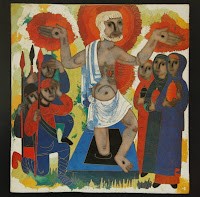
We commemorate All Hallow’s Eve, All Hallows’ Day and All Souls’ Day, aware of the thousands of people who have perished in the horrific wars in Ukraine and Israel. At the same time, the fact that many Americans continue to die from COVID-19, the alarming increase in mass shooting deaths including the recent horrific mass murders in Lewiston, Maine, and the deaths that occur regularly in our parishes and in our families may cause more people than usual to think about death and the relationship between the mystery of the Resurrection of Jesus Christ and the Catholic Church’s affirmation of eternal life. It is unfortunate that some Catholic families may spend more energy preparing ghoulish Halloween costumes for their children than teaching them how to become saints on All Saints’ Day and guiding them in prayer for their dear ones who have died on All Souls’ Day.
On Sundays, Catholics “say” these words from the Creed, “For our sake He was crucified, suffered, died, and was buried. He rose again on the third day in accordance with the scripture.” And a few lines later, “I look forward to the resurrection of the dead and the life of the world to come.” These words are rarely proclaimed with an awareness of their amazing wonder and mystery. They are simply “said” in a matter-of-fact manner that is no different from saying, “I look forward to having breakfast with my family after Mass.” Yet, these are such astounding words that much of the world’s population considers them to be not only unbelievable but also incomprehensible.
I. Religious Language Concerning Death and Eternal Life
When the Letters of St. Paul and the Gospels give testimony about the Resurrection, they are clearly not saying that Jesus of Nazareth simply came back to normal human life, like Lazarus. The wonder of the Resurrection is a glorification of Jesus as the Christ wrought by the God who is God, dwelling in unapproachable light. The Scripture witnesses make it clear that the “event” of the Resurrection was not an ordinary news event that could have been reported by CNN or FOX News reporters. The same is true about the “eternal life” to which Christians look forward. Language about “going to heaven” is not the same as language about “going on vacation to Nigeria.”
When we speak of Christ’s Resurrection and our hope of eternal life, we are “bending” language in a special way, attempting to express what is ultimately inexpressible. The language we use to convey religious faith is not “ordinary, everyday” language at all. It is language struggling to convey religious meaning. Religious language both reveals and conceals the mystery to which it points. The language of religious faith has been compared to the language of individuals bound together by deep and abiding love. We all know that those who love deeply often turn to poetry and poetic discourse to express their interior ecstatic state that they cannot express in ordinary vocabulary.
The philosopher-anthropologist Paul Ricœur wrote about the use of the language of avowal to affirm beliefs, and the employment of mytho-poetic symbolic language to convey awareness of realities beyond everyday experience. Jesuit theologian Bernard J.F. Lonergan wrote about religious language orienting us into mystery, the “unknown-unknown.” Philosopher-scientist Michael Polyni wrote about “tacit knowing,” that which we sense we “know” but cannot satisfactorily verbalize. When we bend language to speak about religious mystery, our intentionality is to convey more and not less than what our inadequate words convey. All of this reminds us that the world is more than we know, and when it comes to expressing deep religious faith, we are constrained by the limits of language, the unlimited horizon of possibilities, and the permanence of mystery.
The Belgian Jesuit Roger Troisfontaines wrote a classic study on death and faith in eternal life, which he provocatively called, “I Do Not Die.” Nevertheless, it is obvious that we Christians really do die like everyone else. Yet our faith affirms that death is not an ending but a transformation or a new beginning. We use language in unique ways to express that faith. Some of our efforts are more adequate than others. Consider these examples:
1.) On the Sundays between Easter and the Solemnity of the Ascension, the Church’s liturgy makes use of this type of language when the scripture readings prompt us to pray and think about what it means to affirm that Jesus Christ was “raised from dead” before “ascending into heaven.” Clearly, we are not saying He ascended to a physical “place” above the earth. What did He mean when He spoke about the many “dwelling places” in His Father’s “house?” In what sense was He “going” to prepare a place for us? Where was He going? Catholics speak about “going to heaven” when they die, without giving critical attention to the fact that this is a completely different kind of language from saying, “We are going to Hawaii for our honeymoon.” “Going to heaven” is using non-literal faith language to orient our minds and hearts into the Christian mystery of eternal life with God. Whereas “going to Hawaii” is simple, literal language about a geographical place. When Jesus spoke of the “many mansions” in His Father’s house, He was clearly using non-literal “faith language.”
Make Us Instruments of Your Peace (War in the Holy Land)
His Excellency,
The Most Reverend Edward K. Braxton, Ph.D., S.T.D.
Diocese of Belleville
9 AM Mass, October 8, 2023
St. Luke’s Parish, Belleville
Sermon:
“Make Us Instruments of Your Peace”
(War in the Holy Land)
(This is the text as originally written. During the actual delivery, some passages were omitted and other comments were added spontaneously. Nota bene: This text has not been thoroughly proofread. Therefore, there may be errors in spelling, grammar and punctuation.)
Dear Sisters and Brothers in Christ:
“Lord, make me an instrument of Your peace.” When we hear these words, many Catholics think, “Ah, the prayer of St. Francis of Assisi,” the amazing man whose feast day we celebrated on Wednesday, October 4. But the thirteenth-century saint did not actually write this prayer, which can only be traced back to 1912, when it was published anonymously in the French journal La Clochette. Later, Francis Cardinal Spellman, Archbishop of New York, distributed millions of copies during World War II. When he was elected pope, Cardinal Bergoglio chose Francis for his pontifical name. And on Wednesday, St. Francis feast day, the Pontiff published a new encyclical, Laudate Deum (Praise God), challenging all people and all nations to care for the earth endangered by undeniable climate change. On St. Francis Day, the Holy Father opened the Vatican Synod on Synodality, a worldwide month long gathering of over three hundred bishops prayerfully pondering the shape of the Church to come, with laymen and lay women as voting participants for the first time in Church history. The Synod has the potential of leading to changes in Church disciplines and a more nuanced understanding of some Church doctrines.
St. Francis was born in 1182, Son of Pietro and Pica di Bernardone. His actual name is Giovanni di Pietro di Bernardone. He was called Francesco "The Frenchman" by his father, who frequently took him on trips to France. After living a selfish and indulgent youth, Francesco felt called by Christ to rebuild and renew the Church. He remained a deacon all his life, feeling unworthy of becoming a priest. Francis became the totally poor and humble workman committed to renewing the Catholic Church. During the final years of his brief life, he was half blind and seriously ill. Two years before his death, Francis became the first person known to receive the stigmata, the wounds of Christ in his hands, feet, and side. He died October 3, 1226, when he was only 44 years old.
********
This morning we heard two of St. Francis’s favorite scripture passages. He took great inspiration from the lyrical words of St. Paul’s 2nd letter to the Christians living in Philippi c 4, v6-9. “Have no anxiety at all, but in everything, make your requests known to God. Then, the peace of God, which surpasses all understanding, will guard your hearts and minds in Christ Jesus. Whatever is true, whatever is honorable, whatever is just, whatever is pure, whatever is lovely, whatever is gracious, if there is any excellence and if there is anything worthy of praise, think about these things. Then the God of peace will be with you.”
Francis often meditated on the parable of the landowner in Matthew, 21:33-43. Francis wrote: “In this parable, Jesus speaks of God as a landowner who plants a vineyard, leases it to us, his tenants, and goes on a trip, leaving us in charge of his land, which produces wonderful grapes. Then, the landowner’s servants come to collect the landowner’s grapes. Jesus says we want to keep the grapes for ourselves, so we kill the servants.
But, instead of punishing us, the landowner sends more servants to collect his grapes. We kill them too. Then, the landowner sends his only son, hoping that we will treat his son with respect and hand over the grapes. Clearly Jesus Himself is the Son, who has come to us not to collect the grapes, but to teach us about the Kingdom of God. Jesus tells us we kill the landowner’s son, hoping we can keep the vineyard for ourselves. When the owner of the vineyard comes, He will put us to death and rent His vineyard to others who will produce good grapes and happily give them to the landowner.
Francis says Jesus is describing us. We are quick to claim as ours that which is actually a gift from God. When God asks us to share what we have produced by God’s grace, we may respond like the tenant farmers in the parable: we claim as our own God’s gifts that have only been lent to us by God, the landowner.
Jesus told this parable just five days before He was arrested and crucified. The chief priests and the Pharisees hear the story, and they know Jesus is talking about them. They call for His death thus fulfilling His parable. St. Francis says Jesus is speaking to all of us as well. He is challenging us to be good stewards of our faith, asking us to think about the different ways that we kill the message of Jesus in our lives. He reminds us of how severely the landowner punished the tenants who killed His son.
St. Francis would be disappointed that 797 years after his death, Pope Francis feels compelled to come to the defense of brother earth and boldly declare on his feast day that it is no longer possible to doubt the human origins of the climate change crisis. The Pope writes, “The world in which we live is collapsing and may be nearing the breaking point. The world must move towards clean energy sources such as wind and solar energy and move quickly away from fossil fuels.” With deep pastoral concern, Pope Francis asks those who deny climate change to open their eyes and see.
********
I Am in Your Midst
His Excellency,
The Most Reverend Edward K. Braxton, Ph.D., S.T.D.
Diocese of Belleville
Twenty-Third Sunday in Ordinary Time
Saturday, September 9, 2023 - 4:30 Mass
Blessed Sacrament
Sermon:
“I am in Your Midst”
(This is the text as originally written. During the actual delivery, some passages were omitted and other comments were added spontaneously. Nota bene: This text has not been thoroughly proofread. Therefore, there may be errors in spelling, grammar and punctuation.)
Dear Sisters and Brothers in Christ:
“I’m sorry! It was my fault. I apologize. Please forgive me.” These are some of the most difficult words for most of us to speak. However, it can be even more difficult for us to tell other people that what they did or said is wrong; that they were at fault. That what they did or said hurt you and others. That they are the ones who should apologize. Often, we tend to look for ways to avoid apologizing and avoid confronting others with their wrong doings.
It seems easier for parents to tell their children that their behavior is unacceptable and that they should apologize than it is for adults to say the same thing to another adult. We may feel it is presumptuous for us to challenge or be critical of another adult. We may be concerned about their possible negative reaction. And, while children may be willing to begrudgingly apologize to their parents for their wrongdoing, adults are often hesitant or embarrassed about apologizing to other adults.
This can be true in almost all relationships: husbands and wives, sisters and brothers, neighbors, coworkers, and, yes, members of a parish like Blessed Sacrament or Queen of Peace. While parishioners, as members of Christian communities, usually make a special effort to get along with one another, we all know that there are conflicts and disagreements in every parish. Pastors and parishioners. Parishioners and other parishioners, staff members and parishioners, school faculty members and school parents. Bishops, priests, and deacons. In all of these relationships, Christians strive to work in harmony. And most of the time we succeed. But since we are flawed human beings and redeemed sinners, there are times when differences lead to conflicts, when conflicts lead to anger, when anger boils over to open hostility and the bonds of Christian fellowship are strained almost to the breaking point.
Such strife can cause some members of the parish family to stop speaking to one another, some parishioners to avoid others, and still others to stop coming to Church altogether because of unresolvable differences.
********
In my own life, I have experienced a situation in which I believe that I truly hurt or offended someone whom I cared for deeply, and it took me several months to realize the pain I had caused. So, I set out to make amends. I called the person repeatedly and left numerous voicemail messages, but I never received a call back. I sent texts, emails, and personal, handwritten letters of apology, with all sincerity, yet the person never responded in any way. Now, more than a year has passed and still I have not succeeded in bringing about reconciliation, or forgiveness.
I have prayed about this situation often, discussed it with my spiritual director, and acknowledged my fault in the matter in Confession. I simply do not know what else to do. Perhaps some of you have had a similar experience of the collapse of a treasured Christian friendship. What are we to do?
**********
Peter and Francis
His Excellency,
The Most Reverend Edward K. Braxton, Ph.D., S.T.D.
Diocese of Belleville
Twenty-Second Sunday in Ordinary Time
St Luke Parish
9 a.m. Mass, September 3 , 2023
Sermon:
“Peter and Francis”
(This is the text as originally written. During the actual delivery, some passages were omitted and other comments were added spontaneously. Nota bene: This text has not been thoroughly proofread. Therefore, there may be errors in spelling, grammar and punctuation.)
Dear Sisters and Brothers in Christ:
Simon, “The Rock,” Peter, is the most interesting, unpredictable, and challenging of all of Jesus’ apostles. His current successor as Bishop of Rome, Jorge Mario Bergoglio, the former archbishop of Buenos Arias, Argentina, Pope Francis 1st, is equally interesting, unpredictable, and challenging. St. Peter and the Pope have the common tendency to do and say things that are completely unexpected.
Peter has been the lead actor in the continuous readings from the gospel of Matthew that we have been reflecting on in recent weeks. We heard him doubting that Jesus was walking on the waters of the stormy sea. Peter turns his gaze from the face of Jesus to the turbulent blue-black waves and begins to sink, screaming, “Lord, save me!”
Last Sunday, a very different Peter boldly answers Jesus’ question, “Who do you say the Son of Man is?” With a confession of absolute faith he answers, “You are the Christ, the Son of the living God!”
Jesus then addresses Simon as petrus, or “rock.” “You are Peter, and upon this rock I will build my Church, and the gates of the netherworld shall not prevail against it. I will give you the keys to the kingdom of heaven.” This is the first time the word “church” appears in the gospels. This verse is critical for several reasons.
First, Jesus trusts Peter’s unsteady faith enough to make him the leader of the apostles. (Remember, after Jesus is arrested, Peter will deny that he even knows Him). Second, those of you who have been to Rome, know that these words, “You are Peter, and upon this rock I will build my Church,” are inscribed in Michaelangelo’s massive dome of the Papal Basilica of St. Peter, which covers the traditional site of Peter’s burial. Third, as Catholics, we believe this Petrine authority continues in the ministry of the Holy Father, Pope Francis, the Bishop of Rome, and Successor of St. Peter.
**********
Forgive From Your Hearts
His Excellency,
The Most Reverend Edward K. Braxton, Ph.D., S.T.D.
Diocese of Belleville
Twenty-fourth Sunday in Ordinary Time
5:00 p.m. Mass, September 16, 2023
St. Teresa Parish, Belleville
Sermon:
“Forgive From Your Hearts”
(This is the text as originally written. During the actual delivery, some passages were omitted and other comments were added spontaneously. Nota bene: This text has not been thoroughly proofread. Therefore, there may be errors in spelling, grammar and punctuation.)
Dear Sisters and Brothers in Christ:
Some time ago I did something which I believe truly hurt someone whom I cared for deeply. When I realized the pain I had caused, I set out to make amends. I called the person repeatedly, left voicemail messages, sent texts, emails, and handwritten letters apologizing with all sincerity, yet the person never responded.
Now, more than a year has passed and still I have not succeeded in bringing about reconciliation, or forgiveness. I have prayed about this situation often, discussed it with my spiritual director, and acknowledged my fault in the matter in Confession. I truly want and need this person to forgive me. I simply do not know what else to do. Will God forgive someone unwilling to forgive me or you?
Forgiveness can be difficult in any human relationship: husbands and wives; sisters and brothers, friends, neighbors, coworkers, and, yes, members of a parish like St. Teresa or St. Luke. While parishioners, as members of Christian communities, usually make a special effort to get along with one another, we all know that there are conflicts and disagreements in every parish. In all of these relationships, Christians strive to work in harmony. And most of the time, we succeed. But since we are flawed human beings and redeemed sinners, there are times when differences lead to conflicts, when conflicts lead to anger, when anger boils over to open hostility and the bonds of Christian fellowship are strained almost to the breaking point.
We hurt each other, and there is a need to be forgiven, and a need to forgive. But this is not always easy. The person who hurts us may not seek forgiveness. If forgiveness is sought, we may not feel ready to forgive.
********
In Matthew 18, 16-25, Peter asks Jesus how many times he should forgive someone who hurts him. Seven times? Peter thinks he is being generous, since local rabbis taught that a good Jewish person must forgive an offender three times. So, Peter is surely shocked when Jesus replies not seven times but seventy-seven times, meaning His followers must forgive each other from their hearts, as many times as forgiveness is sought. Knowing that Peter and the disciples might think that His answer was unreasonable, Jesus tells one of His famous, “The Kingdom of Heaven is like,” stories in which the king represents God or Jesus Himself.
Jesus says: The Kingdom of Heaven is like a king who decides to settle accounts with his servants. A man owes the king a huge amount of money. The king orders him, his family, and land to be sold to pay the debt, since the servant did not have the money to pay it. The servant kneels before the king and begs for mercy. The king is moved with compassion and forgives the debt and lets his servant go free. Later, that servant meets a fellow servant who owed him only a few dollars. But instead of forgiving his friend the way the king forgave him, he chokes the man demanding, “Pay back what you owe.” The fellow servant pleads with his coworker to give him a little time. But he refuses and puts the fellow servant in prison until he can pay his debt.
When the king heard this, he sent for his servant saying, “You wicked servant! I forgave you your entire debt because you begged me to. Should you not have had pity on your fellow servant, as I had pity on you?” Then, in anger, the king handed him over to the torturers until he should pay back the whole debt, which he could never do from prison.
********
Who Do You Say the Son of Man Is?
His Excellency,
The Most Reverend Edward K. Braxton, Ph.D., S.T.D.
Diocese of Belleville
Bishop Braxton prepared this homily to be delivered at the 5 PM Mass on August 27, 2023, at St. Theresa Parish in Belleville. However, on that date, the Mass was changed to 4 PM to accommodate the Parish picnic. Since the Bishop was unaware of this change, the homily was never delivered.
Sermon:
“O Woman, O Man, Great is Your Faith!”
(This is the text as originally written. During the actual delivery, some passages were omitted and other comments were added spontaneously. Nota bene: This text has not been thoroughly proofread. Therefore, there may be errors in spelling, grammar and punctuation.)
Dear Sisters and Brothers in Christ:
Eight of the thirteen people who hope to be the nominee of their party for President of the United States participated in Wednesday evening’s Milwaukee debate, which was viewed by fewer than 13 million people. A small number when you think of the more than 240 million Americans eligible to vote. In a sense, each candidate is asking the same question Jesus is asking us in this evening’s reading from Matthew 16: 13-20. Who do people say that I am? Who do the viewers say that these politicians are? Who do these candidates themselves say that they are? In the end, these presidential hopefuls long for the American people to say that they are the right person to lead this country beginning in January 2025.
Of course, history teaches that Americans will not know the answer to this important question until after a nominee has been elected and served as president for four years.
Jesus Himself is doing something similar in His dialogue with His disciples and with us when He asks, “Who do people say that the Son of Man is?"
Though our parents may have answered this question for most of us when we were baptized, each of us, at some point, should ask ourselves, what do we think of Jesus of Nazareth?
“Who do people say that the Son of Man is?" Using His favorite title for Himself, Jesus is essentially asking: “What are the people who have been listening to me and watching me saying about me? Do they think I am someone exceptional? Do they think I am making claims about myself that are difficult, even impossible to believe? This is a question people have been asking for 20 centuries: Who is Jesus of Nazareth? Why does He matter? The question really isn’t: who do people say Jesus Christ is?” This version of the question already implies the answer in the title “Christ”. As you know, no one called Jesus of Nazareth, “Jesus Christ” in His lifetime. The title “Christ” means messiah, God’s anointed one, a title given to Jesus as an expression of faith.
The response of the disciples to Jesus’s question is quite unusual. "Some say you are John the Baptist, others Elijah, still others Jeremiah, or one of the prophets." But John, Elijah, Jeremiah, and the great prophets have all died. Are the disciples suggesting that the people think that Jesus is someone who has returned to life from the realm of the dead? Instead of asking that tantalizing question, Jesus gets to His real point. What about you? Who do you say that I am? Matthew then has the bold Simon, who doubted that Jesus was truly walking towards him on the stormy sea, make a total and complete profession of faith. "You are the Christ, the Son of the living God."
Jesus then addresses Simon as petrus, or “rock.” “You are Peter, and upon this rock I will build my church, and the gates of the netherworld shall not prevail against it. I will give you the keys to the kingdom of heaven.” This is the first time, and one of the few times, the word “church” appears in the gospels. Even though scripture scholars suggest that the word “church” was not a part of Jesus’s vocabulary, this verse is critical for several reasons. First, Jesus trusts Peter’s unsteady faith enough to make him the leader of the apostles. (Remember, after Jesus is arrested, Peter will deny that he even knows Him). Second, those of you who have been to Rome know that these words (“You are Peter, and upon this rock I will build my Church”), are inscribed in Michaelangelo’s massive dome of the Basilica of St. Peter, which covers the traditional site of Peter’s burial. Third, as Catholics, we believe this Petrine authority continues in the ministry of the Holy Father, Pope Francis, the Bishop of Rome, and Successor of St. Peter.
********
O Woman, O Man, Great is Your Faith!
His Excellency,
The Most Reverend Edward K. Braxton, Ph.D., S.T.D.
Diocese of Belleville
August 20, 2023
St. Theresa Parish, Belleville
Sermon:
“O Woman, O Man, Great is Your Faith!”
(This is the text as originally written. During the actual delivery, some passages were omitted and other comments were added spontaneously. Nota bene: This text has not been thoroughly proofread. Therefore, there may be errors in spelling, grammar and punctuation.)
Dear Sisters and Brothers in Christ:
“The Exorcist” is one of Hollywood’s most famous movies. When William Friedkin, the movie’s director, died on August 7 at the age of 87, The New York Times proclaimed his 1973 film “the best film ever made about the Roman Catholic Church.” You may or may not agree with The Times. But, this ever-popular film, based on William Peter Batley’s novel about a girl possessed by a demon, whose mother asks two Catholic priests to save her, certainly takes the Catholic faith very seriously.Mr. Friedkin, who was a Jewish agnostic, said his film was based on the premise that the claims of the Roman Catholic Church about God and the devil, and heaven and hell, are literally true. The young girl in the story does not have psychological problems. She really is possessed by a demon. Her entire being has been taken over by Satan. In an interview, the director said it was strange to him that many contemporary Catholics seem to doubt the existence of the devil and see his movie simply as a “horror movie,” when it is actually about the spiritual power of the Catholic faith.
In “The Exorcist,” when the desperate mother of the possessed girl asks a young liberal Jesuit priest, Father Damien Karras, how to have an exorcism performed on her daughter, the priest sarcastically replies, “You would have to take her back to the 16th century, since no one believes in demons, possessions, and exorcisms today.”
By contrast, an older priest, Father Merrin, a scholarly expert in ancient Near Eastern cultures, accepts the reality of demonic possession and, armed with his faith, does battle with Satan and performs the exorcisms.
********
This morning’s gospel, Matthew 15: 21-28 presents a story of a woman whose daughter is possessed by a demon.
Jesus and His disciples travel to the region of Tyre and Sidon, two Mediterranean seaside villages northwest of the Sea of Galilee. Sidon was founded by Canaanites and the people who lived there were known to have a pagan culture. Ordinarily, Jewish people did not enter these towns because the people were unclean idol worshippers, enemies of Israel.
From a distance, a Canaanite woman called out to Jesus, “Lord, Son of David, have mercy on me! My daughter is suffering terribly from demon-possession.” (The story does not tell us how a Canaanite woman could know about Jesus or how she knew He was the Son of David (the Jewish Messiah), or why a pagan Canaanite would believe in the Jewish prophet).
Jesus ignores the woman and has no interest in helping her, saying He was sent into the world to tend only to the lost sheep of Israel. (Yet, He might wonder how this unclean outsider, a Canaanite, and a woman, could have a better grasp of His identity than His personally selected disciples, who are only gradually realizing who He is).
The woman is persistent. She kneels before Jesus and pleads in desperation, “Lord, help me!” Jesus’ reply is harsh, "It is not right to take the food of the children and throw it to the dogs." Jesus seems to be using a slur by referring to the Canaanites as “dogs.” Still, the courageous Canaanite woman does not let this insult stop her. "Please, Lord, even the dogs eat the scraps that fall from their master’s table.”
Amazed, Jesus says, “Woman, great is your faith! Let it be done for you as you wish.” And the woman's daughter was healed at that very hour. Does this story suggest that Jesus initially thought that His mission was only to the Jewish people and that He gradually realized that the Good News was for ALL people everywhere?
********
The Back to God Hour
His Excellency,
The Most Reverend Edward K. Braxton, Ph.D., S.T.D.
Diocese of Belleville
Easter Sunday, the Resurrection of the Lord
April 9, 2023
St. Luke Parish, Belleville
Sermon:
"The Back to God Hour”
(This is the text as originally written. During the actual delivery, some passages were omitted and other comments were added spontaneously. Nota bene: This text has not been thoroughly proofread. Therefore, there may be errors in spelling, grammar and punctuation.)
“Good morning, ladies and gentlemen. This is “The Back to God hour.” Let the church say Amen!”
Dear People of God:
“The Back to God Hour,” a Christian radio program, offered a special dramatic Easter Sunday morning broadcast featuring a reporter walking the streets of Jerusalem interviewing individuals who had witnessed the resurrection of Jesus Christ. Each person gave a vivid account of what happened at about sunrise on Easter morning.
“My name is Quintus Arius. I’m the captain of the guard. I saw the whole thing. Pontius Pilate charged me to oversee the crucifixion. I can tell you one thing: that man Jesus of Nazareth was dead alright. I personally took his body down from the cross and placed it in the tomb and ordered soldiers to roll a great stone over the entrance. As I was heading home, I received the order from Pontius Pilate to keep the guards at the tomb all night to prevent the body from being stolen. At about sunrise, I heard roaring wind. There was thunder and lightning. A stone that took four soldiers to move split open and Jesus walked out in glory. I could see Him clearly, but He was more radiant than the sun and I could not look at him. But He is alive!”
Anna and Caiphas, the Jewish high priests who brought the charges against Jesus for blaspheming and claiming to be the “Son of God” said, “We saw the guards seal the tomb. Yet, He strode into the temple precincts, looked at us with piercing eyes and said, “I am Jesus of Nazareth, the Son of God, the one whom you condemned to death.” Then He showed us the wounds from the nails and walked away surrounded by a glorious light. We cannot believe what we have seen. But He is alive!”
The reporter made his way through the streets of Jerusalem to the palace of Pontius Pilate, the procurator of Judea. The streets were filled with people talking in amazement. “We saw Him. He stopped at my market and ate some fruit. He sat at my table and drank some cold water. We were there on Golgotha when the soldiers pierced His heart with a spear. The blood spattered on us. We didn’t believe the testimony of His disciples. But now we know, He is alive!”
Arriving at the palace of Pontius Pilate, the reporter was greeted by Pilate’s wife, Claudia, who said, “I told my husband to have nothing to do with the death of that just man. Now we both know He is more than a man. Pilate entered the room saying, “Last night I dreamed I saw thousands of millions crying for this man. And then I heard them mentioning my name. And leaving me the blame.”
“Moments ago, Jesus was standing right here, even after the soldier assured me that He was dead. He was silent during His trial. Now He spoke saying, “I AM The Messiah, and My Father has raised Me from the dead!”
Pilot said, “I must send word to Emperor Tiberius Caesar in Rome and tell him, “The world has been changed forever! Jesus Christ, whom I condemned to be crucified, has been raised from the dead by the power of His God. Jesus is alive. His God IS God!”
“The Back to God Hour” was a very powerful radio program, accompanied by dramatic music. I am sure that many people were moved by it that Easter morning. There is only one problem. NONE OF IT IS TRUE. The Letters of St. Paul and the four gospels are silent about the ACTUAL event of the resurrection. They do not say that any of these people saw the risen Christ. Jesus NEVER called HIMSELF the Messiah, or the “Son of God.”
This is what you will find in the four gospels:
Jesus is crucified. Jesus dies. Jesus is removed from the cross and buried in the tomb of Joseph of Arimathea. Early Sunday morning, women came to the tomb to anoint the body. A divine messenger rolls back the stone, revealing only the empty tomb. The body is missing. The angel says He has been raised from the dead.
The gospels contain different apparitions of the risen Lord to Mary of Magdala, the apostles, and the disciples. There are NO eyewitnesses to the event of the resurrection. The risen Lord appears ONLY to those who already believe in Him, only to people of faith. He does NOT appear to those who do not believe in Him, like Pontius Pilate, and compel them to believe. The resurrection is not a David Copperfield magic trick. The resurrection is an absolute inscrutable mystery, which is why the Bible does not attempt to describe it, or provide any eyewitnesses to the Lord’s triumph over death.
African American Catholic Administrators and Servant Leadership
AFRICAN AMERICAN CATHOLIC ADMINISTRATORS
AND SERVANT LEADERSHIP
Keynote Address
Annual Meeting
The National Association of Black Catholic Administrators
Austin, Texas
September 22, 2022
His Excellency,
The Most Reverend Edward K. Braxton, Ph.D., S.T.D.
Bishop Emeritus
Diocese of Belleville
Peace be with you!
We gather this morning mindful that dear Bishop Fernand Cheri, O.F.M., the auxiliary Bishop of the Archdiocese of New Orleans, is very seriously ill suffering from heart and kidney ailments. I have known Bishop Cheri long before he became a Bishop and I appreciate his Franciscan spirit and his many contributions to the Church so very much. Let us pray for him constantly throughout this day and the days ahead.
As the National Association of Black Catholic Administrators gather to rededicate yourselves to leadership in the Church, especially in the African American Catholic community, it is clear by the very nature of your ministry, that you yourselves are called to be leaders and to collaborate with other Church leaders. As Directors of offices of African American Catholic Ministries, Superintendents of Schools, representatives of the United States Conference of Catholic Bishops’ African American Affairs Office, Xavier University Institute for Black Catholic Studies, the National Black Catholic Sisters Conference and others, you work with bishops, priests, deacons, religious school administrators, and lay leaders.
You do this in the Catholic Church in which, unfortunately the racial divide still exists. African American Catholics are a very small portion of the Church. The number of African American Catholics serving in positions of leadership is smaller still. But this should not diminish your appreciation of the importance of your leadership. As a Bishop of the Church, I wish to thank you and express the Church’s appreciation and gratitude to you for your exceptional service, which I know is not always appreciated and is sometimes ignored.
The theme of my remarks this morning is AFRICAN AMERICAN CATHOLIC ADMINISTRATORS AND SERVANT LEADERSHIP. I will explore this theme under five headings.
- Recent Examples of Leadership
- Many Kinds of Leadership
- Servant Leadership
- Jesus Christ, Servant Leadership and Black Lives Matter
- Conclusion: A Community of Foot Washers
- Recent Examples of Leadership
Recent events have prompted us to think critically about leadership. The August 30th death of Mikhal S. Gorbachev, 91, the last leader of the Soviet Union, who adopting the principles of glasnost and perestroika presided over the end of the Cold War, lifted the Iron Curtain transforming the map of Europe and the political climate of the world, leading to the collapse of the Soviet Union.
Vladimir Putin, by contrast, has tried to undo all that Mr. Gorbachev accomplished and, with Zarist ambitions is prosecuting a gravely immoral war against the people of Ukraine causing unspeakable violence, destruction, suffering and death in the hope of restoring Russia’s empire status.
Ukraine’s President, Volodymyr Zelenskyy, has demonstrated heroic courage and bold leadership defending his homeland against an unjust aggressor. He has amazed the world by the defense he has mounted, with the help of President Joseph Biden, the United States, and the North Atlantic Treaty Organization.
Just days ago, the world seemed to pause to honor Queen Elizabeth II during her funeral liturgy at Westminster Abbey. The Queen died at 96, after a 70-year reign and 73 years of marriage to Prince Phillip. A constitutional monarch with no political power, Elizabeth exercised unique moral leadership with grace and dignity. Her service provided an extraordinary stability to the United Kingdom as she gave wise counsel to fifteen prime ministers, and fourteen American presidents. Notwithstanding the well-known terrible racist evils of British Colonialism, the Queen is admired as a towering leader.
In the United States the January 6 Committee led by African American Mississippi Congressman Bennie Thompson seeks to understand forces that are threatening the very foundations of democratic leadership in this country. Daily we hear the fiery rhetoric of mid-term election campaigns with the elected leader of one party expressing concern for the soul of our nation and the de facto leader of the other party proclaiming, falsely, that the 2020 presidential election was invalid.
Furthermore, the country is in a state of crisis over the Supreme Court’s Dobbs vs. Jackson Women’s Health Organization ruling. Because of its decision to overturn the 50-year-old Roe vs. Wade concerning what it deemed the constitutional right to end developing fetal life in the womb, the moral leadership of the Supreme court is celebrated and praised by some and condemned and rejected by others.
In the Church, our Holy Father, Pope Francis has brought to the Roman Pontificate a style of leadership somewhat unlike that of his predecessors, Pope Benedict XVI and St. John Paul II. Francis’s leadership style has been brought to full expression in his refocusing all leadership in the Church, including Papal leadership and Episcopal leadership on synodality. The pontiff is directing a renewed spirit of cooperation, consultation and collaboration to be implemented at all levels of the Church.
Catholics are in the midst of a unique, vast worldwide consultation in preparation for the Synod on Synodality scheduled for October 2023. Some observers, applauding the Roman Pontiff’s vision, wonder if he can bring it to fulfillment at this point in his pontificate. You may each have your own ideas about how successful the synod will be based on the preparations in your area while the Pope presses on, placing his trust in the Holy Spirit.
This summer we saw a further example of papal leadership when frail, and in a wheel chair on a “pilgrimage of penance,” Pope Francis apologized to Indigenous people in Canada for the cruel, sinful, and murderous deeds committed in church-run schools.
2. Many Kinds of Leadership
The moving viewpoint of these examples of leadership reminds us that there are many different styles and models of leadership in our world and in the Church.
In the Church, a bishop, a vicar general, a deacon, a religious, a superintendent of schools, a principal, a chief financial officer, a parish council chairperson, the head of a diocesan department or agency, and those charged to lead African American Catholic ministries may lead in different ways. They may lead in the style of 1) a ruler, 2) a manager, 3) a teacher, 4) a prophet, 5) a sage, 6) a holy man or woman, or, 7) a servant leader.
1) Rulers tends to lead with the idea that they are in charge. Decision making is from the top down. They assume that their judgements are the correct ones. They may be impatient with those who disagree with their decisions, since they believe that they alone see the bigger picture.
2) Managers lead with the idea that it is the details that count. They may not see the bigger picture, but they are determined to dot every ‘I’ and cross every ‘T’ in a given project. Managers are willing to delegate but they will always follow up to make sure a task has been done without any missteps.
3) Teachers usually lead first by studying. They read about every aspect of a given undertaking. They also want to make sure that everyone on the staff is knowledgeable, well informed and understands the reason why a project is being tackled in a specific way. Their focus on studious preparation can sometimes slow a project down.
4) Prophets almost always lead by challenging the ideas of others, especially those who lead as rulers. They are not afraid of confrontation. They are bold and confident in their approach even though they may not know the details that the manager or the teacher knows. They have a strong interior sense about the way things should be done. If they do not get their way, they may abandon the project.
5) Sages generally lead with a degree of detachment, offering wise counsel and illuminating insights from the perspective of years of experience and reflection. While they may not involve themselves in the thorny details of the issues that are confronting the community, those who are sages often see the critical questions to be addressed with incisive clarity. The Sage remains calm in the midst of conflict.
6) Holy men and holy women lead from a zone of solitude and prayer. Their leadership, like their lives, is God centered. No plan or program is undertaken without prayer. This is not the superficiality of, “Let’s begin our meeting with a prayer.” All meetings and examinations of the way forward are saturated with a prayerful spirit. A spirituality of discernment is at the heart of this leadership. For such leaders, God the Father, God the Son, and God the Holy Spirit are called upon. “Lead me, guide me.”
However, no matter what style of leadership one follows, leadership in the Church cannot be effective in the long run unless the leader and the leader’s collaborators are willing to follow consistently certain key imperatives. A successful leader must Listen! Learn! Think! Pray! and Act! A good leader must listen to the opinions of coworkers, learn from their opinions, think carefully about what has been learned, pray over the issues being thought about, make decisions, and act with confidence.
Often when the efforts of a leader fail it is because the leader did not consistently Listen! Learn! Think! Pray! and Act! These imperatives must be followed throughout the task at hand, not simply at the beginning. These imperatives may be of particular importance in situations in which African American Catholics exercise administrative responsibilities while working with larger white Catholic leadership structures.
Perhaps you see yourself or those with whom you work in the African American and multi-racial Catholic community in these descriptions of leadership. You may think that the ideal leader brings all of these dimensions of leadership together and relies on a different dimension as circumstances suggest. However, this is not easy. Your own experience of the way you and those around you lead probably confirms that one or two of these models dominate your leadership style.
The Decline of Common Meaning and the Shape of the Church to Come
Keynote Address the Central /Southern Illinois Synod
of the Evangelical Lutheran Church in America
Champaign, Illinois
June 3, 2022
By:
The Most Reverend Edward K. Braxton, Ph. D., S.T. D.
Bishop Emeritus of the Catholic Diocese of Belleville, Illinois
Dear Sisters and brothers in Christ: Peace be with you!
“What is the shape of the Church to come? What will the Catholic Church in the United States look like 50 years from now? Who can say? Still, we hear dramatically polarized views about that Future-Church. We can be confident that the Holy Spirit will guide the Church through the turbulent times ahead so that the Church of a half century from now will faithfully proclaim the Good News of Jesus Christ.” It was a sermon that I began with these words in my Cathedral Church on my Golden Jubilee, that prompted Bishop S. John Roth to invite me to address the Central /Southern Illinois Synod of the Evangelical Lutheran Church in America and I am honored to be with my sisters and brothers in Christ this morning. My theme is: “The Decline of Common Meaning and the Shape of the Church to Come.”
I think most of you would agree that the Lutheran and Catholic Churches in the United States are finding it increasingly challenging to sing the Lord’s song in western culture in which Peter Berger’s “sacred canopy” of has all but collapsed in what Charles Taylor rightly calls “A Secular Age.” Professor Taylor outlines in his book of the same title the enormous difficulties mainline Christian traditions are encountering in a demystified culture which ignores or rejects the idea of the holy, the idea of mystery, and the idea of the sacred. Thus, foundational Christian beliefs about God, Jesus Christ, eternal life, the moral authority of the Ten Commandments, the nature of the family, human sexual identity, and the “golden rule” find themselves competing in the marketplace of ideas as only one of many systems of meaning. We are in a strange land.
This has come about because institutional Christianity and the larger secular, American culture have undergone the fragmentation of community caused by the decline of Common Meaning.
I will explore this topic from a moving viewpoint under five headings:
- What is “Common Meaning”?
- Common Meaning and what it means to be an American
- Common Meaning and Ecumenism
- Common Meaning and Vladimer Putin’s Invasion of Ukraine
- Jesus Christ, Common Meaning, and the Shape of the Church to Come
- What is Common meaning?
The Lutheran and Catholic traditions are committed to being Christian communities of beloved disciples. These communities, in turn, strive to actively engage the larger world around them in order to enrich and transform the larger secular community, influenced by the paradigms of H. Richard Niebuhr’s Christ and Culture. The word “community” often suggests a neighborhood, a tight knit group of people who live near one another and share many common interests and activities. But in today’s complex, fast moving society that understanding of community is only one of many. The Internet and the many forms of social communications have created postmodern communities of people who live far apart and never actually meet one another.
Fifty years ago, most Christians lived in their own spiritual “house,” sheltered to a degree from the outside world. Today almost everyone experiences far more diversity in ecclesial life than in the past. Within this context unity can be undone by unprecedented diversity with many Christians experiencing a degree of breakdown in their shared understanding of the very nature of the Christian community. A once familiar world becomes a strange land. This is what Jesuit philosopher- theologian Bernard J. F. Lonergan, S.J. in “INSIGHT: A Study of Human Understanding” and Method in Theology calls the “decline of Common Meaning.” The decline of Common Meaning shatters our communal self-understanding which leads to the danger of divisions, quarrels, fragmentation, and breakdown.
Common Meaning is what holds individuals together in what we call “community.” Common meaning is grounded in four shared realities that emerge from what Fr. Lonergan calls “the self-assembling structure of human consciousness”: a) experiences, b) understandings, c) judgments, and d) commitments. The dynamic reality of love animating a family, the loyalty animating the citizens of a country, and powerful faith animating the members of an ecclesial family are all manifestations of community born of “Common Meaning.” If even one of the key elements of shared experiences, shared understandings, shared judgments, and shared commitments is removed or significantly changed, the sense of community in a family, state or religious body is deeply shaken.
If young Christians from a traditional Christian family in a small rural town go to a large secular university in a cosmopolitan city and some of them return home as agnostics or atheists, it may well be that their experiences, understandings, judgments, and commitments were radically altered in their new, larger, more complex, secular environment, resulting in the gradual decline of Common Meaning and the breakdown of the religious communion that once bound them to their Christian family and neighbors. They became separated from their base of experiences as people of faith. Gradually, their understandings about the meaning of their lives, their judgments about the purpose of human existence, and finally their commitments about how to live their lives were undone. Their sense of community is now sustained in a world completely alien to their families and friends back home. Under the intense influence of secular culture and religious pluralism, they found it more and more difficult to retain the Common Meaning of their hometown.
The Ascension of the Lord
His Excellency,
The Most Reverend Edward K. Braxton, Ph.D., S.T.D.
Diocese of Belleville
Sermon:
5:00 p.m.
Saturday May 28, 2022,
St. Teresa Parish, Belleville
(This is the text as originally written. During the actual delivery, some passages were omitted and other comments were added spontaneously. Nota bene: This text has not been thoroughly proofread. Therefore, there may be errors in spelling, grammar and punctuation.)
“Why are you Standing There Looking Up? The Ascension and Our National Crisis of Gun Violence”
By
Bishop Edward K. Braxton
“Why are you Standing There Looking Up?” This is the questions that the two mysterious men ask the Apostles after Jesus ascended into heaven. And as we celebrate this great mystery leading to the day of the Holy Spirit, Pentecost Sunday, the risen Jesus may be asking each of us the same question: Why are we standing there looking up? Why are we not in the city proclaiming the Good News about Jesus?
Did you know that if we only had the gospels of Mathew, Mark and John, we would not have the dramatic conclusion to the story of Jesus Christ, the mystery of the ascension, which is only mentioned briefly by St. Luke? Indeed, Luke mentions it twice. Once at the conclusion of his gospel and again at the beginning of his book, The Acts of the Apostles.
Why do Mathew, Mark, and John leave the Ascension out altogether? No one really knows. They must have known about such a dramatic conclusion to the earthly life of Jesus. Some scripture scholars boldly argue that it is because the Resurrection, the coming of the Holy Spirit on Pentecost, and the Ascension of the Lord into Heaven are all different dimension of the mystery of the glorification of Jesus after the Crucifixion and Luke pulls them apart to help us appreciate each aspect of Christ’s transformation. Recall from the Easter readings that the gospel of John says that Jesus gave the Holy Spirit to the apostles on the night of the Resurrection when he breathed on them. Whereas Luke says in the Acts that they received the Spirit 50 days later on Pentecost, the Jewish feast marking 50days after Passover.
In Luke’s in Acts, Jesus says, “You will receive power when the Holy Spirit comes upon you, and you will be my witnesses in Jerusalem, and to the ends of the earth.” When He had said this, He was lifted up, and a cloud took him from their sight. While they were looking intently at the sky as he was going, suddenly two men dressed in white garments stood beside them.
They said, “Men of Galilee, why are you standing there looking at the sky? This Jesus who has been taken up from you into heaven will return in the same way as you have seen Him going into Heaven.” Notice Luke says there were two MEN. Artists often paint them as angels, as if they are correcting Luke’s mistake!
In his gospel Luke tells the story this way, Jesus says, “Behold I am sending the promise of My Father upon you; but stay in the city until you are clothed with power from on high.” Then He led them out as far as Bethany. As He blessed them, He parted from them and was taken up to Heaven. They did Him homage and then returned to Jerusalem with great joy, and they were continually in the temple praising God.” The two men are not mentioned. But significantly a detail is added. The gospel says the Ascension happened near Bethany, where Martha, Mary, and their brother, Lazarus, lived, the one whom Christ raised from the dead.
What then is the meaning of the Ascension accounts found only in Luke? Some Christians assume the text is to be taken literally. The body of the glorified Jesus was lifted up into the air, beyond the clouds and taken to a physical heavenly throne at the right hand of God the Father in a physical place in the universe. But others, knowing the vastness of our solar system, our galaxy, and the universe, suggest that it seems unlikely that the Ascension means Jesus is literally in a physical place in the universe. Still others say the language of ascending up into the clouds of Heaven is a symbolic way for the biblical author who had no knowledge of the vastness of our universe, to say that not only is Jesus no longer physically in our world, but also, He has returned to His Father who sent Him. He is in a realm that is beyond the time and space of the physical world and transcends human comprehension. The Ascension is a work of God that fully ratifies the mystery of the Resurrection.
Many theologians and scripture scholars suggest that we are not only asking an unanswerable question when we ask, “Where did Jesus go?” But also, we are asking the WRONG question. The central point of the Ascension mystery is not a question of science, cosmology, or metaphysics. The central point is what the apostles were being told to do in this experience and what we as members of Christ’s body, the Church are we being told to do by the Holy Spirit whose fiery power and grace keep Christ in our midst.
Jesus tells the apostles “You will receive power when the Holy Spirit comes upon you, and you will be my witnesses in Jerusalem, and to the ends of the earth. But stay in the city until you are clothed with power from on high.” He raised his hands and blessed them. The two men in white garments say, “Men of Galilee, why are you standing there looking up? They returned to Jerusalem with great joy. The blessing of Jesus gives them courage to return to the city and continue the work of the Lord.
The heart of the Ascension story is that Jesus Christ would no longer be physically with His followers. But He would definitely be with them in another way, leading and guiding them by the power of the Holy Spirit. The Ascension experience told the apostles and today tells all of us: You have work to do! Remain in the city where the action is! Be Christ’s witness to the ends of the earth. Act with confidence because Jesus is still with us!
The Forgiving Father
His Excellency,
The Most Reverend Edward K. Braxton, Ph.D., S.T.D.
Diocese of Belleville
Sermon:
Fourth Sunday in Lent,
March 27, 2022,
St. Teresa Parish, Belleville
(This is the text as originally written. During the actual delivery, some passages were omitted and other comments were added spontaneously. Nota bene: This text has not been thoroughly proofread. Therefore, there may be errors in spelling, grammar and punctuation.)
"The Forgiving Father"
Dear Sisters and Brothers in Christ,
Some years ago, after I hosted a group of priests for lunch at my residence, I received an angry letter from a woman condemning me for wasting the money of the diocese buying original Rembrandt paintings. Obviously, I do not own any such paintings. However, during the luncheons with our priests, I usually point out a $25 print of Rembrandt’s famous painting of “The Prodigal Son,” which hangs in the Hermitage Museum in St. Petersburg, Russia. I call their attention to the hands of the father on the back of his repentant son and explained that Rembrandt used the hand of his father and mother as models to show that God has the qualities of Father and mother. Unfortunately, one of the priests gave his parishioners the impression that this inexpensive print was the original!
Jesus of Nazareth never told a parable called “The Prodigal Son.” Jesus simply told stories constructed to have different meanings for different listeners, in different times and in different places. The gospel writers called them “parables” and later organizers of the gospels created chapter headings and titles for the stories to make the text easier to follow. Today’s story, “A man had two sons,” could just as easily be called “the forgiving Father” or “the frustrated faithful son.” The word prodigal means “one who spends money wastefully.” But the word can also mean “generosity and giving on a lavish scale,” the way the father gives his love to his selfish son.
In Luke 15, Jesus is talking to the scribes and Pharisees, the representatives of the Jewish religious authority who decided what behavior was right or wrong, according to Jewish law. The scribes and the Pharisees are watching Jesus. They are not happy about what they see. Jesus is surrounded by “tax collectors and sinners.” Jewish Tax collectors were despised because they worked for the conquering Roman empire. Luke says, “The Pharisees murmured, ‘This Man receives sinners and eats with them.’” Then, after telling them the story of “The Lost Sheep” and “The Lost Coin,” Jesus tells them a story that could be called “The Lost Son,” the younger son who wasted his father’s money on lose and riotous living in a far way country. He is the perfect example of the proverb “A fool and his money are soon parted.” Keep in mind that in Jewish culture inheritance was only received after the father’s death. By demanding that his father give him his inheritance right now, the younger son may as well be saying, “Father, I wish you were dead!”
The younger son ends up feeding pigs. We may think of this as only menial, dirty work. But to the scribes and Pharisees listening to Jesus, feeding pigs was as low as you could sink. Pork was forbidden meat—pigs were regarded as ritually unclean animals. The younger son was so desperate that he wanted to eat the husks that he fed to the pigs, but he was not allowed to do so.
Thinking of how well-fed the servants are back at his father’s house, he decides to return with a speech planned to persuade his father to accept him: “Father, I have sinned against God and against you; I am no longer worthy to be called your son; treat me as one of your servants.”
What he didn’t know, of course, was that his loving father had been waiting for him. Every day he had been going out to look down the road hoping against hope that he would see his son coming home. When his father sees him, he dashes down the road, grabs him—ragged clothes and pig smells and all—and kisses him as if he’d returned from the dead, which, in a way, he had. Before the son could finish his speech, his father was shouting orders to the servants: get some decent clothes for my foolish son, kill the fatted calf, plan a feast.
Put the finest robe on him, the robe that befits the father’s house. Put a ring on his finger, the sign of Father-Son relationship. This is still my son! Put sandals on his feet. Servants were not permitted to wear sandals. The sign of slavery was bare feet.
The welcome home party could have been a good ending to a heartwarming story about a father’s love for a wayward son. The scribes and Pharisees would have gotten the point: God loves all of His children, even those who sin and squander his gifts… He yearns for them, anxious to greet them with abundant love, a story of amazing grace.
But Jesus continued: “Now the elder son was in the field.” He hears the music for his younger brother’s party. He could have said, “Isn’t this great! I’m so happy that my brother has come to his senses and returned home.” Is that what you would have said? Is that what I would have said? I’m not so sure. The older son, thinking this is unfair, refuses to go into the party and the father has to go outside looking for him. “Father, all these years I have worked for you like a slave, and I have never disobeyed your orders. What have you given me? Not even a goat for me to have a feast with my friends! But this son of yours (notice, not “my brother!”) squandered your property on prostitutes, and when he comes back home, you slaughtered the fatted calf for him!”
With whom do you identify? The foolish irresponsible son? The loving, forgiving father? Or the angry older son? “What about me, Oh God, what about me?” The scribes and Pharisees might have asked would God be this unfair?
We Need a New Moses in Our Day
His Excellency,
The Most Reverend Edward K. Braxton, Ph.D., S.T.D.
Diocese of Belleville
Sermon:
Third Sunday in Lent,
March 20, 2022,
St. Luke Parish, Belleville
(This is the text as originally written. During the actual delivery, some passages were omitted and other comments were added spontaneously. Nota bene: This text has not been thoroughly proofread. Therefore, there may be errors in spelling, grammar and punctuation.)
“We Need a New Moses in Our Day”
Dear Sisters and Brothers in Christ:
This morning’s scripture and the tragic events unfolding in our world compel us to pray that God will raise up a new Moses in our midst.
When I was 12 years old, my parents allowed me to take the elevated train to downtown Chicago by myself for the first time. I was excited. I was going to the McVicker’s Theater for a matinee performance of Cecil B. DeMille’s “The Ten Commandments.” I was fascinated by the story of Moses from the opening notes of the powerful musical score by Elmer Bernstein to the final words of Moses to the children of Israel crossing the Jordan river, “Go, proclaim liberty throughout all of the land and unto all of the inhabitants thereof.” I was captivated by Charlton Heston’s towering performance as the deliverer of the Jewish people from bondage under the tyrannical Pharoah Rameses II, portrayed with menacing power by Yul Bryner. While I was dazzled by the scenes of the parting of the Red Sea and the fiery carving of the commandments, I was particularly moved by the Burning Bush scene described in this morning’s reading from the Book of Exodus.
Moses, having fled the court of Pharoh is tending the flocks of his father-in-law, Jethro, in Median. He sees a bush that burns but is not consumed. He decides to turn aside and see this great sight. As he draws closer, he hears the voice of God: “Moses! Moses!” He says, “Here I am.” “Come no nearer Moses! Remove the sandals from your feet, for the place whereon you stand is holy ground. I AM the God of your fathers, the God of Abraham, the God of Isaac, the God of Jacob.” Moses hid his face in fear in the divine presence. The Lord says, “I surely have seen the affliction of my people which are in Egypt and have heard their cries by reason of their task masters. Therefore, I have chosen you, Moses, to lead them out of bondage into a land flowing with milk and honey.”
Moses says, “But when I tell them, ‘The God of your fathers has sent me to you,’ they will ask, ‘What is His name?’” “Tell them, ‘I AM who AM. I AM that I AM.’ You shall tell them: ‘I AM has sent me unto you.’”
This epic film of the birth of freedom stirred my interest in classical music, Jewish and African history, Egyptian architecture, and the art of film making. But most of all, it stirred my interest in the story of Moses, the connections between his story and the story of Jesus and the relevance of this great parable of human deliverance to the stories of oppression and the need for deliverance in our word today.
The first chapters of Exodus tell that, as the number of Hebrew people in Egypt grew into a multitude, the pharaohs enslaved them, forcing them to build treasure cities for them. When pharaoh heard the prophecy that a deliverer had been born to lead the children of Israel out of bondage, he ordered the death of every newborn Hebrew male.
Moses’s mother, Yoschebel, placed the infant in a basket and put it afloat on the Nile River, where he was found by the daughter of Pharoah, who raised Moses as her own son. The story in the Gospel of Matthew of the Maji from the east telling King Harod that they have come to do homage to the newborn “king of the Jews” and Herod’s decree that every newborn Hebrew male must die and Joseph, having had a dream of this cruel plot, takes Mary and her newborn son on the flight into Egypt, is a parallel construction leading some commentators to suggest that maybe Matthew has constructed this story to show that Jesus is the new Moses. Like Moses, He is protected from infanticide, and he is a Jewish leader who came out of Egypt.
Exodus 2:11 tells us the young Moses saw the suffering of his brothers and sisters. When he saw an Egyptian overseer beating a Hebrew, like himself, he grew angry and killed the Egyptian. Moses fled from Egypt, but Exodus does NOT tell us how Moses learned that he was a Hebrew and not an Egyptian. He ended up a long way from Egypt, in the land of Midian.
There, he was befriended by Jethro, married one of his daughters, and began a new life as a shepherd. How did Moses make the transition from being a worshiper of the idols of Egypt to worshiping the one true God of the Israelites? Did it happen gradually while living in Midian with Jethro’s family? Or, did it happen all at once with the burning bush experience? We do not know.
Through the centuries researchers have asked, Did Moses really see a bush that was on fire and yet was not consumed by the fire? Was this some kind of natural phenomenon as the 10 plagues on the Egyptians and the parting of the Red Sea might have been natural phenomenon and not what we generally call a miracle? This is possible. But the point of the story is not the bush. The point is the angel. Though angels are invisible divine messengers, Moses somehow sees the Angel of the Lord and this is what gets his attention triggering a life changing experience.
The rest of Moses’ life was filled with titanic struggles. First the struggle with the pharaoh of Egypt who refused to the command of Moses, “Thus says the Lord, Let my people go!” It was only after the death of his first born son that Pharaoh freed the Hebrews. Then Moses struggled to form this disorganized group into a people committed to worshiping the one true God. After receiving the commandments on Mt. Sinai, he found that his people had become idol worshipers, worshiping a golden calf. God’s chosen people were made to wonder in the desert for 40 years before they could cross over Jordan into Canaan, the promised land. However, Moses did not cross with them. Because the Lord was angry with him, he was forbidden to do so, because of his disobedience and doubts. There arose since in Israel no other prophet like unto Moses whom the Lord knew face-to-face. His God IS God!
The Transfiguration of Christ and the War Against Ukraine
His Excellency,
The Most Reverend Edward K. Braxton, Ph.D., S.T.D.
Diocese of Belleville
Sermon:
Second Sunday in Lent,
March 12, 2022,
St. Teresa Parish, Belleville
(This is the text as originally written. During the actual delivery, some passages were omitted and other comments were added spontaneously. Nota bene: This text has not been thoroughly proofread. Therefore, there may be errors in spelling, grammar and punctuation.)
“The Transfiguration of Christ and the War Against Ukraine"
Dear Sisters and Brothers in Christ:
We are living through a Lent like no other! As Pope St. John Paul II said, “During Lent, we Christians go up to Jerusalem, praying for the candidates for the Easter sacraments, fasting, almsgiving, confessing sorrow for our sins, preparing to participate anew in the suffering, death and resurrection of Jesus Christ, contemplating the mysteries by which we are reborn.” Then he said with prescience, “Whenever we see our fellow men and women of whatever religion, race or nationally enduring innocent suffering, we see Jesus Himself hanging on the cross on Calvery.”
The Holy Father’s words speak directly to the horrific events of the last three weeks which remind us that when we gather to pray at the Sunday Eucharist, we should always have the Word of God in one hand and the morning paper in the other.
***********
Vladimir Putin, the President of Russia, and Kirill, the Patriarch of Moscow and the head of the Russian Orthodox Church have an unusually close relationship. Mr. Putin wears a cross around his neck and is often seen making the sign of the cross before he goes swimming. Still his personal religious views are largely unknown. He has plunged the world into the greatest geopolitical crisis since World War II, by illegally and immorally declaring war on Ukraine, causing death, destruction, and unspeakable suffering of innocent people.
Volodymyr Zelensky, the President of the Ukraine, falsely called a Nazi by President Putin, is actually Jewish. He swore his presidential oath on a Bible and he openly speaks proudly of his Jewish Heritage. Though not personally devout, he leads a nation most of whose citizens are members of the Ukrainian Orthodox Church that separated from the Russian Orthodox Church in 2019. They have their own Primate, Patriarch Filaret of Kyiv. Mr. Zelensky has risen to the occasion by leading his nation in a forceful defense against the President Putin’s wrongful military might with a wisdom, courage, and tenacity that have led some observers to speak of him as Ukraine’s Winston Churchill!
Joseph Biden, the President of the United States, is a Catholic, who talks openly about how his faith has sustained him in the midst of terrible personal suffering, is regularly seen going to Sunday Mass. He is criticized by some Catholics because of his support for Roe v. Wade. He has successfully united the North Atlantic Treaty Organization, the European Union, and other allies in providing massive military support to Ukraine, imposing crippling sanctions on Russia, which are having an impact on the economy of the United States, causing inflation, increasing the cost for gas, hard on all, especially the poor. He vows to defend every inch of NATO territory, insisting that he will not, under any circumstances, lead the United States into World War III with Russia.
The War Against Ukraine and the Golden Rule
His Excellency,
The Most Reverend Edward K. Braxton, Ph.D., S.T.D.
Diocese of Belleville
“The War Against Ukraine and the Golden Rule”
Part 1
I hope you have been praying fervently for Vladimir Putin, the President of Russia, for Joseph Biden, the President of the United States and for Volodymyr Zelenskyy, the President of the Ukraine and their citizens. Many political observers believe that the world is in a state of crisis not equaled since the end of the Cold War. The United Nations, the North Atlantic Treaty Organization, the European Union, the governments of Ukraine and of the United States have all expressed urgent concern now that diplomatic efforts have failed, and the President of Russia has invaded the sovereign nation of Ukraine with such violent force that suggest that it is his intention to make it a part of Russia as it was a part of the former Soviet Union as he did with Crimea in 2014. He has declared the Moscow-approved separatist controlled areas of eastern Ukraine (Donetsk and Luhansk, which have been at war with Ukraine for 8 years) to be independent republics. Mr. Putin is destroying cities and killing scores of innocent children, women, and men. He shows every intention of attacking the capitol, Kyiv, removing President Zelensky and setting up a puppet government. Such violations of international law would be in opposition to the clear international justice and peace teachings of the Second Vatican Council and the teachings of the social encyclicals of the recent Popes.
Mr. Putin’s war had been catastrophic for the people of Ukraine who are fighting back valiantly. It has shaken the stability of Europe and caused the United States and NATO to impose massive sanctions against Russia causing suffering for the Russian people but having no impact on Mr. Putin’s czarist ambitions. The sanctions have already had a negative impact on the economy of the United States, shaking the stock markets, increasing inflation, and causing higher gas prices that impact us all, especially the poor. We must pray with all seriousness during this morning’s Eucharist for a peaceful, diplomatic resolution to this dangerous, unnecessary war, which, with talk of chemical, cyber and nuclear weapons could take the world to the brink of World War III.
It might seem naïve for me to say this, but the challenging words of Jesus Christ in this morning’s reading from the Gospel of Luke contain the wisdom needed to end this horrific war, if only individuals and the Kremlin would take them seriously. Jesus says, “Do unto others as you would have others do unto you.” Do not lie about other people, if you do not want others to lie about you. Do not threaten to harm other people, if you do not want others to threaten to harm you. Do not endanger the lives, safety and well-being of your neighbor’s children, if you do not want others to endanger the lives, safety and well-being of your children. Do not treat people unjustly because of their religion, nationality, race, gender, sexual identity, or social status, unless you want others to treat you unjustly because of your religion, nationality, race, gender, sexual identity, or social status. Do not imperialistically presume to cross the borders of an independent country, declare that it has no right to exist, bomb maternity wards, schools, family homes, residences for the disabled, and evacuation routes and kill numerous innocent citizens with the intent to overthrow the government, if you do not want other countries to imperialistically cross the borders of your independent country and do the same to you.
***********
The Sermon on the Plain
His Excellency,
The Most Reverend Edward K. Braxton, Ph.D., S.T.D.
Diocese of Belleville
Sermon:
Sixth Sunday in Ordinary Time,
February 13, 2022,
St. Teresa Parish, Belleville
(This is the text as originally written. During the actual delivery, some passages were omitted and other comments were added spontaneously. Nota bene: This text has not been thoroughly proofread. Therefore, there may be errors in spelling, grammar and punctuation.)
"The Sermon on the Plain"
Dear Sisters and Brothers in Christ:
What’s wrong with this morning’s gospel? The casual reader knows that Jesus gave this famous sermon on a mount and that he proclaimed 9 beatitudes. So why is Jesus speaking on a plain and giving only 4 beatitudes and then adding 4 woes? The simple answer is: the most famous version of this story, which we all know, is in the gospel of Matthew. This morning’s less well-known version is in gospel of Luke. The two versions are similar and yet they are very different. Are the differences because Jesus, as an itinerant street preacher, gave two different versions of this sermon, one on a mount ant the other on a plain? That’s a possibility. But it may be more likely that each gospel writer changed the story to suit his audience.
Let me remind you that Matthew and Luke are the only gospel writers who tell the story of the birth of Jesus. But their stories could not be more different. Matthew’s infancy narrative tells the story of the exotic Maji who come from the far away “east,” the non-Jewish world, following a mysterious star to the home where the child Jesus in living with Mary and Joseph. They bring symbolic gifts of gold, frank-incense, and Myrrh, foreshadowing Jesus as the royal, divine, king who will suffer and die for the sins of the world.
Luke’s infancy narrative tells of Mary giving birth to Jesus in the poverty of an animal barn. She has no choice but to wrap her new baby boy in swaddling clothes (prefiguring His burial shroud) and placing Him in the food basket from which the animals ate. No exotic Maji visit the Holy Family. Instead, shepherds tending their flocks by night experience a heavenly vision telling them: “Behold, I proclaim to you glad tidings of great joy. Today in the city of David a savior has been born for you who is Christ and Lord. You will find an infant wrapped in swaddling clothes and lying in a manger.” It is important for you to keep in mind that shepherds were considered almost social outcast. They were poor, undesirable, and dangerous. Their clothing was dirty and their bodies unclean. They lacked all social graces. They had NO gifts to bring to Jesus other that their wide eyed faith. They were what the Old Testament and St. Luke called God’s lowly ones, the rejected, the anawim. The entire thrust of Luke’s gospel is a unique concern for the poorest of the poor. This is why for Luke, the poor shepherds are the first to see Jesus. It should not be surprising that in Matthew’s beatitudes, Jesus says, blessed are the POOR IN SPIRIT. But in today’s beatitudes from Luke, Jesus says simply “Blessed are the POOR!” There are no qualifiers, simply the poor.
In today’s proclamation from Luke, Jesus has come down from a mountain to deliver His “sermon on a level plain.” For Luke the phrase “level plain” suggests the everyday world in which the Jewish people lived. The world of idolatry, suffering, misery, hunger, death, and mourning. Jesus teaches that the coming Kingdom of Heaven should be hoped for and anticipated in everyday life. Luke is asking us, “How are we living by the attitudes of God’s Kingdom in our ordinary lives on the level plain of life.” In contrast, the Gospel of Matthew places a very similar sermon on a mountain to emphasize that Jesus is the new Moses on Mount Sinai, receiving His teachings on the Jewish law from God.
Luke tells us Jesus has attracted a large crowd -- people all the way from Judea and Jerusalem in the south, as well as hearers from the Gentile lands along the coasts of Tyre and Sidon in the north, present-day Lebanon. Jesus heals many sick people with great power. Only after showing His power does Jesus begin to teach the Twelve, His disciples and the large crowd that has gathered. He teaches with great authority as if He is looking each person in the eye and saying: “Now listen to me! I have something important to say that you need to understand!”
He is saying, You need to know that there is a radical difference between the kind of life you must live as My followers and the secular life most people around you are living. The two ways of living are almost polar opposites. If you want to be a part of My Father’s Kingdom you need to know and understand what God desires from each one of you. You must give up many of the worldly values around you and embrace God-centered values. As a member of a God-centered family, you must trust Me and live differently from many people around you, including some of your relatives and friends. I am calling you to try to live from this day forward looking at the world as My Father and I do. This will not be easy. But I will help you by My word and My example. If you follow Me, you will realize that God has different priorities than the world does. It may take your entire lifetime to live as My Father wishes.
"Duc in Altum! Put Out Into the Deep!"
His Excellency,
The Most Reverend Edward K. Braxton, Ph.D., S.T.D.
Diocese of Belleville
Sermon:
Fifth Sunday in Ordinary Time,
February 6, 2021,
St. Luke Parish, Belleville
(This is the text as originally written. During the actual delivery, some passages were omitted and other comments were added spontaneously. Nota bene: This text has not been thoroughly proofread. Therefore, there may be errors in spelling, grammar and punctuation.)
"Duc in Altum! Put Out Into the Deep!"
Dear Sisters and Brothers in Christ,
Duc in Altum! Duc in altum! These three Latin words mean, “Put out into the deep.” They have come to mean “Go deeper into your inner spiritual life,” or “Take the risk and plunge into a personal relationship with Jesus Christ,” or “Trust the Word of God as a guide for your daily life.” Duc in Altum was a favorite expression of St. John Paul II. He used it often, especially in his Apostolic Letter, Novo Millennio Ineunte (At the beginning of the new millennium) in which the pontiff outlined priorities for the Catholic Church for the third millennium. He said, “Duc in altum! Let us put out into the deep! These words ring out for us today, and they invite us to remember the past with gratitude, to live the present with enthusiasm and to look forward to the future with confidence: because Jesus Christ is the same yesterday and today and forever.”
These words, Duc in Altum, come from this morning’s reading from the gospel of Luke. Early one morning, Simon (whose name had not yet been changed to Peter) and James and John had been fishing all night without catching any fish. They were finished for the day, cleaning their nets and ready to go home. Jesus tells them, “Put out into deep water and lower your nets for a catch.” These fishermen know the young rabbi from Nazareth—after all, he borrowed Simon’s boat—but they are not yet His disciples.
You can imagine these exhausted men, who have just finished a fruitless, night-long fishing trip, asking, “What? After a long, hard night without catching a single fish? Why is Jesus telling us to get back into our boats and back to work, under the hot sun of daylight, when we have already cleaned our nets?” They might be thinking the young teacher clearly knows nothing about fishing? After all, every fisherman knows that the best time to fish is at night and the best place is close to the shoreline, where the water is shallow and the plant life, which the fish feed on, is plentiful. So, Simon says, “Master, we have worked hard all night and have caught nothing!”
Still, Simon listening to Jesus’ words and Duc in altum, says, “but if you say so, I will lower the nets.” Perhaps he was influenced by the fact that Jesus had recently cured his mother-in-law at her nearby home in Capernaum (Lk 4:38-39). Suddenly, they caught a great number of fish. Shocked by this, Simon fell at the feet of Jesus saying, “Depart from me, Lord, for I am a sinful man.” The concluding sentence reveals the whole point of this unusual story. “Do not be afraid, Simon, from now on you, James and John will be fishers of men, then you will be catching people!” The men left everything and followed Jesus!
**********
Who is My Neighbor: Go and Do Likewise
A Mass for Peace and Reconciliation
commemorating the 93rd anniversary of the birth of
The Reverend Dr. Martin Luther King, Jr.
Saints Simon and Jude Cathedral,
Diocese of Phoenix, Arizona
January 17, 2022
His Excellency,
The Most Reverend Edward K. Braxton, Ph.D., S.T.D.
Homilist
“Who is My Neighbor: Go and Do Likewise”
Scripture Readings:
Micah 6, 7-8
Colossians 3, 12-15
Luke 10, 25-37
Who is my neighbor? A man fell victim to robbers who stripped and beat him, leaving him half-dead. Passersby ignored him until a Samaritan, moved with compassion, approached the beaten bleeding, half naked man, poured oil and wine over his wounds and bandaged them. He cared for him, telling the innkeeper, “Take care of him!” Who was neighbor to the half dead man? “The one who treated him with mercy and compassion.” Jesus said, “Go and do likewise!”
Dear Sisters and Brothers in Jesus Christ:
When His Grace, Archbishop Desmond Tutu of Cape Town, South Africa died on Sunday, December 26, the day after Christmas, at the age of 90, many commentators surveying the heroic life of this moral giant, who with Nelson Mandela, helped to bring down the evil, racist apartheid regime in South Africa, noted his many remarkable achievements for the cause of racial justice, reconciliation, and world peace during what has been called the Second Act of his extraordinary and long life.
He knew who his neighbor was and how to go and do likewise!
The Reverend Dr. Martin Luther King, Jr. should have celebrated his 93rd birthday on Saturday, January 15. But the events of unspeakable horror of 54 years ago, April 4, 1968, made that impossible. I can still see Reverend King’s body sprawled on the balcony with a towel over the gaping hole in the side of his face and so much blood flowing from his wound.
This murder most foul ended the life of a moral giant, who with many others before and after him, worked tirelessly to bring down the evil, racist apartheid-like regime that has endured in the United States ever since the first enslaved free human beings were dragged in chains to this country from West Africa, in the Middle Passage. Despite the undeniable and remarkable strides that have been made to bridge the racial divide in this country, the blood stained headline of almost every morning’s newspaper makes clear how much we needed the voice and the deeds of this drum major for racial justice and this trumpeter for peace during these past 54 years. For many Americans, and, yes, for many American Catholics, the brutal murder of Reverend King means little more than a “day off” in January. But for many others, our country has been impoverished by his death because, unlike Archbishop Tutu, Reverend King’s life was robbed of what might well have been a powerful Second Act. He was only 39 years old!
He knew who his neighbor was and how to go and do likewise!
**********
But, what if? What if Reverend King were still alive today? What if this towering Baptist minister were still in our midst, as one like Moses, “whose eyes were not dimmed, nor his natural forces abated” (cf. Deuteronomy 34:7)?
He would see both progress and regression. He would take pride in the role he played in the eight-year presidency of Barack Obama, the country’s first bi-racial president. But he would dismiss as naive those who wrongly concluded that President Obama’s election signaled the dawn of a post-racial America.
Examining contemporary data on widespread discrimination against African Americans in education, housing, healthcare and employment, he might conclude that for every two steps forward since 1968 there have been three steps backwards. He would be shocked by the assault on the capitol and on democratic government a year ago on January 6 and distressed by the extreme polarization of the American people and the blatant efforts of some courts and states to take away hard won rights for People of Color to vote.
While Reverend King might still affirm that the moral arc of the universe is long, but it bends towards justice when he sees the convictions of those accused in the deaths of Mr. George Floyd, Mr. Ahmaud Arbery and Mr. Daunte Wright, he would still weep at the litany of African American men and women who continue to die in altercations with white representatives of law enforcement.
He would readily concede that when African American young men are accused of committing crimes, they should be arrested, tried, and, if convicted, punished. But he would insist with all vehemence that suspected wrong doers of even small offenses should not be tried, convicted, and executed on the streets by white law enforcement officers.
A thoughtful man of prayer, not inclined to make hasty judgments, Reverend King would readily acknowledge that police are sometimes in very difficult situations in which they must make split decisions. They must act in an instance when they think their lives, or the lives of others are in danger. Nevertheless, he would not hesitate to point out that when Mr. Dylann Roof, a self-proclaimed white supremacist, slaughtered nine innocent African Americans at prayer in Mother Emmanuel African Methodist Episcopal Church in Charleston, S.C. on June 17, 2015, he was arrested by the police without a shot being fired.
If Reverend King were alive today and he accepted an invitation from the Diocese of Phoenix to speak to you today on the topic of the racial divide in the United States and the ongoing efforts of the Catholic community here to pray and work for racial justice and reconciliation, then, you might hear that voice like no other, echoing through this Cathedral, saying:
“Thank you, sisters and brothers for inviting me to share fellowship with the Christian community in Phoenix. Your warm welcome is in contrast with the controversary in this state after President Reagan declared my birthday a national holiday in 1986. Later that same year Governor Babbitt declared my birthday an Arizona holiday but the following year his proclamation was repealed by Governor Mecham, arguing that his predecessor did not have the authority to declare such a holiday. I remember that in 1991, the National Football League voted to remove the 1993 Super Bowl from Phoenix after Arizona voters failed to make this day a paid holiday. Then, in 1992, Arizona voters reinstated the holiday.
Thirty years have passed since the volatile debate about honoring my birthday was national news. I certainly applaud all of the efforts that religious and civic groups have made to bridge the racial divide during the past three decades. You know better than I do how much or how little the climate has changed here since then.
**********
The Valiant Woman
The Valiant Woman
The Homily for the Liturgy of Christian Burial
Scripture Readings:
The Valiant Woman: Proverbs 31, 10-31
St. Paul, 2nd Corinthians, 5-8
St. Matthew 6, 19-34
Mrs. Karen Lynn Reime Siddall
(Tuesday, June 7, 1960 – Friday, December 10, 2021)
The Cathedral of St. Peter
10:00 AM, Wednesday, December 15, 2021
His Excellency,
The Most Reverend Edward K. Braxton, Ph.D., S.T.D
Celebrant and Homilist
Silence…Silence…
There are no words, no words, no words at all to express what we are all feeling at this hour. We are still in the fog of unbelief, wishing that what had happened had not happened. Perhaps we should simply sit in silence turning over in our hearts the personal, physical, and
spiritual, drama that has unfolded in our midst since that terrible day, April 9, 2015, when she received the diagnosis from her oncologist. She once told me that she had a list of questions which she hopes to share with God, when the time comes. Somewhat lightheartedly, she suggested that I pass out these questions to you on this day inviting all of you to meditate on them in silence.
Dear Tom, Dear Kim, Dear Michael, Dear People of God:
Every year the world tells us that we should spend the Advent days between Thanksgiving and Christmas, in frantic shopping, decorating, addressing cards, and planning meals and social gatherings. Do anything other than thinking about the coming of Jesus Christ 2,000 years ago, the coming of Jesus Christ at the end of time, and the coming of Jesus Christ at the hour of our death.
Every year John the Baptist storms out of the desert into our Advent, half naked in scratchy camel’s hair, eating dried locusts and wild honey, preaching a baptism of repentance for our sins, shouting: Get Ready! Get Ready! Prepare! Prepare the way of the Lord! The crowd, thinking he might be the Messiah, ask John, “What should we do? How should we prepare?” How do we get ready for the coming of Christ?
Of course, she knew! She knew how to prepare the place for Christ to be born anew in her heart, in her family and in the cold stable of our world. She did not learn this recently, she learned it years ago in the home of her mother and father, Joan and Harold Reime. She continued to learn and teach how to get ready for the Lord at St. Augustine school; as an extraordinary young wife and mother; as a grandmother pouring herself out in love for her children’s children; as a generous and caring neighbor; as a manager of real estate; as an active member of this Cathedral parish; a model of Christian faith; working with young couples preparing to marry; filling vessels with sacred oils during the Chrism Mass; as the one who took superb care of the Bishop’s Residence for many years. As my coworker in the Ministry of Hospitality, her dedication was without equal. Her towering example of persevering faith, in the face of life-threatening illness, made it clear that she knew how to prepare His way, how to be ready for Him.
In the singular way she cared for her family and the way she ministered to me and so many others, in spite of suffering, she gave us a powerful example of grace under pressure. Karen is a kind of latter-day John the Baptist in our lives, showing us every day that she loved the Man who carried His winnowing fan in His hand, the Man who had baptized her with the Holy Spirit and with fire!
* * * * * * * * * *
“Who shall find a Valiant Woman?”
The Spirit of God blew the breath of life into Mrs. Karen Lynn Reime Siddall on Tuesday, June 7, 1960. Her journey from God to God ended on at 9:30 PM on Friday, December 10, 2021, in the beautiful home she made for her family. She centered her life around nurturing her family. With pride and joy, she told me, “I may have a kind of sixth sense, because sometimes I simply know things.” She said, the first time she saw you, Tom, she knew that you were the man she was destined to marry.
“My love for him has only grown during these 41 years. I know my children and grandchildren will care for and comfort him.” She sometimes could not help boasting about how much other people admired and loved her husband. She is attentive to the smallest desires of the members of her family, even baking several different pies for the same meal, so everyone could enjoy their favorite! And, more profoundly, her selfless family love overflowed during the brief life (July 15, 2017-August 6, 2017) of her beloved grandson, Harrison Robert Siddall. She pointed out August 6 was the Feast of the Transfiguration of the Lord and spoke with anticipation of seeing him healthy and without blemish.
Karen loves taking her grandchildren to Belleville parades, seeing them dressed up for Halloween, and buying them their favorite toys (little dinosaurs and unicorns). She also liked sneaking out with me on a “secret mission” on a rainy afternoon to see a thought-provoking movie of which most people had never heard. Karen read widely. She always had the book she was currently reading on the kitchen counter. When she saw that I am reading N.T. Wright’s “Paul: A Biography,” she wanted to know everything I was learning about the peripatetic preacher. She studied the drafts of my writings on the “racial divide,” providing informed criticisms and insights. When I wanted to get her a special gift for her 60th birthday, I knew a St. Louis Blues Hockey jacket would be perfect. She sometimes liked to escape into Netflix movies (one of her favorites is “The Boy in the Striped Pajamas”). In our work together, she grew in her appreciation of classical music. I cannot hear Bach’s Christmas cantata without seeing the smile of enjoyment on her face. And thanks to Karen, you, Riley, may be the only eight-year-old who immediately recognizes Erik Satie’s piano composition, Gymnopédie.
* * * * * * * * * *
You Are Not Far From The Kingdom Of God
His Excellency,
The Most Reverend Edward K. Braxton, Ph.D., S.T.D.
Diocese of Belleville
Sermon:
Thirty-first Sunday in Ordinary Time,
October 30, 2021,
St. Teresa Parish, Belleville
(This is the text as originally written. During the actual delivery, some passages were omitted and other comments were added spontaneously. Nota bene: This text has not been thoroughly proofread. Therefore, there may be errors in spelling, grammar and punctuation.)
"You Are Not Far From The Kingdom Of God"
Dear Sisters and Brothers in Christ,
Every year as the autumn leaves start to fall, as the days grow cooler and cloudier, and evenings grow darker, we know that summer is over, and winter is coming soon. In the midst of this harvest time of transition, we mark three thought provoking days beginning tomorrow with October 31, All Hallows’ Eve (sadly corrupted into “Halloween”), Monday, November 1, All Saints’ Day, when we honor those who have lived faithfully Jesus’ Law of Love (that is, “Love God with your whole being and Love your neighbor as you love yourself!”), and Tuesday, November 2, All Souls’ Day, when we will pray intensely for the dearest of the dear in our lives who have died and for all the faithful departed. These three days are unique in the Church’s year of Grace.
They make clear the importance of the words of Moses in our first reading from the Book of Deuteronomy and the words of Jesus in our gospel reading from Mark.
“Hear, O Israel! The LORD is our God!
Therefore, you shall love the LORD, your God, with your whole being.”
To this Jesus adds: “The second commandment is this: You shall love your neighbor as you love yourself. There is no other commandment greater than these.” Jesus then tells the scribe who questioned him, “You are not far from the kingdom of God.”
These three days: All Hallows’ Eve, All Saints’ Day, and All Souls’ Day remind us that most human beings have a strange fascination with death, a fear of death, and a curiosity about the possibility of the life of the world to come. These three days also take us back to ancient, pre-Christianity customs.
The Church rightly celebrates All Saints’ Day on November 1, before the Commemoration of the Faithful Departed on November 2. In this way, we are reminded that through Baptism we are all called to live in such a way as to be numbered among the Communion of Saints. However, for many Catholics, All Hallows’ Day has been obscured by the ghosts and ghouls of All Hallows’ Eve (Halloween). Regrettably, in most communities, as the children of Catholic families join with others in the children’s celebration of Halloween and “trick or treat,” “haunted house” images of the dead may eclipse a true Christian spirituality of death. As a result, children may have little or no catechesis about the meaning of All Saints’ Day. When All Saints’ Day is diminished, the true meaning of All Souls’ Day is obscured and we lose sight of our Christian hope that Christ’s faithful disciples are to be numbered among the saints.
Lord, That I May See
His Excellency,
The Most Reverend Edward K. Braxton, Ph.D., S.T.D.
Diocese of Belleville
Sermon:
Thirtieth Sunday in Ordinary Time,
October 24, 2021,
St. Luke Parish, Belleville
(This is the text as originally written. During the actual delivery, some passages were omitted and other comments were added spontaneously. Nota bene: This text has not been thoroughly proofread. Therefore, there may be errors in spelling, grammar and punctuation.)
"Lord, That I May See"
Dear Sisters and Brothers in Christ,
Peace be with you!
One month ago tomorrow, someone very dear to me had a mild stroke. My first concern was that the stroke would impair my dear one’s speech or movement. Happily, this was not the case. The speech and mobility of this treasured friend remained normal. However, at least initially, the stroke has created a strange vision phenomenon. While this person can see normally, there are now unusual and distracting moving images that appear in front of one’s eyes. This caused my friend and I to have several conversations about the importance of our ability to see. What would be the greatest suffering? To lose the ability to speak? To hear? Or, to see? We agreed that this is a painful question to answer. But, in the end, we thought that blindness, living in total darkness would be the greatest suffering! We talked about the experience of children covering their eyes and playing Blind Man’s Bluff. The only reason the game is “fun” is the fact that children can uncover their eyes and see the world around them again!
St. Mark’s gospel is preoccupied with the question of blindness, that is, “spiritual blindness,” the blindness of the Pharisees who refuse to see who Jesus really is. The blindness of some disciples who cannot see that the Kingdom about which Jesus speaks is not one of military power like King Saul or King David. It is a kingdom of the heart. The blindness of the apostles James and John, who ask Jesus to give them a seat on either side of his royal throne, even as they approach Jerusalem where he will be hung on a cross as a common criminal in the Roman empire. Why do they not have the spiritual sight to see themselves on crosses on either side of their leader?
This morning’s story of Bartimaeus, the blind man, concludes a long section of Mark’s gospel that began back in chapter eight, when Jesus healed another blind man – only that time, Jesus had to twice cover the man’s eyes with spittle before the man could see. This portion of the gospel come to a dramatic climax today in chapter ten.
The journey of Jesus and His disciples from Galilee to Jerusalem was an 85-mile walk over several days, stopping outside Capernaum long enough for Jesus to teach about marriage and divorce. On the road again, they run into the rich young man, and Jesus tells him that, if he is attached to money and material things, it will be difficult for him to enter the Kingdom of Heaven.
Then, Jesus explains, for the third time since the first blind man was healed with spittle, how He will be arrested, scourged, and crucified, once they get to Jerusalem. But they keep heading for Jerusalem anyway and along the way, James and John selfishly ask for seats at the side of Jesus in the Kingdom of Heaven, forcing Jesus to make clear to the disciples that those who would be great must become servants of all. Indeed, they must become suffering servants like Jesus Himself. But the disciples are blind and cannot see the tragic future that Jesus is trying to reveal to them. They cannot see that he is on a collision course with death.
Now we have continued to travel with Jesus from Capernaum to Jericho, just 15 miles outside of Jerusalem, which is where we meet the blind son of Timaeus, begging beside the road.
Letter to the Hebrews: Christianity and Judaism
His Excellency,
The Most Reverend Edward K. Braxton, Ph.D., S.T.D.
Diocese of Belleville
Sermon:
Twenty-Ninth Sunday in Ordinary Time,
October 17, 2021,
St. Teresa Parish, Belleville
(This is the text as originally written. During the actual delivery, some passages were omitted and other comments were added spontaneously. Nota bene: This text has not been thoroughly proofread. Therefore, there may be errors in spelling, grammar and punctuation.)
"Letter to the Hebrews: Christianity and Judaism"
Dear Sisters and Brothers in Christ:
The Art of Letter Writing is a fascinating book which traces letter writing back to the Papyrus letters of the Egyptians 2,000 years before Christ; to the classic letter writing of 17th and 18th centuries, when prominent people wrote three or four drafts of their letters to get the wording and spelling just right before preparing the final version in thick black ink. They signed their names with a flourish and added their personal seal. People looked forward to receiving a letter with great anticipation and they saved the letters they received in special binders. The book says today the art of letter writing is rapidly disappearing. The sale of handsomely monographed stationary has declined. More and more people communicate largely by email or by brief text messages written in haste with no punctuations, spelling errors and quaint abbreviations, such as “how are you?” have become an R. and a U. Such communications are rarely signed!
What if you had to write an important personal letter to a dear friend, a devout Catholic, who is seriously considering leaving the Catholic Church because of the of the clergy abuse scandal or because your friend could no longer accept certain Catholic beliefs concerning the Real Presence of Christ in the Eucharist, eternal life, abortion, or the meaning of human sexuality? How would you go about composing the letter? How would you structure it? What arguments would you use to persuade your friend to remain in the Church? Would you sign it or would you send it anonymously? Would it be a hasty email, or would it be a carefully crafted real letter on stationary?
Or, how would you feel if you received a special delivery letter containing extremely helpful and important information, but it was not signed? You would have no idea who it was from. You would find this rather frustrating, but you probably would not ignore its wise content. This is exactly the situation we find ourselves in this morning.
Our brief second reading is from a document originally called simply “to the Hebrews.” It is not clear which Hebrews are being addressed or who is writing to them. For a long time, early scholars thought it might have been written by St. Paul. But that idea has long since been rejected.
Most likely the letter fragment was written to a group of well-educated Jewish converts to Christianity who were beginning to doubt their faith and leaving the Christian community. Written in eloquent Greek, the letter is a complex and at times controversial argument that intends to show that Christianity is to be preferred to the faith of Judaism. It may have been written to persuade Jewish Christians, who lived in Jerusalem, to persevere in the face of persecution, at a time when some believers were considering turning back to Judaism to escape being persecuted for accepting Christ as their Savior. The theme of the text is the doctrine of the person of Christ and His role as mediator between God and man. While the logic of the letter can be difficult to follow, the author makes his devotion to Jesus Christ as the great and only high priest very clear. The writer argues forcefully that though Jesus was a layman and not a rabbi or a priest in the traditional sense, his Priesthood surpassed the high Priesthood of Moses’s brother Aaron and the tribe of Levi because of Jesus’ unique relationship to God the Father.
Is It Lawful For A Man to Divorce His Wife?
His Excellency,
The Most Reverend Edward K. Braxton, Ph.D., S.T.D.
Diocese of Belleville
Sermon:
Twenty-Seventh Sunday in Ordinary Time,
October 2, 2021,
Blessed Sacrament Parish, Belleville
(This is the text as originally written. During the actual delivery, some passages were omitted and other comments were added spontaneously. Nota bene: This text has not been thoroughly proofread. Therefore, there may be errors in spelling, grammar and punctuation.)
"Is It Lawful For A Man to Divorce His Wife?"
Dear Sisters and Brothers in Christ:
“This is my worst nightmare!”
When I was a young priest, I was in an ecumenical sermon preparation group with Protestant ministers and Catholic priests. We met on Mondays to discuss drafts of our sermons for the following Sunday. One Monday, the gospel we discussed was the same as this morning’s text, Mark, 10, 2-12, the clear teaching of Jesus Christ on marriage and divorce. Pastor Jinkins from New Hope Baptist Church, said, “Every year when we have to preach on this scripture passage in which Jesus condemns divorce so definitively, it is my worst nightmare. I feel I can’t win, no matter what I say, since I, myself, am divorced and since I know that a number of people in my congregation are divorced; no matter what I say, I am bound to alienate many of them.” Then, Fr. Baranowski, the Associate Pastor of St. Mary Parish said, “Pastor Jinkins, I know exactly how you feel. Preaching on this text is also my worst nightmare. My parishioners, some of whom are divorced, look at me, a Catholic priest who is not married, never will be married, has no children, and no firsthand experience of the joys of married life or of the emotional stress, and difficult problems many married people face. I think some members of the congregation may feel like saying, “Sit down, Father, you can’t tell us divorce is always wrong, when you haven’t lived through the pain and suffering of a bad marriage.”
That was 45 years ago. Today, Mark 10, 2-12 is even harder for a minister or priest to preach on because American culture has changed so radically and has become so secular that there is no longer even a consensus about what it means to be married. Or what is the nature of marriage? More and more people live together and have children without ever getting married. Of those who do marry, the number of marriages that end in divorce increases every year. Even second marriages end in divorce. Many people marry 3 or 4 times. The Supreme Court has ruled that two men and two women have the constitutional right to a civil non-sacramental marriage. Sociologists have argued that marriage is not a permanent, unchanging social institution established by God. It is an ever-evolving social structure, shaped by a patriarchal society and economic factors, that will continue to change in the future based on changing ideas that people have about love, intimacy, children, commitment, social stability, human sexuality, the human life span, the role of women, population control, religion in general and Christianity in particular. Social scientists predict that, since permanent commitment is no longer an ideal, in the next 50 years the number of people who will participate in monogamous, permanent unions between one man and one woman with the goal of raising families will decline dramatically. Even today every Bishop knows that, in the United States, the number of Catholics who chose to celebrate the Sacrament of Christian marriage is steadily declining. I know many Catholics find it difficult to understand the Church’s distinction between a Church annulment, which concludes that a valid sacramental marriage never existed, and a civil divorce which, concludes that the civil contract of a marriage has been dissolved.
Perhaps the most important thing I as a Catholic Bishop can say to married couples and widows who hear Jesus’s words about marriage and divorce, when they come together for the celebration of the Eucharist and to be nurtured by the spiritual food of Body and Blood is simply: Thank you! Thank you for your wonderful fidelity to the Christian commitment you made on your wedding day. Thank you for persevering through your own unique challenges, hardships, and difficulties. Thank you for being a lasting example of what love is to your children, your grandchildren, your friends, your neighbors and to the Church. Your words were true when you said, “I take you to have and to hold, from this day forward, for better, for worse, for richer, for poorer, in sickness and in health, until death do us part. What God has joined together; let no man put asunder.”
Monsiere Vincent: St. Vincent de Paul
His Excellency,
The Most Reverend Edward K. Braxton, Ph.D., S.T.D.
Diocese of Belleville
Sermon:
Twenty-sixth Sunday in Ordinary Time,
September 26, 2021,
St. Luke Parish, Belleville
(This is the text as originally written. During the actual delivery, some passages were omitted and other comments were added spontaneously. Nota bene: This text has not been thoroughly proofread. Therefore, there may be errors in spelling, grammar and punctuation.)
"Monsiere Vincent: St. Vincent de Paul"
Dear Sisters and Brothers in Christ,
What if tomorrow you were to learn that someone you know had died peacefully the age of 79? The person lived an exemplary Christian life as spouse, parent, grandparent, exemplifying a genuine love of God and neighbor through a long life. Your reaction might be one of admiration, concern for the grieving family and gratitude that your neighbor had a long full happy life, spared, the heavy burden of brain cancer or Alzheimer’s disease. You might also ponder the fact that, though this good Christian lived an exceptional life, the impact of that life of grace was limited to a small circle. You know from experience that in 5, 10, 15, or 20 years few people will think of this dear neighbor, whose name will gradually no longer be mentioned at all.
Now I invite you to imagine someone who died on that same date, tomorrow, September 27, 361 years ago in 1660, whose name is mentioned every day by millions of people all over the world and whose name will probably still be mentioned 361 years from now. You may wonder what kind of life could such a person have lived to have such an impact? But there was such a man.
He was born to a very poor peasant family in Gascony, France. He spent his early life doing everything he could to escape the poverty of his humble roots. His parents shared this ambition, hoping that, if he would become a priest, he would meet wealthy people who would share their riches with them. Thus, as a boy, he was entrusted to the Franciscans and was eventually ordained at the early young age of nineteen, which required a special dispensation from the Vatican, since Church Law then as now required priests to be at least 24. He had a completely worldly attitude toward his life as a priest. The priesthood would be a way to escape the impoverishment of his childhood. He was intent on a life of leisure and luxury. When his father visited him in the seminary, he was so ashamed of his aging father’s shabby peasant clothes that he refused to receive him, denying that he was his father.
He was a clever and charming young man, and soon gained entrance into the highest levels of French society. He sought and obtained lucrative positions as chaplain to the rich and tutor to their children. He associated only with the wealthiest families in Paris.
All of this changes when he was 29 years old. The wealthiest family in Paris summoned him to hear the confession of a dying man. He assumed the man was a wealthy member of the family who lived on their vast estate. But the dying man was a poor, ignorant laborer who worked as a tenant farmer on the estate, a man of poverty like his father. The self-centered priest was deeply moved by the man’s Christ-centered faith, by his purity of heart and by his concern for the needs of others, even as he was dying.
The ambitious cleric saw in this ignorant, foul-smelling peasant a far better Christian, a far better example of what a priest should be than he was himself.
This was the beginning of a radical spiritual conversion in his life and a new understanding of the seriousness of his vocation as a priest called to bring the love and concern of Jesus Christ to all people, especially the poor and needy. Gradually, his life changed and he became determined that his priesthood would be dedicated to the service, not of himself, but of those most in need of the message of Christ.
Will You, Too, Abandon Me?
His Excellency,
The Most Reverend Edward K. Braxton, Ph.D., S.T.D.
Diocese of Belleville
Sermon:
Twenty-first Sunday in Ordinary Time,
August 22, 2021,
Blessed Sacrament Parish, Belleville
(This is the text as originally written. During the actual delivery, some passages were omitted and other comments were added spontaneously. Nota bene: This text has not been thoroughly proofread. Therefore, there may be errors in spelling, grammar and punctuation.)
"Will You, Too, Abandon Me?"
Dear Sisters and Brothers in Christ,
I’m sure you weren’t expecting this. When you left your homes and headed for Mass and Communion at Blessed Sacrament Church, you weren’t expecting Jesus to confront you with this question: Will you, too, abandon me?
How can he be asking you that? After all you are here to participate in his great Prayer of Thanksgiving, the Eucharist. Fidelity to the Eucharist is just the beginning of discipleship. So many ways for “practicing” Catholics to walk away from Jesus: only think of Him once a week at Sunday Mass, week after week passes and you never meditate on his story in Sacred Scripture, we make little effort to obey His command to love all people as we love ourselves, you ignore tensions in your marriage and other relationships that require His healing love, you don’t return to Sunday Mass because it is easier to watch it live-streamed, and you rarely, if ever, confide in Christ in the sacrament of reconciliation.
When I teach adult Catholics a course called “An Introduction to the Gospel of John,” I often begin with three questions.
1. What is distinctive about the story of the birth of Jesus in the gospel of John? Most say John’s infancy narrative is very similar to the ones found in Matthew, Mark, and Luke. Once in a while, a participant says, “the story of the birth of Jesus is NOT in the Gospel of John. John begins his work with a long poem, “In the beginning was the Word and the Word was with God, and the Word was made flesh and dwelt among us.” Someone who reads the Bible carefully might add, “There is no infancy narrative in the gospel of Mark either, only in Matthew and Luke.”
2. My second question is: When is Mary, the mother of Jesus, mentioned by name for the first time in John’s gospel? There are often one or two people who say, “Mary is mentioned by name for the first time in the story of the Wedding Feast at Cana.” They are surprised when I tell them that, while the gospel does speak of the mother of Jesus for the first time at the Wedding Feast, it does not mention her name. Indeed, if we had only the gospel of John, we would not know Mary’s name, because he never calls her by her name, even once!
3. My third question is: In John’s account of the Last Supper, what key part of the story is missing that is found in Mathew, Mark, and Luke? Usually, no one knows this. When I tell them John omits completely the “this is my Body, this is my Blood” narrative concerning the Eucharist, they are amazed. I explain that John replaces “this is my body, this is my blood” with Jesus washing the feet of the apostles, telling them “What I have done for you, you must do for others.” Furthermore, while he leaves out the Eucharist narrative, John includes a long reflection. “I am the bread of life that has come down from heaven. The one who eats my flesh and drinks my blood, even though he may die, will live.”
Who Do You Say That I Am?
Silver and Golden and Silver Jubilees + One Celebrations
Homily
“Missa Pro Populo”
Sunday, September 12, 2021
The Cathedral of St. Peter
(This is the text as originally written. During the actual delivery, some passages were omitted and other comments were added spontaneously. Nota bene: This text has not been thoroughly proofread. Therefore, there may be errors in spelling, grammar and punctuation.)
“WHO DO YOU SAY THAT I AM?”
Dear Sisters and brothers in Jesus Christ:
Jesus asked His disciples, “Who do you say that I am?”
Peter said to Him in reply,
“You are the Christ, the Son of the living God!”
Who do you say that Jesus is? While visiting the town of Caesarea Philippi, Jesus asked His disciples, “Who are people saying that I am?” They said, some think you are John the Baptist, raised from the dead, or Elijah, announcing the end of the world, or one of the prophets. Then Jesus looked them in the eye and asked, “But, who do YOU say that I AM?” Simon Peter, who would later deny that he knew Jesus,
(WOMAN
I think I've seen you somewhere.
I remember.
You were with that man they took away.
I recognize your face.
PETER
You've got the wrong man lady.
I don't know him,
And I wasn't where he was tonight
Never near the place.
SOLDIER
That's strange, for I am sure I saw you with him.
You were right by his side, and yet you denied.
PETER
I tell you I was never with him.
OLD MAN
But I saw you too.
He looked just like you.
PETER
I don't know him!
MARY MAGDALENE
Peter, don't you know what you have said.
You've gone and cut him dead.
PETER
I had to do it, don't you see?
Or else they'd go for me.
MARY MAGDALENE
It's what he told us you would do.
I wonder how he knew.)
hastily makes a staggering confession of faith: “You are the Christ, the Son of the living God!” As we celebrate this Eucharist to commemorate 50 + 1 years as a Priest and 25 +1 years as a Bishop, Jesus of Nazareth looks each of us in the eye and asks: Who do you say that I Am? We should pause before hastily responding as Peter did: “You are the Christ. The Son of the living God!” Only to later deny we even know Jesus, when our faith is tested.
Like the crowds that followed Jesus in Caesarea Philippi, Americans give Jesus very different answers to His soul penetrating question: Jesus, you were a man full of God’s Love… You are the Son of God … A great Prophet… …… Jesus, you are my Lord and Savior … You are someone I never think about… A man like any other man … the founder of the Catholic Church… A subversive political revolutionary…Jesus, you are someone who never really existed… A fabrication of the early Church… The Lord of Lords and King of Kings, the ruler of the universe, the one whose resurrection from the dead is the single most important event in human history… Jesus Christ, you are the one who commands me to love every person in the world as I love myself … You assure me that even though I will surely die, I will share eternal life with You.
What Is The Shape Of The Church To Come?
Silver and Golden and Silver Jubilees + One Celebrations
Homily
Mass of Thanksgiving
Friday, September 10, 2021
The Cathedral of St. Peter
(This is the text as originally written. During the actual delivery, some passages were omitted and other comments were added spontaneously. Nota bene: This text has not been thoroughly proofread. Therefore, there may be errors in spelling, grammar and punctuation.)
WHAT IS THE SHAPE OF THE CHURCH TO COME?
Dear Sisters and brothers in Jesus Christ:
What is the shape of the Church to come?
When I was very young, I never wanted to be a Priest. I always thought I would become a physician, an attorney, or even, an actor, and marry Beverly Anne Ponton, with whom I thought I was in love in 7th grade. It is by a strange fate and a stranger fortune that I am Priest today. When my Mother Dear, Evelyn and my beloved father, Cullen, devout Baptists, expressed an interest in sending their children to Catholic schools, because of their reputation for excellence, they were warned that, because of the racial divide in the Church, they should never consider becoming Catholics. Nevertheless, they sent us to Catholic schools and later became Catholics. In spite of painful experiences of rejection, my parents persevered, and lived deeply committed Catholics lives.
When I was eleven years old, I told my parents that I would not live very long. Since I was in very good health, they asked me why I would say such a thing. I told them, “I said it because it is true. NO ONE lives very long. Even if I live to be 100, my life will be short. Every human life goes by in a flash!” My father said, “Son, you are a very old eleven-year-old, wise before your time.” At that early age, I knew the sum of our journeys around the sun races by in a flash!
There was never any pressure from my family to consider the priesthood. Studying at Chicago’s Quigley Seminary never crossed my mind. It was my BVM teachers, Sr. Mary Antoine, Sr. Mary Mildred, and my pastor, Msgr. O’Brien who encouraged me to think about the priesthood, because I was a sacristan and I served Mass almost every day. Looking back, I think of my eleven-year-old self-musings on the unbearable lightness of being. These were the embers that, enflamed by my prayers, listening to the scripture readings, and receiving the eucharist at daily Mass, triggered my first thoughts of the priesthood.
When I was at Quigley Seminary, the Second Vatican Council was unfolding in Rome under the sagacious leadership of St. John XXIII. I was struck by Gaudium et Spes, the Constitution on the Church in the Modern World.
It begins with these words: “Gaudium et Spes. The joys and hopes, the grief and anguish of the people of our time, especially of those who are poor or afflicted, are the joys and hopes, the grief and anguish of the followers of Christ.” This document played a central role in my persevering in the seminary and, many years later, “Gaudium et Spes” became my original episcopal motto. On that rainy Wednesday morning, May 13, 1970, when I was ordained a Priest forever, I was expressing the hope that, as a minister of Word and Sacrament, I would play some part in the shape of the Church to come.
Looking back over the moving viewpoint of my life as a Priest and Bishop that has taken me across the country and around the world, I can say that, while I have experienced days when I was profoundly unhappy, there has never been a day when I was unhappy that I was a priest. By a strange fate, a stranger fortune, and a mysterious providence, this is what I was meant to be!
What is the shape of the Church to come?
I have a friend, a wonderful, precocious, Spirit-filled little girl, whose name is Riley. 50 years from now, she will be 57 years old. As we gather this afternoon to celebrate this Mass of Thanksgiving for 50 + 1 years in the priesthood and 25 +1 years in the episcopacy, it is fitting to ask: What will the Catholic Church in the United States look like 50 years from now in the summer of 2071?
What is the shape of the Church to come?
Some say the shape of the Church to come will be very different from the Church of today. The number of priests will continue to decline forcing unforeseen changes in ecclesial life and Catholic worship. There will be far fewer parishes and even fewer Catholic schools. The ministry of priests will necessarily evolve and adapt as deacons and members of the Christian Faithful assume more and more positions in ministry and leadership. The tension between the hierarchical structure of the Church and consensus building, community-wide decision making will spill over into the daily life of Catholics. Women will assume new positions of responsibility. The number of practicing Catholics will be smaller and interest in ecumenism and Christian unity will decline. The debate about challenging issues, concerning the dignity of human life, social justice, human sexuality, the nature of marriage and the family will create opposing camps of so-called “Old Catholics” and “New Catholics.” Some future Pope may try to address all of this by convoking the Third Vatican Council. But, by then, the Petrine ministry of the Bishop of Rome will be exercised in a very different way.
The Assumption of the Blessed Virgin Mary
His Excellency,
The Most Reverend Edward K. Braxton, Ph.D., S.T.D.
Diocese of Belleville
Sermon:
The Assumption of the Blessed Virgin Mary,
August 15, 2021,
St. Teresa Parish, Belleville
(This is the text as originally written. During the actual delivery, some passages were omitted and other comments were added spontaneously. Nota bene: This text has not been thoroughly proofread. Therefore, there may be errors in spelling, grammar and punctuation.)
“The Assumption of Mary”
Dear Sisters and Brothers in Christ:
How much do you know about Mary? How well do you know her? Are you aware that she was never called Mary but that she was addressed by her Hebrew name, Myriam of Nazareth? There is much more to the woman whose assumption we celebrate today than an image in a church window or a rosy-cheeked maiden on a holy card.
Where in the Bible does it say that Mary, the mother of Jesus, was miraculously assumed into heaven? This is the first question that many Bible believing Protestants will ask Catholics about today’s feast. The simple, honest answer is: Nowhere. Like Mary’s Immaculate Conception, her Assumption is NOT explicitly mentioned in Scripture. Catholic tradition has always taught that these two uniquely Marian realities are implicit and derived from Mary’s unique position as the mother of Jesus Christ. (Her “Behold the handmaid of the Lord. Be it done unto me according to thy word!”) This is why today’s gospel does not describe or even mention the Assumption. Instead, Luke places the words of a great hymn of praise on Mary’s lips, “Magnificat anima mea.” “My soul magnifies the Lord and my spirit rejoices in God my savior.” Many Christians listen to this hymn and ignore its bold, challenging message.
Some commentators say Mary’s Prayer is a revolutionary song of salvation whose political, economic, and social dimensions should not be overlooked. People in need in every society hear a plea for them in Mary’s song. The battered woman, the single mother without resources, those without food on the table or without even a table, the homeless family, the young abandoned to their own devices, the old who are discarded: all are encompassed in the hope of Mary’s proclamation. Did you know this hymn is so challenging that it was banned from being sung or read in India under the British Empire? Did you know, in the 1980’s, the Magnificat was banned in strife torn Guatemala. Did you know, in Argentina, the Mothers of the Plaza de Mayo—whose children all disappeared during the Dirty War (1976-1983)—placed the words of the Magnificat on posters throughout the country? So, the military junta of Argentina outlawed any public display of Mary’s song.
Recall Mary’s words: “The Lord has scattered the proud in the conceit of their hearts. He has cast down the mighty from their thrones and has lifted up the lowly. He has filled the hungry with good things, and the rich he has sent away empty.” You can see why certain governments might find Mary’s words a challenge to their power. Some scripture scholars suggest that Mary’s Magnificat gives us a preview of the justice and peace message that Jesus Himself would proclaim.
* * * * * *
“Ite, Inflammate Omnia”
His Excellency,
The Most Reverend Edward K. Braxton, Ph.D., S.T.D.
Diocese of Belleville
Sermon:
Eighteenth Sunday in Ordinary Time,
July 31, 2021,
St. Teresa Parish, Belleville
(This is the text as originally written. During the actual delivery, some passages were omitted and other comments were added spontaneously. Nota bene: This text has not been thoroughly proofread. Therefore, there may be errors in spelling, grammar and punctuation.)
“Ite, Inflammate Omnia”
(ST. IGNATIUS OF LOYOLA)
Dear Sisters and Brothers in Christ:
How many of you have a spiritual Director? All of you? A few of you? None of you?
There was a time when almost every priest, deacon, religious sister and brother and many lay people had a personal spiritual director. This priest director served as a personal guide helping Catholics to learn their faith, love their faith, and live their faith, and discern how to live as a true follower of Jesus Christ in a complex world which often shows very little serious interest in the spiritual life, the journey of a soul from infancy, to childhood, to old age, to death, and to eternal life.
In those days, of course, Catholics went to Confession almost every Saturday evening. Sometimes the confessor served as the spiritual director. More often the spiritual director was a priest in a religious order, like the Jesuits, who regular gave retreats in parishes. Or, who directed a retreat house in a prayerful setting and served as a spiritual director to the members of the women’s Altar and Rosary Society and the men’s Holy Name Society. Most spiritual directors had special training to help them understand the best way to listen to the hearts and souls of Christians as they made the perilous journey from God to God. Spiritual directors guided individuals in meditating on passages of scripture like the ones just proclaimed:
From St. Paul’s letter to the Ephesians:
“Brothers and sisters:
You should put away the old self of your former way of life, corrupted through deceitful desires, and be renewed in the spirit of your minds, and put on the new self, created in God’s way in righteousness and holiness of truth.”
And from the gospel according to John:
“So the people said to Jesus, ‘What can we do to accomplish the works of God?’ Jesus said, ‘The work of God is to believe in the one God has sent you.’”
In the 1940s, 50s, 60s, and 70s, many Catholics faithfully met with their spiritual directors at least three or four times a year. These meetings were so important to the interior life of Catholic Christians that they would not allow anything to cause them to miss this special hour or two in confidential prayerful conversation with their spiritual director. Many of the best spiritual directors, then, as now, made use of one of the great treasures of the Catholic church: The “Spiritual Exercises” of St. Ignatius of Loyola.
* * * * * *
Exactly 465 years ago today, July 31, 1556, Iñigo López de Oñaz y Loyola (St. Ignatius of Loyola), 64, died in Rome, from malaria, which was widespread in Rome throughout the Middle Ages. He was Canonized in 1622, by Pope Paul III. His life can be summed up by two of his favorite expressions: “Ad maiorem Dei gloriam,” “To the greater glory of God,” and “Ite, inflammate omnia,” “Go, set the world on fire,” a phrase that inspires Jesuits and other spiritual leaders to this day. I would like to share with you a brief introduction to the life of this most unlikely saint who became a towering spiritual master, whose work has helped tens of millions of Christians to develop a burning love for Jesus Christ. In teaching you about Ignatius, I hope to encourage you to consider making a spiritual retreat in the coming year and to seek out a spiritual director, which, sadly, may not be easy today, since most priests are over-extended and many do not have in-depth training in spiritual direction. With spiritual direction, it is far easier to “put on the new self, created in God’s way in righteousness and holiness.” I personally have had a spiritual director ever since I entered the seminary!
* * * * * *
Healing the Sick
His Excellency,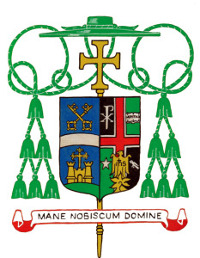
The Most Reverend Edward K. Braxton, Ph.D., S.T.D.
Diocese of Belleville
Sermon:
Fifteenth Sunday in Ordinary Time,
July 11, 2021,
St. Luke Parish, Belleville
“Healing the Sick”
(This is the text as originally written. During the actual delivery, some passages were omitted and other comments were added spontaneously. Nota bene: This text has not been thoroughly proofread. Therefore, there may be errors in spelling, grammar and punctuation.)
Dear Sisters and Brothers in Christ:
When I was pastor of St. Catherine of Siena parish in Oak Park, Illinois, there was a 68-year-old widower, retired with adult children, who had terminal metastatic colon cancer. The doctors told his family there was absolutely no hope. But his family prayed day and night that he would be healed. After about three months the doctors could find no cancer and could not explain the remarkable recovery. About a year and a half later, there was a very similar case of a 34-year-old woman, with three young children and a disabled husband, who had terminal metastatic colon cancer. Her doctors told her family there was absolutely no hope. But her family prayed day and night that she would be healed. However, after about four months, the woman died.
These families knew each other, and many parishioners knew them as well. Some asked why was one person was healed by prayer and the other person was not, since both were faith-filled families? Some said, were not the small children and their ailing father in more need of a “cure” than the older man living in retirement? Another person said, maybe the family of the woman did not pray “hard enough.” Or perhaps God simply decided to show more mercy to the widower. Others said maybe the man was not “cured” or “healed” at all. He was just the lucky one in five million who recovered from terminal cancer. Some parishioners asked: what is the difference between the Sacrament of the Sick and faith healings? Why do we almost never hear of gravely ill people recovering after they are anointed in this sacrament and yet, we seem to hear often of gravely ill people regaining their health through “faith healing,” especially among Protestants? Does the Church teach us to hope for physical recovery from life threatening sickness when we receive the Sacrament of the Sick, or does the Church teach us that this sacrament simply helps us to face serious illness and death with inner peace and confident hope? Do Protestants have more faith in the power of God to intervene and heal the sick than Catholics do?
* * * * *
Belleville Bishop Edward K. Braxton opens up about the ‘racial divide’ in the Roman Catholic Church

Belleville Bishop Edward K. Braxton opens up about the ‘racial divide’ in the Roman Catholic Church
- Jesse Bogan
- Jul 4, 2021
BELLEVILLE — The Most Rev. Edward K. Braxton, one of the few African American bishops in the Roman Catholic Church, rarely talks to the press. He says he doesn’t live in a “yes or no” world, and instead makes statements in pastoral letters and other writings.
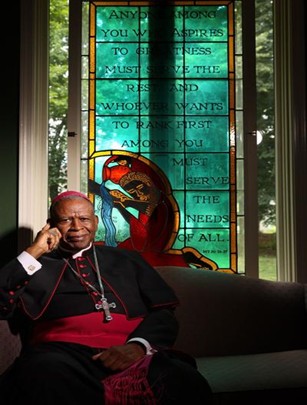
Belleville Bishop Emeritus Edward Braxton poses in the Thomas More room of his home on Thursday, July 1, 2021, beneath a verse from the Book of Matthew in stained glass.
Braxton sat down with the Post-Dispatch to discuss his new book, "The Church and the Racial Divide," and his experience as one of few African American Roman Catholic bishops. Photo by Christian Gooden, This email address is being protected from spambots. You need JavaScript enabled to view it.
“My thinking is more nuanced than something you put on the 5 o’clock news,” said Braxton, 77. “I write as I speak. I have a moving viewpoint from many experiences.”
His parents, Baptists from Mississippi, migrated to the south side of Chicago in 1941. Catholic schools motivated their conversion. Braxton said he went on to be the only African American in his graduating class at a high school preparatory seminary. There, he chose Aristotle over basketball.
Ordained a priest in 1970, he became a post-graduate student in Belgium, earning doctoral degrees in theology and religious studies. He taught at Harvard, the University of Notre Dame and other places but ultimately realized he wouldn’t be happy as a priest “exclusively focused on the life of the mind.”
His formal demeanor followed him to his role as a pastor and bishop. To some, he seems distant, most at ease surrounded by books and art. His ringtone is set to the Lord’s Prayer sung in Latin. Last summer, after 15 years at the helm, he became bishop emeritus of the Belleville Diocese. He’d formerly served as a bishop in Louisiana and auxiliary bishop in St. Louis.
He recently agreed to visit at length with the Post-Dispatch. The topic was his new book, “The Church and the Racial Divide,” which details some of the things he’s been thinking about all these years. He wrote that clergy sex abuse has been the greatest crisis in the history of the Catholic Church in the United States since he was ordained, followed by the “reticence to speak up in the public square about systemic racial bias in society and in the practices of the church.”
He makes the latter argument across 208 pages dedicated to African American Catholics, “who, remarkably, have remained steadfast in their commitment to the Catholic Church, even though the racial divide continues to manifest itself within the church in many ways to this day.”
Q: Why did you name your book, “The Church and the Racial Divide” instead of “The Church and Racism”?
A: The racial divide is much more complex and widespread. The racial divide embraces the vague biases and negative feelings that many people have toward people of other races that are not hatred, that would not lead to violence or harming people. All people, unconsciously live with bias — religious, racial, sexual, social — but it would never be acted out in attacks on individuals or groups. Racism, to me, is overt. The overt psychological and mental attitude of “I hate those people. I wish them harm.” I have much more to say about this.
Q: What was it about the Michael Brown shooting that motivated you to write this book?
A: It simply provided an occasion for me to organize things that I’ve been thinking for many years. It wasn’t the first time I heard of a bad, painful story about an altercation between an African American man and a police officer that resulted in the death of a young person. I’ve heard many of those. My experience goes back to Emmett Till and beyond, but it became the occasion for me to take the time and organize my thoughts in a way to be of service to the church.
Q: Your book mentioned personal instances of being stopped and questioned for walking and driving through white neighborhoods. Why not say when and where this happened?
A: It’s just meant to be an instance to make the reader aware that I know where I speak. I could have written the whole book on personal experiences of unkind things said and done to me and my family. I never would write such a book.
Lord, I Am Not Worthy: The Bishops and the Eucharist
His Excellency,
The Most Reverend Edward K. Braxton, Ph.D., S.T.D.
Diocese of Belleville
Sermon:
Thirteenth Sunday in Ordinary Time,
June 27, 2021,
St. Luke Parish, Belleville
“Lord, I Am Not Worthy: The Bishops and the Eucharist”
(This is the text as originally written. During the actual delivery, some passages were omitted and other comments were added spontaneously. Nota bene: This text has not been thoroughly proofread. Therefore, there may be errors in spelling, grammar and punctuation.)
Dear Sisters and Brothers in Christ:
“Here comes everybody!”
In Finnegans Wake, his last and most difficult novel, James Joyce, the great Irish Catholic writer, described the Catholic Church with those words, “Here comes everybody!” The Catholic Church is indeed a vast community, the people of God on every continent, with many saints and more than a few sinners, with believers who hold firmly to Catholic teachings and others who question or doubt those teachings, with members who are quick to judge the moral conduct of others and members who focus instead on living Christ’s mandate to love God with our whole being and love our neighbor, that IS every living soul, as we love ourselves.
This love that we are to have for one another clearly means that we must respect the dignity and value of every human person and every human life, even the lives of people with whom we vehemently disagree, the marginalized, the terminally ill, AND the unborn!
Today’s scripture teaches the “everybody” who constitute the Church that God is the God of Life. Our first reading from the Book of Wisdom declares paradoxically “God did not make death, nor does He rejoice in the destruction of the living. For He fashioned all things that they might live.” These words are reinforced by Mark’s gospel story: Jairus, one of the synagogue officials, pleaded with Jesus, “My daughter is at the point of death. Please, come lay your hands on her that she may live.” But, his daughter died. Later, Jesus entered the room where the child’s body was. He took her by the hand and said, “Talitha koum,” “Little girl, arise!” The girl arose immediately and walked around. All the people were utterly astounded! God is the God of Life.
The Catholic Church in the United States was in the news last week because of the ZOOM meeting of the more than 300 members of the United States Conference of Catholic Bishops. Since the media generally find it difficult to understand the teachings and structures of the Catholic Church, it was not surprising to read incorrect headlines like: “The conservative right wing of the bishops out-maneuvered the liberal left wing of the bishops and voted to approve a statement denying Holy Communion to prominent Catholics who support a mother’s right to an abortion, over the objection of Pope Francis.”
There should be no so-called conservative “left wing” of the Church. There should be no so-called liberal “right wing” of the Church. The Church, like the birds of the air, can only fly with both wings. There is only one Church. “Here comes everybody!”
Let All Mortal Flesh Keep Silence: A Reflection on Christian Marriage and the Real Presence
His Excellency,
The Most Reverend Edward K. Braxton, Ph.D., S.T.D.
Diocese of Belleville
Sermon:
Corpus Christi: The Solemnity of the Most Holy Body and Blood of Christ
June 6, 2021,
Queen of Peace Parish, Belleville
“Let All Mortal Flesh Keep Silence: A Reflection on Christian Marriage and the Real Presence”
(This is the text as originally written. During the actual delivery, some passages were omitted and other comments were added spontaneously. Nota bene: This text has not been thoroughly proofread. Therefore, there may be errors in spelling, grammar and punctuation.)
“Let All Mortal Flesh Keep Silence,
And with fear and trembling stand;
Ponder nothing earthly-minded,
For with blessing in his hand,
Christ our God to earth descendeth,
Our full homage to demand.”
Dear Sister and Brothers in Christ:
This hymn, “Let All Mortal Flesh keep Silence,” was composed in Greek in Anno Domini 275 as a Cherubic Hymn for the Offertory of the Divine Liturgy of St. James. For more than 1,740 years, this remarkable hymn, with its exquisite melody, has been an expression of Catholic awe and wonder before Christ’s gift of His Body and Blood in the Eucharist. Today, the Church celebrates the feast of Corpus Christi, the Solemnity of the Most Holy Body and Blood of Our Lord Jesus Christ.
The gospel of Mark has just reminded us of this sublime gift.
“While they were eating,
Jesus took bread, said the blessing,
broke it, gave it to them, and said,
‘Take it; this is my body.’
Then He took a cup, gave thanks, and gave it to them,
and they all drank from it.
He said to them,
‘This is my blood of the covenant,
which will be shed for many.’”
The reading from the Letter to the Hebrews expresses the power of the Eucharist.
“How much more will the blood of Christ,
who through the eternal Spirit offered Himself unblemished to God,
cleanse our consciences from dead works
so that we may worship the living God.”
The gift of the Real Presence of Christ is a mystery beyond our comprehension. It is a gift we must never take for granted. It is a living gift of divine love. Therefore, we must never allow ourselves to fall into irreverence in the presence of the Eucharist. We should never receive the Eucharist without fasting from food and drink. We should never receive the Eucharist chewing gum or with soiled hands. We should never leave our places and walk about the church for any reason when the words of consecration are being proclaimed. We should be kneeling in silent adoration. When Catholics celebrate the mysteries by which we are reborn, in word and sacrament, the life, death and resurrection of Jesus Christ are re-presented. In the Eucharist, Christ Himself is present under the appearance of bread and wine, for those who believe.
“King of kings, yet born of Mary,
As of old on earth he stood,
Lord of lords, in human vesture,
In the body and the blood;
He will give to all the faithful
His own self for heavenly food”.
We Catholics regularly speak of the “Real Presence” of Christ in the Eucharist. But what does this “presence” mean? Is it merely subjective? Something in our minds or imagination? Is it some type of scientific wonder that can be seen with a microscope? The Sacramental Presence of Christ in the Eucharist is more than a reminder of His words and deeds, more than a symbol. He tells us this presence is REAL. “This IS my body!” “This IS my blood!”
Why Are You Standing There Looking Up?
His Excellency,
The Most Reverend Edward K. Braxton, Ph.D., S.T.D.
Diocese of Belleville
Sermon:
The Solemnity of the Ascension of the Lord,
May 15, 2021,
Blessed Sacrament Parish, Belleville
“Why Are You Standing There Looking Up?”
(This is the text as originally written. During the actual delivery, some passages were omitted and other comments were added spontaneously. Nota bene: This text has not been thoroughly proofread. Therefore, there may be errors in spelling, grammar and punctuation.)
Dear Sisters and Brothers in Christ:
Where did He go? This is the first question young children ask me when I tell them about the mystery of the Ascension of the Lord, which we celebrate today. When He was lifted up into the clouds, where did He go? Because of the imagery in scripture, the children think, Jesus must have been lifted up and carried through space to some distant place. The question “Where did He go?” is not easy to answer for children or for adults. If the risen Lord was not taken to some distant “place” in the universe when He was lifted up, where did He go? Obviously, He did not go to some physical place to which we could travel on the latest spacecraft. We must remember that at the time of Christ, people believed that the earth was like a flat table. The moon, the sun and the stars were above the table and above that was the realm of water, and above that, God and the angels dwelled. So, it was common to refer to God as living UP in Heaven! “He was lifted up” means that Jesus returned to the Father and the Holy Spirit, who sent Him. (Similarly, when the Gospel states that the ascended Lord “took His seat at the right hand of the Father,” this is not to be taken literally. He is being compared to a royal prince, the heir to his father’s throne, who sits at his father’s right side as one equal to his father in dignity and power.)
For the past seven weeks we have been meditating on Jesus’ death, resurrection, ascension, and his sending us the Holy Spirit. We began to celebrate this mystery during Holy Week, the Sundays of Easter, the mystery of the Ascension, which we celebrate today, and the coming of the Holy Spirit which we celebrate next week on Pentecost Sunday. In a very real sense the Resurrection of Jesus, the Ascension of Jesus, and Jesus sending His followers the gift of the Holy Spirit on Pentecost are all part of one dense three-fold mystery. If we really understand this three-fold mystery, we realize that the Resurrection, Ascension and Pentecost have a far greater religious significance than the birth of Jesus. This may be why the biblical account of the birth of Jesus, found only in Luke and Matthew, were written AFTER the rest of the gospels and added as a kind of prologue.
Luke tells us about the ascension in today’s reading from the Acts of the Apostles. “In the first book, Theophilus (a name which simply means “one who loves God”), I dealt with all that Jesus did and taught until the day he was taken up, after giving instructions through the Holy Spirit. He told the apostles not to leave Jerusalem, but to wait for “the promise of the Father.” “In a few days you will be baptized with the Holy Spirit. You will receive power when the Holy Spirit comes upon you, and you will be my witnesses in Jerusalem, and to the ends of the earth.” When He had said this, Jesus was lifted up, and a cloud took Him from their sight. Suddenly, two men dressed in white garments said, “Men of Galilee, why are you standing there looking up?” Notice just as there were men or angels in white garments at the empty tomb, so, at the moment of the Ascension, there are “men in white garments” who always symbolize the divine presence.
The ascended Christ remains with the Apostles, urging them to preach His Good News of salvation, peace, justice and reconciliation.
“Why are you standing there looking up?”
What Does “Happy Easter” Mean?
His Excellency,
The Most Reverend Edward K. Braxton, Ph.D., S.T.D.
Diocese of Belleville
Sermon:
Easter Sunday,
April 4, 2021,
The 53rd Anniversary of the Brutal Murder of The Reverend Dr. Martin Luther King, Jr.
St. Luke Parish, Belleville
“What does “Happy Easter” Mean?”
(This is the text as originally written. During the actual delivery, some passages were omitted and other comments were added spontaneously. Nota bene: This text has not been thoroughly proofread. Therefore, there may be errors in spelling, grammar and punctuation.)
Dear Sisters and Brothers in Christ:
- The Requirements for a Happy Easter.
“Happy Easter!” To many people this traditional Easter Sunday greeting is a cheerful, upbeat message that usually means, “Enjoy your “holiday” with family and friends!” “Have a great Easter dinner and have fun with your children and grandchildren as they open their Easter baskets.” Or, “Winter is over, Covid-19 vaccines are available, so get out into the sunshine on this beautiful spring day!”
Strangely enough, for many Christians, the expression “Happy Easter!” ignores the fact that these “holidays” are actually Holy days. There is no way for a committed Christian to have a happy Easter if they ignore the meaning of this day. If you want your Easter celebration to be truly happy, this is what you must do: think and pray seriously about the words of the Creed which we proclaim most Sundays: “For our sake He was crucified, suffered, died, and was buried. He rose again on the third day in accordance with the scripture.” And a few lines later, “I look forward to the resurrection of the dead and the life of the world to come.”
We say “happy Easter” year after year, rarely thinking deeply about the resurrection. On Easter Sunday, do we ever ask ourselves, our wives, our husbands, our children, and our fellow parishioners: What do we think the resurrection really is? We seldom ask: What is the relationship between our hope for “the life of the world to come” for ourselves and for our loved ones and the resurrection of Christ?
Since we Christians tend to take our faith for granted, “Happy Easter” does not usually mean: “If you want your Easter to be happy, sit down with your New Testament and carefully and prayerfully study the Easter story. IF you did that, the first startling thing you would notice is that neither St. Paul’s letters, nor the four gospels, actually describe the resurrection. The only thing the scriptures say is: 1.) Jesus was crucified. 2.) He died and was buried. 3.) Holy women went to anoint Jesus’ body and found the empty tomb. Either a man or an angel tells the women: “Jesus has been raised.” 4.) The risen Lord appears to a small number of his followers. Listen again to what we heard from Mark, the oldest gospel narrative:
“When the sabbath was over, Mary Magdalene, Mary, the mother of James, and Salome bought spices so that they might go and anoint Jesus’ body. On entering the tomb, they saw a young man sitting on the right side, clothed in a white robe, and they were utterly amazed. The young man said, “Do not be amazed! You seek Jesus of Nazareth, the crucified. He is not here. He has been raised. (Mark 16,1-7)
According to the scriptures. only about five hundred disciples experience apparitions of the Risen Lord. The risen Christ is NOT seen by anyone who does not ALREADY believe Him to be the Messiah. Pontius Pilate, King Herod, the Roman Soldiers at the tomb, the leaders of the Jewish people who rejected Him, the crowds of Jewish people filling the street of Jerusalem for Passover. NONE of THEM see the Glorified Christ! Why not? Wouldn’t the testimony of unbelievers be more powerful than the testimony of believers? If the Risen Christ had appeared to emperor Tiberius Caesar in Rome, the emperor could have commanded the entire Roman empire to embrace the new faith. But, the Risen One did not appear to the emperor. He was only seen by those with eyes of faith. Let me remind you of what we heard Luke say in the Acts of the Apostles:
“God anointed Jesus of Nazareth with the Holy Spirit and power. He went about doing good for God was with Him. They put Jesus to death by hanging Him on a tree. This man God raised on the third day and granted that He be visible, NOT to all the people, but only to us, the witnesses chosen by God. He commissioned us to preach to the people and testify that He is the one appointed by God as judge of the living and the dead.” (Acts 34,37-43)
The Bible’s complete silence about the actual resurrection of Jesus makes it clear that we are dealing with something completely different from the resuscitation of a dead body, as with the raising of Lazarus. We are dealing with the transformation, transfiguration and glorification of Christ that is utter mystery. The resurrection is the wondrous work wrought by the God who IS God, dwelling in unapproachable light. The resurrection is a wonder that can only be experienced in the community of faith. Without that faith, a truly “happy Easter” is not possible for a Christian. It cannot be proved, not even by The Shroud of Turin! Neither CNN’s Wolf Blitzer nor Fox News’ Chris Wallace could have covered the actual resurrection for a television audience. The resurrection of Christ was not a “news event” in the same sense that the election of the President was a “new event.”
Yet, faith in the resurrection was the source of the hope of the earliest Christians. The resurrection of Jesus Christ is the radical source of our own hope as Christians that we, too, are called to share in the Lord’s resurrection and thereby experience a happy, or better, a blessed Easter.
We Would Like to See Jesus
His Excellency,
The Most Reverend Edward K. Braxton, Ph.D., S.T.D.
Diocese of Belleville
Sermon: Fifth Sunday of Lent, March 21, 2021
St. Teresa Parish, Belleville
Queen of Peace Parish, Belleville
“We Would Like to See Jesus”
(This is the text as originally written. During the actual delivery, some passages were omitted and other comments were added spontaneously. Nota bene: This text has not been thoroughly proofread. Therefore, there may be errors in spelling, grammar and punctuation.)
Dear Sisters and Brothers in Christ:
“Sir, we would like to see Jesus.” Today’s gospel tells us that “some Greeks” approached the apostle Phillip and told him, they wanted to see Jesus. Perhaps they approached Phillip because, he too could speak Greek, whereas Jesus only spoke Aramaic. But why would “some Greeks,” come to town for the Passover, want to see Jesus? Could it be because of the amazing stories they have heard about Him?
People say He turned water into wine. He drove the money changers from the temple. He healed the paralytic. He fed 5,000 with a few loaves of bread and a couple of fish! He even walked on water. He promised the Samaritan woman living waters bubbling up with eternal life. He gave sight to the man who was blind from birth. AND! Most startling of all, He is said to have raised Lazarus, from the dead.
So, Philip and Andrew go to Jesus and tell him there are “some Greeks” in town who want to see Him. Notice, Jesus doesn’t ask, “Why do they want to see Me?” He doesn’t say, “I am too busy to see them.” Nor does He say, “Maybe I can squeeze them in after breakfast tomorrow?” NO, Jesus responds in a way that makes us think he did not hear the request. “The hour has come for the Son of Man to be glorified. Amen, I say, to you ‘Unless a grain of wheat falls into the earth and dies, it remains just a single grain; but if it dies, it bears much fruit.’” Phillip and Andrew might have asked, “Well, Jesus, are You going to see these Greeks or not?” The gospel writer and Jesus seem to ignore the curiosity of the Greeks. Instead, they confront us with what “seeing” Jesus really means. Jesus Himself is the grain of wheat who must fall to the earth and die only to bear much fruit. Using a common symbol from nature and local farmers, Jesus proclaims that His death is just days away. But, paradoxically, His death will lead to transcendent life. The abundant fruit is the work of the Holy Spirit giving life to the Church. (Christ has died! Christ has risen! Christ will come again!)
Jesus of Nazareth’s message to the Greeks is his message to you and to me. If you really want to see Jesus, we must put aside our idle curiosity about a wonder worker. “The way to see Me is to model your lives on My teachings, so that you, like the grain of wheat, may fall to the earth and participate in the mystery of My resurrection, by dying to your selfish ways.
************
African American Catholics and “The Black Church”
African American Catholics and “The Black Church”
(A presentation for the Berkley Forum on “the Black Church” in American Public Life)
By
The Most Reverend Edward K. Braxton, Ph.D., S.T.D.
Are African American Catholics considered part of what is popularly called “the Black Church”? In most instances, it would seem we are not. When you hear about the leadership of “the Black Church” impressing for racial and social justice, you are likely to think of the Reverend Senator Raphael Warnock, until recently the Pastor of the Reverend Dr. Martin Luther King, Jr.’s Ebenezer Baptist Church in Atlanta and now, the first African American Senator from Georgia. And when you think of African American Catholic parishes, you are more likely to think of parishes served by White Priests. “The Black Church” is not a single Christian community. The expression usually describes a collective of African American Christians in certain Protestant Christian communities. (An African American “high church” Episcopalian, for example, is quite different from an African American “low church” Jehovah’s Witness.) Because the 3 million African American Catholics are a very small number of the 68-million-member Roman Catholic Church in the United States, we seem invisible to many who speak about “the Black Church.” Most African American Christians are Baptists (though not Southern Baptists). Many are members of the African Methodist Episcopal Church. The AME has about 2.5 to 3 million members including a significant number of communities in Africa. Many African American Protestants would be surprised to learn that the approximately 3 million African American Catholics is equal to and possibly larger than the AME membership in this country. And yet, African American Catholics are often not mentioned in conversations about “the Black Church.” Is this because the Catholic Church is such a large world-wide community of faith? Is it because of the Church’s shameful past history of racial discrimination in this country? Is it because some Catholic beliefs are not compatible with the positions held by some Christians who identify with “the Black Church”? Or, is it because the Euro-centric style of Catholic liturgy is so starkly different from the Afro-centric style worship experienced in African American Protestant churches? These difficult questions are not easily answered.
"The Ten Commandments and the True Meaning of Lent"
His Excellency,
The Most Reverend Edward K. Braxton, Ph.D., S.T.D.
Diocese of Belleville
Sermon: Third Sunday of Lent, March 7, 2021
St. Teresa Parish, Belleville
“The Ten Commandments and the True Meaning of Lent”
(This is the text as originally written. During the actual delivery, some passages were omitted and other comments were added spontaneously. Nota bene: This text has not been thoroughly proofread. Therefore, there may be errors in spelling, grammar and punctuation.)
Dear Sisters and Brothers in Christ:
When I was twelve years old, I went to downtown Chicago by myself, for the first time, to see Cecil B. DeMille’s new motion picture, “The Ten Commandments.” I had heard about it on television and I was struck by Elmer Bernstein’s powerful music score, the dramatic images of massive Egyptian architecture and Charlton Heston’s towering performance bringing the biblical story of Moses and the Law to life. I was so impressed by this nearly four-hour biblical epic that the following week I returned to see the film again with my Aunt Ella, a devout Baptist, who knew whole passages of the Bible by heart. As we watched the movie’s portrayal of the struggle between Moses and Pharaoh Ramses II (imposingly portrayed by Yul Brenner), the exodus of the children of Israel from Egypt, the parting of the Red Sea, and the fiery scene on Mt. Sinai where Moses receives the commandments on tablets of stone, “written with the finger of God,” my Aunt Ella would whisper to me which scenes were actually from the Bible and which ones were from the vivid imagination of Mr. DeMille and his script writers.
After the three hour and thirty-nine minute long film, we were hungry. So, my aunt took me to dinner. We continued to discuss what at the time was the most expensive movie ever made. I was full of questions: “Did the Nile River really turn to blood?” “Did the children of Israel literally walk through high walls of water in the Red Sea?” “Did Moses actually hear the voice of God saying, “I am that I am” from the burning bush?” “Did God actually carve the commandments into the granite walls of Mt. Sinai with a fiery finger?” Sensing my deep curiosity about the Bible text, my aunt decided to teach me about the book of Exodus from her well-worn Baptist Biblical Commentary. I still remember some of the insight I gleaned sitting each Saturday morning with my aunt and my Bible at her kitchen table.
My aunt explained that, while some of the wondrous events in the story of The Ten Commandments might be literally true, others may be symbolic, since the writers might use bold images, metaphors and hyperbole to convey their belief that the deliverance of the children of Israel from bondage was the “mighty work” of God.
She pointed out that, in Exodus (17:3-7), the commandments are much longer and there are actually more than ten. Further, she explained, in the original language, each of The Ten Commandments is directed to each of us individually not to a group. The “you” in “You shall not” is “you” the individual, not “you” a group. This makes clear that God is declaring that it is the personal responsibility of each one of us to live by these commandments each day.
She also taught me that in the Gospels Jesus teaches that “Love God with your whole being and Love your neighbor as yourself” are the greatest commandments. Yet, they are NOT mentioned as two of The Ten Commandments. But, she explained, The Ten Commandments are actually the application of these two great commandments. She stressed that the whole point of the Exodus story is that the commandments should be carved in our heart and our consciences and not merely in stone.
Aunt Ella agreed completely with her commentary’s statement that The Ten Commandments are called commandments for a reason. They are NOT recommendations. They are not suggestions. They are not requests. They are commands! (Do this! Don’t do that!) This is clearly not a very appealing idea in our secular, pluralistic, almost post-Christian age. Many people today argue that human conduct is completely up to the individual. “If you want to live by The Ten Commandments, you are free to do so. But don’t try to impose beliefs and morality from another age on me.”
Shortly before my Aunt Ella died, fully lucid at ninety-one, she gave me her Bible, which she had had for 70 years; it had notations on almost every page. She also gave me her prized Baptist Biblical Commentary, from which she taught me so long ago. I still have her Bible and her Commentary!
Aunt Ella’s commentary compared The Ten Commandments to the maker’s handbook for a complex new car. The maker’s handbook tells you how to take care of your car properly so that you can enjoy it safely for many years. If you do not follow the new car manual, you will surely have problems with the car. The commentary argues that The Ten Commandments are God, the creator’s handbook for people. They tell us how to live good, happy lives, helping us to make the world a better place and preparing us for life beyond this world. The commentary says that in today’s world many people do not believe that the commandments are the manufacturer’s handbook for humanity. They believe the commandments are simply the product of an ancient culture and once-accepted moral precepts of a far away place.
“The Leap of the Heart: George Washington, Abraham Lincoln and the Journey of Lent”
His Excellency,
The Most Reverend Edward K. Braxton, Ph.D., S.T.D.
Diocese of Belleville
Sermon: First Sunday of Lent, February 21, 2021
St. Luke Parish, Belleville
“The Leap of the Heart:
George Washington, Abraham Lincoln and the Journey of Lent”
(This is the text as originally written. During the actual delivery, some passages were omitted and other comments were added spontaneously. Nota bene: This text has not been thoroughly proofread. Therefore, there may be errors in spelling, grammar and punctuation.)
Dear Sisters and Brothers in Christ:
I.
Tomorrow, February 22, is the 289th birthday of George Washington, who was born in 1732 in Popes Creek, Virginia. Abraham Lincoln was born February 12, 1809 in Hodgenville, Kentucky, 212 years ago. Since 1971, Americans have commemorated the births of our 1st and our 16th presidents on the third Monday of February. The primary impact of reducing their birthdays simply to “Presidents Day” has been that almost no one thinks of these two flawed giants of American history at all. Last week, we simply had a long holiday weekend and, were it not for the pandemic, a time for more shopping. There is little evidence that many Americans spend time learning about these towering chief executives on their birthdays.
Since the day honoring these iconic presidents always falls near Ash Wednesday, the beginning of Lent, it might be helpful to explore some of their views on religion and Christianity. Both men faced personal and political challenges that might have been illuminated by the light of faith and the teachings of Jesus.
We know George Washington was a member of the Anglican Church and a Mason. We also know he was very private about his religious beliefs. Unlike Thomas Jefferson, Benjamin Franklin and John Adams, Washington never wrote anything about his beliefs concerning God, Jesus Christ or Christianity.
The first president encouraged his fellow Americans to go to church regularly, but he himself was not a regular church goer. He served as a dedicated vestreman and a church warden, but he usually left services early without receiving Holy Communion. In his writings, Washington often made reference to “Divine Providence,” but he rarely mentioned God and he never referred to Jesus Christ. Some biographers argue that Washington was a deist who did not believe in a personal God. Thomas Jefferson said George Washington did not believe in what he called “the system of Christianity.” (The famous story of the first president “kneeling” in prayer at Valley Forge is probably not true since historians believe that when Washington prayed, he always remained standing.)
For 56 years, Washington maintained hundreds of enslaved free human beings at his plantation, Mount Vernon. Many commentators believe that he struggled with the practice of enslaving African people, perhaps because of his Christian background.
But, it was only in his will that he stated that, upon his death, his “slaves” should be freed. However, only one was actually freed. The rest remained in bondage for decades after Washington’s death. One may ask: If George Washington understood the commandment of Jesus of Nazareth to love God with our whole being and to love our neighbors as ourselves, he might have experienced the leap of the heart born of Lenten Love. He would have seen the absolute moral contradiction between “owning” free human beings and authentic Christianity.
Abraham Lincoln was apparently one of the deepest thinkers to occupy the White House. He was a deeply spiritual man but he had little interest in organized religion. As a young man, Lincoln seemingly lost interest in Christianity after seeing how excessive emotion and bitter sectarian quarrels marked yearly camp meetings and the ministry of traveling preachers. Like Washington, Lincoln enjoyed reading the works of deists. But, when accusations of hostility to Christianity almost cost him a congressional bid, Lincoln began to keep his unorthodox beliefs to himself. One biographer said “Lincoln’s views on Christianity were not orthodox: He held opinions utterly at variance with what Christians heard in their churches.”
But after being accused of being anti-Christian by a political opponent, Lincoln wrote: “I have been called an open scoffer at Christianity. That I am not a member of any Christian Church, is true; but I have never denied the truth of the Scriptures; and I have never spoken with intentional disrespect of religion in general, or of any denomination of Christians in particular.” (July 31, 1846, Handbill to the Voters of the Seventh Congressional District)
We know that one aspect of Lincoln’s parents’ Calvinist religion that he embraced was the "doctrine of necessity," or predestination. Belief in predestination seemed to influence much of President Lincoln’s thinking about the unfolding tragedy of the Civil War.
Because he penned the Emancipation Proclamation, which began the process of ending slavery, Lincoln has been called “the Great Emancipator” with many citing his statement “I have always hated slavery, I think as much as any Abolitionist. As I would not be a slave, so I would not be a master. This expresses my idea of democracy.” (Lincoln-Douglas Debate, August 1, 1858)
However, many Americans might be surprised to learn that this visionary leader, who was certainly not an abolitionist, was a product of the widely-held views concerning “white supremacy” of his day. He said, “I will say then that I am not, nor ever have been in favor of bringing about in anyway the social and political equality of the white and black races — that I am not nor ever have been in favor of making voters or jurors of negroes, nor of qualifying them to hold office, nor to intermarry with white people; and I will say in addition to this that there is a physical difference between the white and black races which I believe will forever forbid the two races living together on terms of social and political equality. And inasmuch as they cannot so live, while they do remain together there must be the position of superior and inferior, and I, as much as any other man, am in favor of having the superior position assigned to the white race. I say upon this occasion I do not perceive that because the white man is to have the superior position the negro should be denied everything.” (Lincoln-Douglas Debate, September 18, 1858)
Therefore, as with President Washington, President Lincoln’s life work might have been made even more extraordinary, if he had grasped the “Law of Love” of Jesus Christ. He might have experienced the leap of the heart born of Lenten Love, which would have compelled him to go against the tide by affirming the dignity and equality of every human person.
On March 4, 1865, in his second inaugural address, President Lincoln gave us food for thought for this Lent after a season of traumatic political conflict: “With malice toward none; with charity for all; with firmness in the right, as God gives us to see the right, let us strive on to finish the work we are in; to bind up the nation’s wounds; and to do all which may achieve and cherish a just, and a lasting peace among ourselves.”
This very small glimpse into the religious attitudes of George Washington and Abraham Lincoln remind us that these men were indeed MEN, not paintings in the White House, not mere etchings on the one and five dollar bills. They were real, live human beings on spiritual journeys, on the road to conversion, just as you and I are. Though neither of them was a member of the Catholic Church, they each experienced spiritual challenges of Lent in their own way.
“The Journey of Conversion”
The Most Reverend Edward K. Braxton, Ph.D., S.T.D.
Diocese of Belleville
Third Sunday of the year, sermon January 24, 2021 at St. Teresa Catholic Church, Belleville, IL
Dear Sisters and Brothers in Jesus Christ:
I.
Tomorrow the Church celebrates the conversion of St. Paul. As you know Saul, a staunch defender of the Jewish faith against the new Christian heresy, was on the road to Demascus, where he was working to close down the Christian sect, when he is thrown from his horse and blinded. He heard an unknown voice, “Saul, Saul, why are you persecuting me?” “Who are you?” “I am Jesus whom you are persecuting!” Saul never met Jesus in person, although he later insisted that he should be called an apostle.
Saul was instructed in the teachings of Jesus by Ananias. Saul became Paul, the apostle to the gentiles. He travelled the Mediterranean world and wrote numerous letters to Christian communities. His teachings were focused almost exclusively on the suffering, death, and resurrection of Jesus, and details for Christian living. Paul has very little to say about the personal life and teachings of Jesus. In many ways, he was the Church’s first theologian. He so influenced the development of early Christian thought that some secular commentators have called him the true founder of Christianity, noting that Jesus never traveled beyond the Jewish world and he never wrote any documents that have survived. Paul was beheaded in Rome around the same time Simon Peter was crucified. (Since Paul was a citizen of Rome, crucifixion was beneath his dignity.)
St. Paul’s dramatic instantaneous conversion (knocked from his horse, blinded, personal vision of Jesus Christ) is what many people today mean by conversion or “being saved.” Before the pandemic, when I traveled often by plane wearing my Roman collar, passengers would sometimes ask me if “I was saved.” By that they usually meant, did I know Jesus Christ as my personal savior. And could I, like Paul, tell them the day and the time of my conversion when I was saved. If I said, I was a baptized, committed Christian and that I strive to live by the teachings of Christ, and I hope I will share in the salvation promised by Christ – this was usually challenged. “Either you are saved or you are not saved! If you have been saved it is once and for all. So even if you sin over and over again, if you have been saved, your place in heaven is secure!” Some people think conversion is exclusively a dramatic encounter with Christ, in which we confess our sins. Others, think salvation is not so much a single event as it is a gradual lifelong process. During that lifelong process there may be particular events that are spiritual high points, but they do not guarantee eternal salvation. Certain Protestant and Catholic theologians have had ongoing dialogues about this for generations.
A Dangerous Hour for the United States: We Must Unite Together in Prayer
The Most Reverend Edward K. Braxton, Ph.D., S.T.D.
Bishop Emeritus
Diocese of Belleville
Sermon Delivered January 17, 2021 at Blessed Sacrament Church, Belleville, IL
Dear Sisters and Brothers in Jesus Christ:
I.
This week American Catholics have reached the point where our faith and politics meet in a unique and intense way. There has always been a crossroad between the Christian faith and grave moral issues like war, capital punishment, abortion, racial prejudice, poverty, and care for the earth. But the completely unthinkable events that have overshadowed the end of one presidency and challenged the beginning of another presidency compel us to examine the startling events of each day’s news through the eyes of our Catholic faith. This is a dangerous hour for our country. We need to pray fervently for the end of violence and hostility and the renewal of civic harmony.
The month of January takes its name from the Roman god, Janus, who was said to sit on the top of the walls of the city of Rome with two heads. One head looked to the past and the other head looked to the future. And because of this unique vantage point, in January the citizens would look back on the past year and seeing their failures they would look to the coming year resolving to do better. They would make New Year’s resolutions. The custom continues to this day, even though very few of us keep our resolutions to exercise more, eat less, work harder, be kinder to others, and live our Catholic faith more genuinely. Anno domini 2021 has already begun as a turbulent, troubled year. We can each make this new journey around the sun better by making and keeping a New Year’s resolution to think and pray about the intersection between our faith and politics. We can do this by listening to the voice of God whispering in the corridors of our souls urging us to think more and learn more about the causes of the political turmoil swirling around us. Could it be that, if we listen, God is calling us to be more responsible citizens by opening our minds to learn more about the many different and opposing factions that are causing such divisions in our country?
When we hear about the Oath Keepers, the Three Percenters, Boogaloo, Proud Boys, Christian extremists, Militias, Nationalists, Neo-Nazis, militant racists, anti-Semitic groups and domestic terrorists, do we reflect as committed Catholics on our responsibility to learn what these groups are about? When people on the evening news say they are part of Q-Anon and they believe the President is protecting America from a cabal of Satanists and pedophiles, do you study the matter to find out if this is indeed true?
Have you ever thought that you might become a better American Christian by studying the Constitution, the Declaration of Independence, the Bill of Rights and key supreme court decisions? Could God be summoning us to free ourselves from closed minded thinking, as conservatives, liberals, republicans, democrats, independents, and people who never vote at all?
Bishop Braxton to Deliver Keynote Address at Louisville Conference on the Racial Divide
Bishop Edward K. Braxton, Bishop Emeritus, is scheduled to deliver the Keynote Address at the Call from the Mountain: A Pilgrimage for Racial Justice gathering hosted by the Archdiocese of Louisville and Modern Catholic Pilgrim on Saturday, October 17, 2020. The event, sponsored by the Archdiocese’s Office of Multicultural Ministry will be held at Thomas Merton's hermitage on the grounds of the trappiest monastery, the Abbey of Gethsemani. The day-long gathering will be focused on racial and racial harmony in American society and in the Catholic Church.
Catholic leaders in the greater Louisville area who are striving for racial justice will participate in the Conference, which, due to the coronavirus pandemic, will be live streamed to a larger audience. The Bishop will lead the dialogues during the meeting using the short stories of Flannery O’Connor and his forthcoming book, The Church and the Racial Divide in the United States.
The Bishop’s address is particularly timely because of recent events in Louisville. In March Ms. Breonna Taylor, an African American medical worker was shot and killed by Louisville police officers during a raid on her apartment. The police with a no knock warrant fired thirty shots into her apartment after being first shot at by her boyfriend, who said he thought the officers were intruders. Ms. Taylor died in the raid that was seeking illegal drugs. However, no drugs were found in the apartment. These events led to ongoing nationwide protests against what many believed to be excessive force on the part of the police. Demonstrations continued into the spring and summer as the case drew more attention. The situation was made more volatile when a grand jury recently ruled that no police officer would be charged for causing Ms. Taylor’s death.
Speaking about the conference, Bishop Braxton said, “I do not go to events like this presuming to make definitive judgments about who is right and who is wrong in the face of complex situations about which I have only partial knowledge. I go to listen and learn. I go in to hope of contributing, in some small way, to an ongoing, difficult process in an atmosphere of prayerful concern for the value and dignity of the lives of everyone involved. My writings and addresses are intended to invite individuals and groups of different racial backgrounds to enter with open minds and hearts into conversations about an important and sensitive subject without hastily judging others. The goal is to attain a greater understanding and mutual respect, and to make realistic efforts to bridge the racial divide. This can only come about by a deep interior conversion of hearts made possible by an openness to the Holy Spirit. It is, in truth, a high and distant goal.”
A National Crisis: A Pastoral Reflection on the Deadly Epidemic of Gun Violence in the United States
August 6, 2019
The Feast of the Transfiguration of the Lord
A National Crisis
A Pastoral Reflection on the Deadly Epidemic of Gun Violence in the United States
By
The Most Reverend Edward K. Braxton, Ph.D., S.T.D., Bishop of Belleville
“Your kindness should be known to all. The Lord is near. Have no anxiety at all, but in everything, by prayer and petition, with thanksgiving, make your requests known to God. Then the peace of God that surpasses all understanding will guard your hearts and minds in Christ Jesus. Finally, brothers (and sisters), whatever is true, whatever is honorable, whatever is just, whatever is pure, whatever is lovely, whatever is gracious, if there is any excellence and if there is anything worthy of praise, think about these things. Keep on doing what you have learned and received and hear and seen in me. Then, the God of peace will be with you.”
-Saint Paul, Letter to the Christians living in Philippi, 4, 5-9
(1) We are facing a national crisis in the United States. As a Catholic Bishop striving to live by and teach the good news of justice and peace proclaimed by Jesus of Nazareth, I am compelled to name this truth. It is, in some way, a crisis of gun violence. (With the exception of a bomb or chemicals, it is difficult to think of another weapon with which so many lives can be extinguished in seconds.) I say this knowing well that guns do not kill people. Hunters and those who use guns for recreation do not ordinarily kill people. The reasons for this crisis are many. The crisis is caused, in part, by a small number of gun owners who frequently abuse the firearms that are readily available to them and by the lack of consensus on the part of the American people and their elected representatives concerning how to respond to what has become a daily occurrence. It is a crisis which could explode on any given day with bloodshed and death here in southern Illinois. It is a crisis for which there is no easy solution. But, as Christians, we are obliged to be a part of the conversation and the practical efforts to address this deadly crisis. We must listen, learn, think, pray and act.
Oscar Arnulfo Romero: A Most Unlikely Saint
Óscar Arnulfo Romero: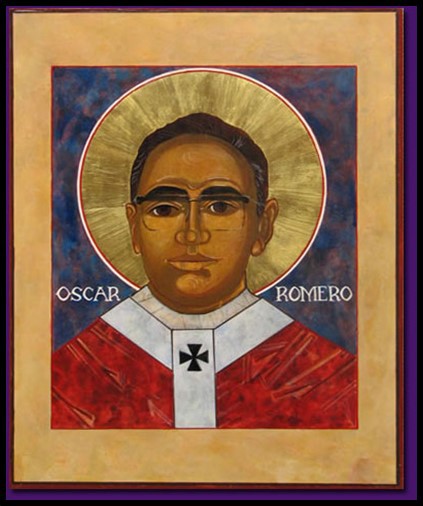 A Most Unlikely Saint
An All Saints Day Reflection, 2018
By
The Most Reverend Edward K. Braxton, Ph.D., S.T.D.
Bishop of Belleville
“How beautiful will be the day when all the baptized understand that their work, their job,
is a priestly work, that just as I celebrate Mass at this altar, so each carpenter celebrates Mass at his workbench, and each metalworker, each professional, each doctor with the scalpel, the market woman at her stand, is performing a priestly office! How many cabdrivers, I know, listen to this message there in their cabs? You are a priest at the wheel, my friend, if you work with honesty, consecrating that taxi of yours to God, bearing a message of peace and love to the passengers who ride in your cab.”
(St. Oscar Romero, The Violence of Love, November 20, 1977)
The Reverend Dr. Martin Luther King, Jr.: What If He Was Still Alive Today?
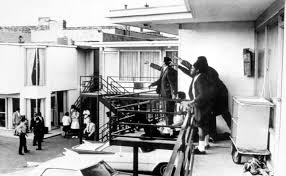
The Reverend Dr. Martin Luther King, Jr.:
What If He Was Still Alive Today?
(April 4, 1968-April 4, 2018, Fifty Years Later)
A mortally wounded Dr. King sprawled on the balcony of the Lorraine Motel as his aides point in the direction of the gunman.
"Everybody can be great, because everybody can serve. You don't have to have a college degree to serve. You don't have to make your subject and your verb agree to serve. You don't have to know about Plato and Aristotle to serve. You don't have to know Einstein's theory of relativity to serve. You don't have to know the second theory of thermodynamics in physics to serve. You only need a heart full of grace, a soul generated by love. And you can be that servant."
- Dr. Martin Luther King, Jr.
By
The Most Reverend Edward K. Braxton, Ph.D., S.T.D.
Bishop of Belleville
April 4, 2018
(This reflection is an exercise in imaginative thinking. Writing in this format allows the author to imagine possible points of view and thoughts. It does not intend to suggest, in any way, that these are actual thoughts or words of Dr. King. Hence the frequent use of phrases such as, “He might have said,” or “He might have thought.” Ultimately, the words and thoughts must necessarily be the author’s own, since Dr. King’s mighty voice has been silenced.)
ST. MARTIN DE PORRES
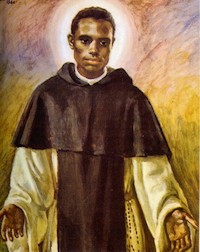 From the Desk of Bishop Braxton
ST. MARTIN DE PORRES
November 3, 2017
Dear Sisters and Brothers in Christ,
Today, the Church honors St Martin de Porres Velázquez, O.P. (December 9, 1579 – November 3, 1639), a lay brother of the Dominican Order, who was beatified in 1837 by Pope Gregory XVI and canonized in 1962 by Pope John XXIII. He is the patron saint of bi-racial people and all those seeking racial harmony. He was born in the city of Lima, Peru, the son of a Spanish nobleman, Don Juan de Porres, and Ana Velázquez, an enslaved free woman. Since his mother could not support him, he grew up in poverty.
By law in Peru, descendants of African people were barred from becoming full members of any religious order. The only route open to Martin was to ask the Dominicans of Holy Rosary Priory in Lima to accept him as a volunteer who performed menial tasks in the monastery, in return for the privilege of wearing the habit and living with the religious community. At the age of 15, he asked for admission to the Dominican Convent and was received as a servant boy.
White Supremacists Movements are Incompatible with the Law of Love
White Supremacists Movements are Incompatible with the Law of Love
By
The Most Reverend Bishop Edward K. Braxton, Ph.D., S.T.D.
Bishop of Belleville
Jesus of Nazareth, drawing on Deuteronomy 19:7-18 and Leviticus 6:4-5, teaches us the Law of Love (Matthew 22:35-40). We must love God with our whole heart and our whole being. And we must love our neighbor as we love ourselves. It is a threefold law. Love God! Love ourselves! Love our neighbor! And, in the story of the man who shows compassion to the stranger, beaten, robbed, and ignored by his countrymen (Luke 10:25-35), Jesus teaches us that our neighbor is any fellow human being of any race, nationality, religion, or social situation anywhere in the world. White Supremacists and White Nationalists movements such as Neo-Nazis, and the Ku Klux Klan, are incompatible with this Law of Love.
- The Horizon Of Possibilities "The Catholic Church and the Racial Divide in the United States: Old Wounds Reopened"
- Centenary
- Bishop Braxton Reflects on the Museum of African American History and Culture in Essay
- A Prayer of Praise For Thanksgiving Day
- There Are No ‘Minority’ Voters
- Moral Leadership in Action: All Lives Really Do Matter
- "Even Their Virtues Were Being Burned Away"
- Bishop Braxton Publishes New Pastoral Letter
- ‘Happy Easter!’ A Christmas Reflection
- Body Of St. Maria Goretti Coming To Diocese Cathedral