



His Excellency,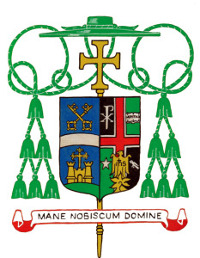
The Most Reverend Edward K. Braxton, Ph.D., S.T.D.
Diocese of Belleville
Sermon:
Corpus Christi: The Solemnity of the Most Holy Body and Blood of Christ
June 6, 2021,
Queen of Peace Parish, Belleville
“Let All Mortal Flesh Keep Silence: A Reflection on Christian Marriage and the Real Presence”
(This is the text as originally written. During the actual delivery, some passages were omitted and other comments were added spontaneously. Nota bene: This text has not been thoroughly proofread. Therefore, there may be errors in spelling, grammar and punctuation.)
“Let All Mortal Flesh Keep Silence,
And with fear and trembling stand;
Ponder nothing earthly-minded,
For with blessing in his hand,
Christ our God to earth descendeth,
Our full homage to demand.”
Dear Sister and Brothers in Christ:
This hymn, “Let All Mortal Flesh keep Silence,” was composed in Greek in Anno Domini 275 as a Cherubic Hymn for the Offertory of the Divine Liturgy of St. James. For more than 1,740 years, this remarkable hymn, with its exquisite melody, has been an expression of Catholic awe and wonder before Christ’s gift of His Body and Blood in the Eucharist. Today, the Church celebrates the feast of Corpus Christi, the Solemnity of the Most Holy Body and Blood of Our Lord Jesus Christ.
The gospel of Mark has just reminded us of this sublime gift.
“While they were eating,
Jesus took bread, said the blessing,
broke it, gave it to them, and said,
‘Take it; this is my body.’
Then He took a cup, gave thanks, and gave it to them,
and they all drank from it.
He said to them,
‘This is my blood of the covenant,
which will be shed for many.’”
The reading from the Letter to the Hebrews expresses the power of the Eucharist.
“How much more will the blood of Christ,
who through the eternal Spirit offered Himself unblemished to God,
cleanse our consciences from dead works
so that we may worship the living God.”
The gift of the Real Presence of Christ is a mystery beyond our comprehension. It is a gift we must never take for granted. It is a living gift of divine love. Therefore, we must never allow ourselves to fall into irreverence in the presence of the Eucharist. We should never receive the Eucharist without fasting from food and drink. We should never receive the Eucharist chewing gum or with soiled hands. We should never leave our places and walk about the church for any reason when the words of consecration are being proclaimed. We should be kneeling in silent adoration. When Catholics celebrate the mysteries by which we are reborn, in word and sacrament, the life, death and resurrection of Jesus Christ are re-presented. In the Eucharist, Christ Himself is present under the appearance of bread and wine, for those who believe.
“King of kings, yet born of Mary,
As of old on earth he stood,
Lord of lords, in human vesture,
In the body and the blood;
He will give to all the faithful
His own self for heavenly food”.
We Catholics regularly speak of the “Real Presence” of Christ in the Eucharist. But what does this “presence” mean? Is it merely subjective? Something in our minds or imagination? Is it some type of scientific wonder that can be seen with a microscope? The Sacramental Presence of Christ in the Eucharist is more than a reminder of His words and deeds, more than a symbol. He tells us this presence is REAL. “This IS my body!” “This IS my blood!”
Consider this example of what could be called presence. The ink on your parish bulletin is obviously on the paper. But we would not call it a real presence. The ink is not aware of the paper and the paper is not aware of the ink. This presence is only physical, with no interpersonal meaning.
Now, consider the profound example of presence in Christian marriage. A man and a woman who have never met before are sitting next to each other at the Sunday Eucharist. They have no knowledge of each other and their physical presence to one another is not real in the sense of a personal relationship. However, because they are human, spiritual beings, their presence to each other can change significantly. Let us say that after the Liturgy, they have a conversation. Eventually, they become good friends, and spend a great deal of time together. In time, they grow to love each other. They get married and have children and live out their Christian marriage with a great love for God, for one another, and for their children. What began as a mere physical presence has become personal, intimate, spiritual and REAL in a much deeper sense. As the years pass, this intimate, personal presence becomes so deep that it transcends their physical nearness. When they are hundreds of miles apart, this loving husband and wife are still present to one another at the most radical level of their beings.
After more than 60 years of marriage, one of them dies. Death brings more than physical distance. Death makes it impossible for them ever to be physically present to one another again. The surviving spouse is left with their children, grandchildren and the loved one’s personal belongings, letters, home movies, and profound memories. This husband or wife now knows what love is! When someone seeks to comfort them in their aloneness, they acknowledge that it is true that sometimes they are lonely. In one sense, they are alone. Yet, in another sense, they are not. Longing for the absent one makes them present. They may say that, at times, their beloved seems more present to them than when they lived. This presence is much more than warm memories and imagination. It is a real presence born out of the transcendent and spiritual nature of the human condition and a deeply rooted loving relationship nurtured over years when the two have become one. Does love transcend death?
A presence is real when a person is open to being affected by others and other people actually affect them. This presence is utterly different from the presence of ink on your bulletin. Because of their shared history, the depth of their love and the human spirit’s capacity to transcend itself, even in death, spouses can, at times, continue to be moved by the real presence their dear one, who has died.
Understanding the powerful reality of human, spiritual communion and presence provides us with an inadequate analogy that may make it possible for us to understand better the mystery of the Real Presence of Jesus Christ in the Eucharist. Historically, Jesus was physically present on earth for about thirty-three years. This historical, physical presence occurred a long time ago and far away. Christ’s presence in the Eucharist is not the biological body that walked on earth. Nor is it the dead body of Jesus in the tomb. It is not a “physical” presence in the ordinary sense of the term. No scientific analysis will reveal any elements of flesh and blood. This Sacramental Presence is the transformed risen body of Christ. It is important for us to remember that, in spite of the language of the liturgy, the consecrated bread is the Body and Blood of Christ, and, the consecrated wine is also the Body and Blood of Christ.
Like the resurrection itself, the Real Presence is a mystery that cannot be fully understood or explained. This objective, sacramental presence of Christ’s “Body and Blood, soul and divinity” is made real by the Holy Spirit and Christ’s love for the Church, by the sacramental ministry of the Priest who consecrates the Eucharist, and by each person who comes forward with faith to receive Him or to pray in the presence of the Blessed Sacrament. But, just as a husband and wife mutually contribute to their presence to each other, the Sacramental Presence of Christ in the Eucharist cannot be fully effective and beneficial if the one receiving the sacrament or praying before the tabernacle is not personally open to entering a loving relationship with Christ. Just as a married couple can undermine their intimate, loving Christian presence to each other by mistrust, anger or hatred, so also Catholics can undermine their openness to the Real Presence by doubt, denial, and unbelief.
The presence of Jesus Christ, the Word of God to the Church is manifold. As creator, Christ is present to the material universe, in the personal existence and history of each individual and in the new life which comes through baptism. This presence is experienced when the People of God gather in prayer, in the ministry of the priest and in the scriptures proclaimed in the liturgy. Within this manifold presence, the grace of the personal and fully actualized Presence of Christ in the gifts of consecrated bread and wine in the Mass is pre-eminent. Here, Christ comes to the Church as food and drink, as nourishment for us pilgrim people. In the abiding Presence of Christ in the Eucharist, Christians are made aware of His great desire to be available to us, to be a companion with us, breaking bread with us. He wishes to walk with us on the journey of life’s joys and sorrows. When Catholics do not know or experience this Presence of Christ, it may be due to a lack of spiritual openness, indifference, or passive faith.
The personal and Real Presence of Christ in the Eucharist is more intimate than the loving relationship between husband and wife in Christian marriage. The intimate gift is given to each believing member of the Church. But it is not a private or exclusive gift. It is a gift that must be shared in every aspect of life, at home, in the parish, in the neighborhood, and at work. Christ is the sacrament of God’s love and the Eucharist is the sacrament of Christ. Every one of us is called to be a sacrament of the Eucharist, that is, all of us as baptized Christians are called to make Christ personally and really present in the lives of those around us and in the world.
At his feet the six-winged seraph,
Cherubim, with sleepless eye,
Veil their faces to the presence,
As with ceaseless voice they cry:
Alleluia, Alleluia,
Alleluia, Lord Most High!
Alleluia, Lord Most High!
Praise be Jesus Christ.
Both now and forever. AMEN!