



BLAZON
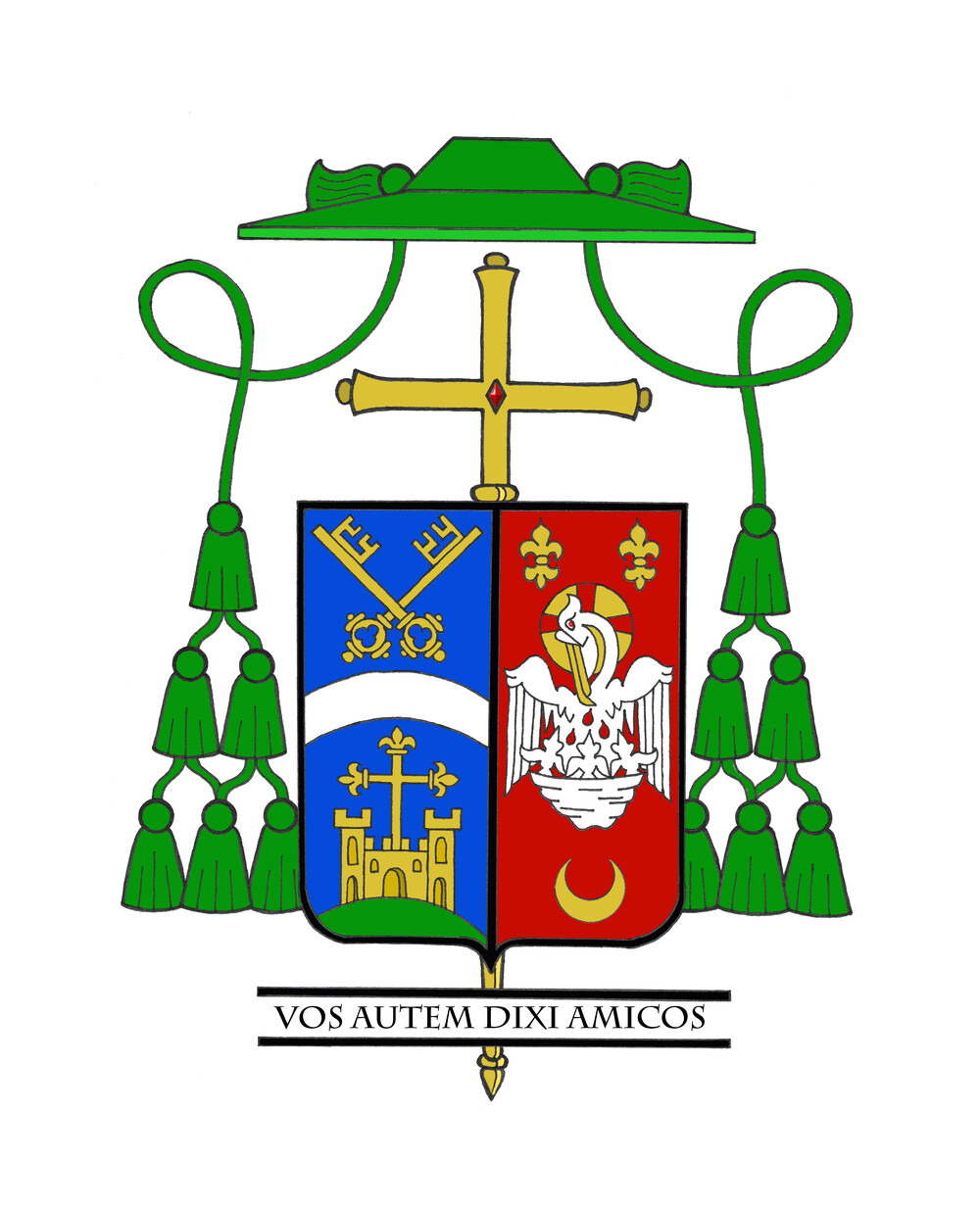
Arms impaled. In the dexter: Azure a fess enarched Argent; in base on a mound issuant in base Vert a castle with two towers and a wall embattled surmounted by a Latin cross fleuretty all Or; in chief two keys in saltire the wards upwards Or (Diocese of Belleville). In the sinister: Gules a Pelican in its Piety Argent, beaked Or and enhaloed Or with a cross Gules between in chief two fleurs-de-lis and in base a crescent all Or (Bishop McGovern). Shield ensigned with an episcopal cross Or behind the shield and a bishop’s galero Vert cords and twelve tassels disposed in three rows of one, two and three al Vert. On a scroll below the shield the motto: Vos Autem Dixi Amicos.
EXPLANATION
Belleville is symbolized by a blue field with a green mount or hill rising from the base of the design. This hill has a dual significance. It refers to Compton Hill, the name of Belleville until 1814, and to Cahokia Mounds near which Bishop Laval of Quebec established the first mission serving the Cahokia Native Americans in 1699. On the top of the hill is a castle which is the traditional symbol for a city (“ville”). It is rendered in the precious color of gold for beauty (“belle”) which identifies the See City, Belleville. Rising above the castle is a gold cross with arms that end in fleur-de-lis to honor the French missionaries who served the Native Americans of Southern Illinois. Above the castle is an arched bar which is taken from the Coat of Arms of His Holiness, Pope Leo XIII who erected Belleville as a Diocese in 1887. Just above this bar are the symbolic “keys to the Kingdom of Heaven” given by Christ to Simon Peter, the rock on which He built the Church. This is in recognition of the diocese’s Cathedral Church of Saint Peter.
The personal coat of arms assumed by Bishop McGovern combines symbols that are meaningful to him reflecting his spiritual life and priestly ministry. The field is red, a color associated with the Holy Spirit as well as with the Passion of the Lord. The life and ministry of a priest and bishop are rooted in the Paschal sacrifice of Christ and guided by the Holy Spirit. The main charge, a silver (white) pelican in its piety, symbolizes the discipleship to Christ to which all Christians are called. It depicts a pelican vulning its breast, or picking at its own flesh to feed its young with its blood. This is clearly an image of Christ and the Eucharist who calls us all together as His brothers and feeds us with His Body & Blood.
Below the pelican is a gold (yellow) crescent which is a symbol of Our Lady under her title of the Immaculate Conception, the patroness of the United States of America. Above the pelican are two gold fleurs-de-lis which, while also being a symbol associated with Our Lady, are included here because they are taken from the coat of arms of the Archdiocese of Chicago where Bishop McGovern served as a priest prior to becoming a bishop.
The motto below the shield is, Vos Autem Dixi Amicos, taken from John 15:15. Jesus says to His disciples, “I have called you friends, for everything that I learned from my Father I have made known to you.” This, too, is an allusion to the fellowship of discipleship which Jesus gives to all people.
The shield is also ensigned with those external ornaments that indicate the bearer is a bishop. The gold (yellow) cross is placed vertically behind and extending above and below the shield. This is often mistakenly thought to be a processional cross like those used in liturgical processions which is not entirely correct. In former times archbishops, and later all bishops, had a cross mounted on a staff carried immediately in front of them while in procession or on solemn occasions. This cross was a symbol of their rank as bishop. While such an episcopal cross is no longer used practically it has been retained heraldically. In fact, there are other clerics who make use of the ecclesiastical hat with its many tassels but the one true heraldic emblem of a bishop, and the only essential one, is the episcopal cross placed behind the shield.
Above the shield is the ecclesiastical hat, called a galero which, in heraldry, replaces the martial helmet, mantling and crest. “The hat with six pendant tassels (green, purple or black) on each side is universally considered in heraldry as the sign of prelacy. It, therefore, pertains to all who are actually prelates.” (Helm, Bruno B., Heraldry in the Catholic Church 1978, page 114) The galero is green with green cords pendant from it and twelve green tassels arranged in a pyramid shape on either side of the shield. At one time in history bishops and archbishops wore green before adopting the more Roman purple we see today. In heraldry the green hat and tassels was retained for prelates with the rank of bishop according to the Instruction of the Secretariat of State, Ut Sive, of March, 1969.
The armorial bearings of Bishop McGovern were designed, blazoned and rendered by the Rev. Guy Selvester a priest of the Diocese of Metuchen, New Jersey.
June, 2020