His Excellency, 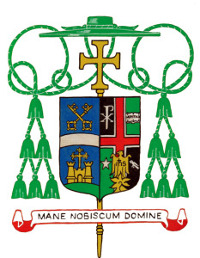
The Most Reverend Edward K. Braxton, Ph.D., S.T.D.
Diocese of Belleville
Sermon:
Thirteenth Sunday in Ordinary Time,
June 27, 2021,
St. Luke Parish, Belleville
“Lord, I Am Not Worthy: The Bishops and the Eucharist”
(This is the text as originally written. During the actual delivery, some passages were omitted and other comments were added spontaneously. Nota bene: This text has not been thoroughly proofread. Therefore, there may be errors in spelling, grammar and punctuation.)
Dear Sisters and Brothers in Christ:
“Here comes everybody!”
In Finnegans Wake, his last and most difficult novel, James Joyce, the great Irish Catholic writer, described the Catholic Church with those words, “Here comes everybody!” The Catholic Church is indeed a vast community, the people of God on every continent, with many saints and more than a few sinners, with believers who hold firmly to Catholic teachings and others who question or doubt those teachings, with members who are quick to judge the moral conduct of others and members who focus instead on living Christ’s mandate to love God with our whole being and love our neighbor, that IS every living soul, as we love ourselves.
This love that we are to have for one another clearly means that we must respect the dignity and value of every human person and every human life, even the lives of people with whom we vehemently disagree, the marginalized, the terminally ill, AND the unborn!
Today’s scripture teaches the “everybody” who constitute the Church that God is the God of Life. Our first reading from the Book of Wisdom declares paradoxically “God did not make death, nor does He rejoice in the destruction of the living. For He fashioned all things that they might live.” These words are reinforced by Mark’s gospel story: Jairus, one of the synagogue officials, pleaded with Jesus, “My daughter is at the point of death. Please, come lay your hands on her that she may live.” But, his daughter died. Later, Jesus entered the room where the child’s body was. He took her by the hand and said, “Talitha koum,” “Little girl, arise!” The girl arose immediately and walked around. All the people were utterly astounded! God is the God of Life.
The Catholic Church in the United States was in the news last week because of the ZOOM meeting of the more than 300 members of the United States Conference of Catholic Bishops. Since the media generally find it difficult to understand the teachings and structures of the Catholic Church, it was not surprising to read incorrect headlines like: “The conservative right wing of the bishops out-maneuvered the liberal left wing of the bishops and voted to approve a statement denying Holy Communion to prominent Catholics who support a mother’s right to an abortion, over the objection of Pope Francis.”
There should be no so-called conservative “left wing” of the Church. There should be no so-called liberal “right wing” of the Church. The Church, like the birds of the air, can only fly with both wings. There is only one Church. “Here comes everybody!”
I participated in all three days of the meeting and I can tell you that these and similar media statements are simply not true. The Bishops’ Conference did not issue a statement of any kind. Instead, since many Catholics seem to have lost an appreciation for the Eucharist and the mystery of the Real Presence, we discussed and debated the timeliness of drafting a pastoral statement on the Holy Eucharist.
We discussed including in this pastoral statement a reminder to all Catholics, that we should not receive the Body and Blood of Christ unworthily, no matter what positions we hold in society. If we know that we have sinned seriously, we should go to confession BEFORE receiving communion, or refrain from communion.
Once our statement is drafted and after many consultations, including consultations with Catholic politicians who do not abide by the Church’s teachings on life, the bishops will discuss and debate it during our November meeting. Before the final statement can be released to all of you, it must receive the support of at least two-thirds of the bishops.
Of course, the reason the bishops’ discussion has made it to the front pages is the fact that President Joseph R. Biden, only the second Catholic President in history, speaks openly about the importance of his Catholic faith, as a support in the face of great personal suffering; he goes to Mass and communion regularly. Some Catholics admire the President for his openness about his faith. Other Catholics do not. They consider him a hypocrite, an opportunist, and a chameleon because he consistently affirms and advances policies in favor of abortion, an action which the Catholic Church clearly teaches is gravely immoral because it ends developing, helpless, innocent human life in a mother’s womb. The Church has long taught that the Christian Gospel of life compels us to protect ALL human life from conception to natural death. Indeed, Pope Francis has declared that even those convicted of murder, should not be put to death. During the vigorous discussion, some bishops asked: is the President giving scandal when he receives communion while supporting abortion? Does giving him communion allow faithful Catholics to think the Church approves of his position on life? Other bishops said that the Eucharist should not be politicized, or used to shame individuals.
Still other bishops asked if we refuse communion to political leaders who support sinful policies, shouldn’t we do the same with regular parishioners? What about people in invalid marriages, or in same-sex relationships who approach the altar for communion? Some bishops pointed out that even the popes have given communion to pro-choice Catholic politicians. Pope Francis recently said, “Holy communion is not the reward of saints, but the bread of sinners.” While there was disagreement among the bishops about the wisest pastoral way to address these questions, you can be sure that there was complete agreement that abortion is an unspeakably immoral act.
The bishops agreed that our statement will not contain a national policy to deny Holy Communion to any individual or group of people because of their positions on issues of life. Individual bishops are already free to make that pastoral decision. Currently, a small number of bishops already do this. The pastoral statement will restate the Church’s constant teaching on the responsibility of every Catholic, including bishops and politicians to avoid scandal and receive communion worthily.
Contrary to some media reports, the Vatican did not tell the American Bishops not to draft a document addressing these difficult questions. However, Luis Cardinal Ladaria, Prefect for the Congregation for the Doctrine of the Faith, did write the bishops, urging us to preserve unity and avoid discord amid discussions on pro-life and pro-choice issues. The Cardinal wrote that it would be misleading if the bishops gave the impression that the Church’s teachings on abortion and euthanasia are the only grave moral and social issues that confront the consciences of Catholics.
A number of the Catholic faithful feel very strongly that the president should not be allowed to go to communion because the president and some policies of his administration support the right to an abortion. Other Catholics feel this should be a matter of the president’s conscience and the confessional. The Church is aware that there are Catholics who regularly receive communion even though they are not living according to the Church’s clear teachings on human sexuality, marriage, economic and racial justice, and the dignity and value of every human life. Some bishops asked should all of these Catholics be banned from communion. Others argued that these moral offenses are minor when compared to abortion. We were reminded that Holy Communion is not the reward of saints, but the bread of sinners. “Here comes everybody!”
The discussion of the bishops underscores a dilemma faced by any faithful Catholic who wishes to be elected to public office. Since neither political party supports all of the important moral teachings of the Catholic Church, how can a Catholic of either party run for a political office and at the same time remain publicly faithful to the central tenets of the Church? Must a Catholic seeking higher office either compromise or deny his or her Catholic beliefs, or are Catholics forced to accept that they cannot hope to be elected to a political office while forcefully defending Catholic moral teachings on issues of human sexuality and human life, knowing that many voters, including some Catholics, will not vote for them precisely because of their defense of Catholic teaching? Are Catholics who wish to serve in political positions forced to oppose elements of their Catholic faith or withdraw from public life and preserve their faith and their conscience? However, if Catholics do this, would they not be withdrawing from the Public Square? Unfortunately, this would mean Catholic voices would be absent from civil discourse.
It is not for me to tell you what to think about Catholic politicians whose public statements about moral issues are inconsistent with the teachings of the Catholic Church. However, I do invite each of you to pray earnestly for all elected Catholic officials, for the bishops of the United States, and for one another. May we never forget that God is the God of light when we are making life and death moral decisions.
Tomorrow, June 28 – an important day in my life – the Church honors St. Irenaeus of Leyon, a second-century bishop and martyr. In one of his sermons, he said, “Error never shows itself in its naked reality, in order not to be discovered. Instead, error dresses elegantly so that the unsuspecting may be led to believe that error is more truthful than truth itself. The glory of God is the Human Person fully alive.”
Today at Mass, when priests all over the world elevate the consecrated bread and wine that have become the Body and Blood of Christ, every Catholic: pope, bishop, president, speaker of the house, senator, priest, those who are staunchly pro-life, those who are staunchly pro-choice: all Catholics bow their heads and pray: “Lord, I am not worthy” – notice, I AM not worthy, NOT those with whom I disagree about the Church’s moral teachings are not worthy. NO, the prayer is: “Lord, I AM not worthy that you should enter under my roof. But only say the word and my soul shall be healed!”
There is some truth to Joyce’s description of the Catholic Church as “Here Comes Everybody!” However, “everybody” must never forget that God is the God of Life!
Praise be Jesus Christ. Both now and forever. Amen!